


Why in News?
Central Government has decided to constitute a High-Level Committee to resolve water sharing problems between 3 southern States- Telangana, Andhra Pradesh and Karnataka across Tungabhadra River.
About the Dispute over Tungabhadra River
- Upper Bhadra Project (Karnataka): Located on upstream of the Tungabhadra Dam, Karnataka, the project faces objections from Andhra and Telangana over water impoundment affecting supplies to downstream canals.
- Tungabhadra Board under oversees project and regulates water supplies to these States in line with order of Krishna Water Disputes Tribunal.
- Rajolibanda Diversion Scheme (RDS): Telangana expressed concern over its inability to get the share of its allocated water under the scheme due to silt accumulation, structural impediments etc.
- RDS canal is an interstate project of Karnataka and Telangana states in Raichur district, Karnataka
- Tummilla Lift Irrigation Scheme and expansion of Mallammakunta Reservoir are devised by Telangana to offset water deficits under RDS.
About Tungabhadra River (Ancient name: Pampa)
|
Inter-States River Disputes: Constitutional and legal provision
- Distribution of power as per 7th schedule of constitution: Power to legislate on water supplies, irrigation, canals, drainage, embankments, water storage, and water is under state list, but is subject to the Union's power to regulate and develop interstate rivers and river valleys, which lies under Union List
- Article 262: Empowers Parliament to adjudicate by law any dispute concerning of interstate waters and even to exclude the jurisdiction of the Supreme Court and all other courts.
- Exercising its power under the Article 262 of the Constitution Parliament has enacted two laws-
- Inter-State River Water Disputes (ISRWD) Act, 1956: For establishment of ad-hoc tribunals to resolve conflicts when they can't be resolved by negotiations or when state approaches.
- 2002 Amendment: Mandated a 1-year limit for setting up tribunal and a 3-year for delivering award.
- River Boards Act, 1956: Allows Union to make boards for the integrated development of interstate basins.
- However, no river board has ever been constituted under it.
- Inter-State River Water Disputes (ISRWD) Act, 1956: For establishment of ad-hoc tribunals to resolve conflicts when they can't be resolved by negotiations or when state approaches.
Evolving Role of Judiciary in Interstate water disputes
|
Challenges in resolution
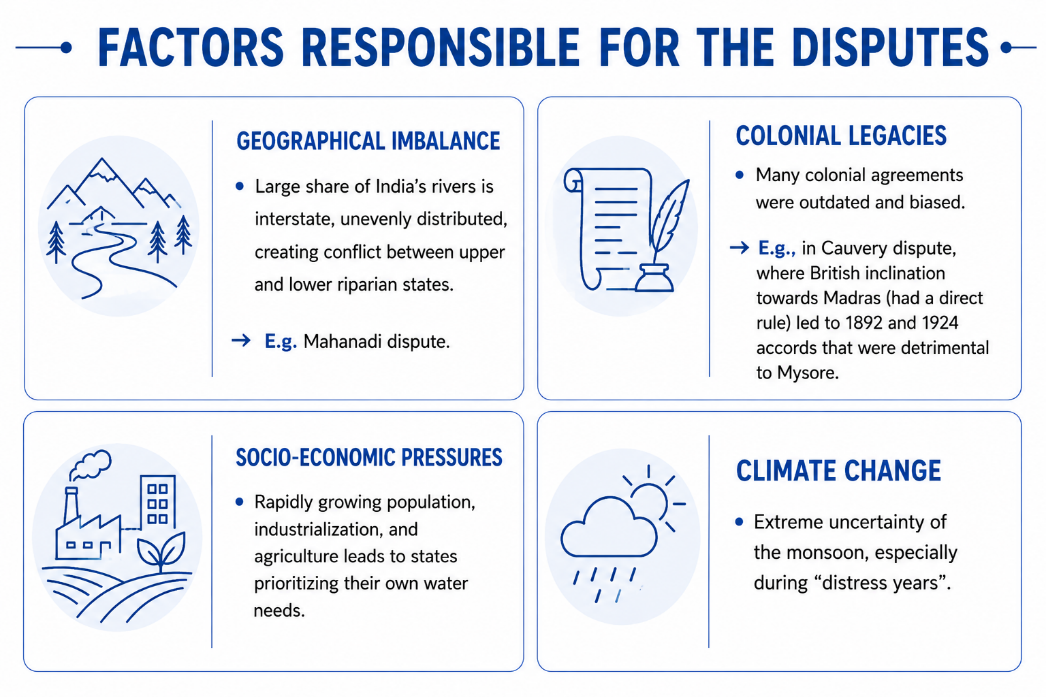
- Finite Resources: India holds ~ 18% of global population but only about 4% of the world's water resources.
- Lack of Reliable Data: Decisions are often hindered by a lack of universally agreed-upon water data, as states may be reluctant to share hydrological information for political reasons.
- Delays:
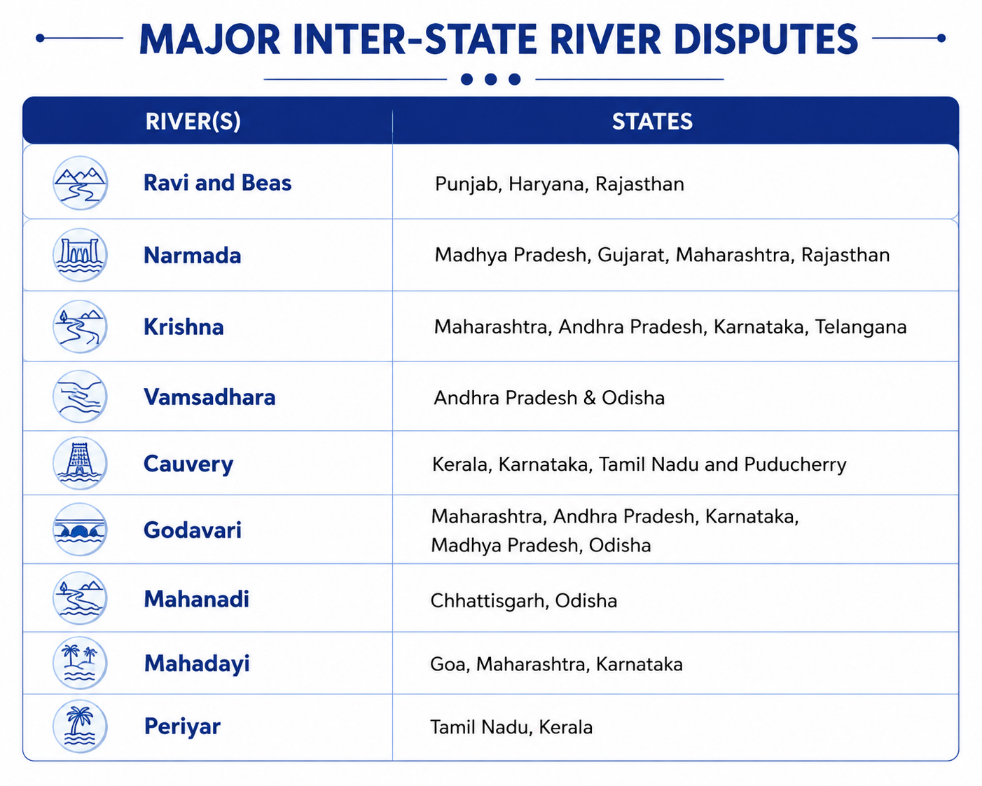
- Constitution of tribunals: E.g. Initial requests in Godavari water dispute (Maharashtra, Andhra Pradesh, Karnataka, Madhya Pradesh & Odisha) were made in 1962 and tribunal was constituted in 1969.
- Award Notifications: Delays in publishing tribunal orders in the Official Gazette (e.g., Krishna: 3 years, Godavari: 1 year) lead to uncertainty in enforcement.
- Ineffective Enforcement: Tribunal awards are final and binding but lack contempt/enforcement powers and mechanism to review the ruling, prompting judicial intervention.
- E.g. Mahadayi dispute (Goa, Maharashtra, Karnataka)where Goa challenged the tribunal's order (article 136) and then had to file contempt petition against Karnataka accusing it to continue with Kalasa and Banduri Nalas despite the case pending.
- Non-Inclusive Approach: E.g. In Narmada dispute (MP, Gujarat, Maharashtra and Rajasthan) tribunal delivered its award, allocating water while laying down the framework for Sardar Sarovar Dam without stakeholder consultation causing severe protests.
Way Forward
- Implementation of the ISRWD (Amendment) Bill, 2019: To replace individual ad-hoc tribunals with a Single Permanent Tribunal with multiple benches to expedite the process.
- It also suggests the creation of a Dispute Resolution Committee (DRC) for time-bound, mediated agreements before adjudication
- Strengthening Cooperative Federalism: Utilizing the Inter-State Council under Article 263 can provide a vital institutional space for defusing tensions and facilitating negotiation
- Establishing a National Data Repository: Creating a transparent national data bank and information system for each river basin is a key priority to ensure that decisions are based on robust scientific evidence
- Adopting an Integrated Basin-Wide Approach: It can help balance competing demands while considering ecological sustainability. For e.g. Australia's Murray-Darling Basin Authority and the Tennessee Valley Authority
- Stakeholder Participation: Future mechanisms must include civil society dialogue and stakeholder engagement to ensure that the voices of those directly dependent on the rivers are heard.
- Legal Clarity: There is a need to constitutionally validate the Supreme Court's power to hear appeals against tribunal awards to eliminate current institutional ambiguities.
Conclusion
Inter-state river water disputes test India's cooperative federalism by balancing state interests with national priorities. Timely dispute resolution, transparent data sharing, stronger institutional mechanisms, and an integrated river basin management approach are essential to ensure equitable, sustainable, and conflict-free utilization of shared water resources.



