


Union Government has extended the Digital Health Incentive Scheme (DHIS) till 2025.
About DHIS
- Launched in 2023 as part of the Ayushman Bharat Digital Mission (ABDM).
- Aims to provide right incentives to providers of digital health solutions such as Hospital/ Health Management Information System (HMIS) and Laboratory Management Information System (LMIS) to make available right software at an affordable cost.
- Eligible health facilities and digital solutions companies shall be able to earn financial incentives of up to Rs. 4 crores based on number of digital health records they create.
Article Sources
1 sourceMinistry of External Affairs (MEA) and State Bank of India signed an MoU for digital payment services on eMigrate portal.
- It will integrate SBIePay with eMigrate portal to provide digital payment services to Indian migrant workers, recruiting agents (RAs), and other users of eMigrate portal.
About eMigrate portal
- Launched in: 2014 for the online emigration process.
- Initiative by Overseas Employment Division of MEA to automate emigration processes and create a seamless ecosystem.
- It assists mainly blue-collar workers going to Emigration Check Required (ECR) countries.
- Allows ECNR (Emigration Check not Required) passport holders' voluntary registration.
India will host its first multinational air Exercise Tarang Shakti in August 2024.
- Exercise will be scheduled in two phases - first will be held in southern India and the second will be in the western sector.
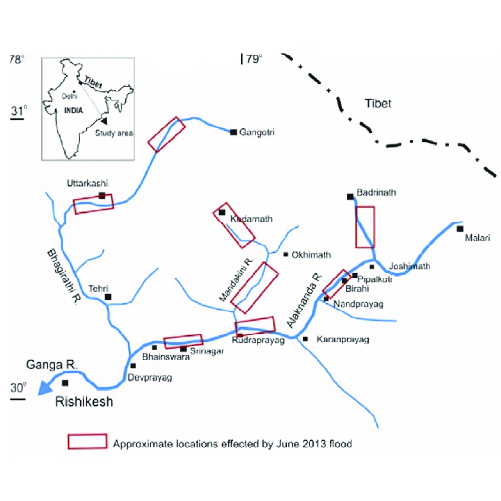
A tempo fell into a ditch in the Alaknanda river in Uttarakhand.
About Alaknanda river
- Source: It originates at an elevation of 3641m from Alkapuri Glacier.
- Alkapuri glacier is combination of snout of Bhagirath kharak glacier and Satopanth glacier
- Alaknada comprises Panchprayags:
- Alaknanda meets Dhauli Ganga at Vishnuprayag; Meets Nandakini at Nandaprayag; Meets Pindar at Karnaprayag; Meets Mandakini at Rudraprayag.
- And finally, at Devprayag, the Bhagirathi meets the Alaknanda; hereafter, it is known as the Ganga.
- ‘Badrinath’ is situated along the right bank of river Alaknanda.
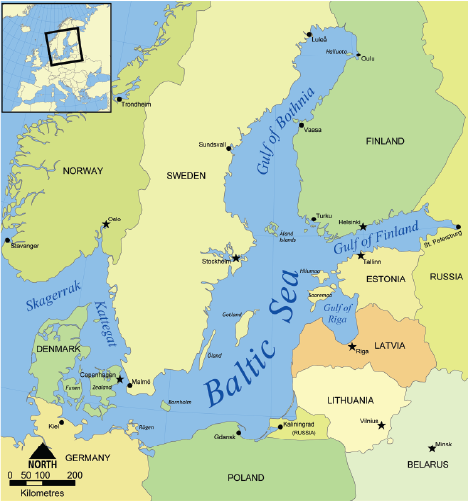
Reportedly, a Russian SU-24 bomber breached Swedish airspace near the strategically vital Baltic Sea island of Gotland.
About Baltic Sea:
- It is an arm of the North Atlantic Ocean.
- Connected to the Atlantic Ocean through the Danish Straits.
- It separates the Scandinavian Peninsula from the rest of continental Europe.
- It is the world’s largest inland brackish sea. It records low salinity due to the influx of river waters in large quantities.
- Surrounding Countries: Denmark, Germany, Poland, Lithuania, Latvia, Estonia, Russia, Finland and Sweden.
- Rivers Draining: Vistula and Oder
- Kiel Canal connects the North sea to Baltic sea
- Major Gulfs: Gulf of Bothnia, Gulf of Finland, Gulf of Riga, Gulf of Gdansk
A study has found that Asiatic lions & Bengal tigers co-existed for so long in the Subcontinent due to Sympatric Speciation.
About Speciation
- A speciation is a lineage-splitting event that produces two or more separate species. This process generates biodiversity.
Modes of Speciation
- Allopatric: New species formed from geographically isolated populations.
- Peripatric: New species formed from a small population isolated at the edge of a larger population.
- Parapatric: New species formed from a continuously distributed population.
- Sympatric: New species formed from within the range of the ancestral population.
Recently, Scientists have discovered that bioluminescence is pretty common among deep-sea shrimp.
About Bioluminescence
- It is the property of a living organism to emit light.
- Light emitted is produced by energy released from enzyme-catalyzed oxidation reactions in organisms.
- It requires two unique chemicals: Luciferin and either Luciferase or Photoprotein.
- Spectral range of light emission of bioluminescent organisms spans from blue to red light.
- Species exhibiting Bioluminescence: Sponges, jellyfish, hatchet fish, worms, Sea Walnuts, fireflies, fungi, bacteria, etc.
- Functions of Bioluminescence: Counter-illumination (Camouflage against predatory animals), prey attraction, intra-species communication, etc.
Union Jal Shakti Ministry launched an e-flow ecological monitoring system.
- E-flow refers to the flow that is required to meet the ecological functions of the flora and fauna present in the water body.
About E-flow Monitoring System
- It is developed by National Mission for Clean Ganga (Namani Gange).
- The Namami Gange program involves cleaning the Ganga and now includes its tributaries.
- It will allow real-time analysis of the water quality of the Ganga, Yamuna, and their tributaries.
- It will also allow monitoring of the Namami Gange program activities at the central level.
