
CITES launched “CITES Rosewoods: The Global Picture" Report | Current Affairs | Vision IAS
MENU
Home

Periodically curated articles and updates on national and international developments relevant for UPSC Civil Services Examination.

Quick Links

High-quality MCQs and Mains Answer Writing to sharpen skills and reinforce learning every day.

Watch explainer and thematic concept-building videos under initiatives like Deep Dive, Master Classes, etc., on important UPSC topics.

ESC

The report details CITES-listed rosewood species’ characteristics, ecosystem roles, regeneration rates, and threats. 

  • Such information will help CITES parties make informed Non-Detriment Findings (NDFs). 
    • NDF is a mandatory scientific analysis under CITES to ensure that exporting a specified quantity of specimens of Appendix I and II -listed species will not affect their long-term survival in the wild. 

Rosewood

  • About: ‘Rosewood’ also called as “palisander” encompasses a wide range of tropical hardwoods in the Fabaceae (Leguminosae) family. Rosewood in Appendix II of CITES include:
    •  Dalbergia latifolia (Malabar rosewood) and Dalbergia Sissoo (Shisham) are found in India and are listed as Vulnerable and Least Concern on IUCN red list. 
    • African rosewood, native to West African countries, is listed as endangered on IUCN red list.
  • Utility: Crafting furniture and musical instruments.
  • Role in Ecosystem: 
    • Soil Improvement: Dalbergia species can improve degraded soil through fast decomposing leaf litter, rich in nitrogen, phosphorus, and carbon.
    • Nitrogen Fixation: Some species form symbiotic associations with soil bacteria to fix atmospheric nitrogen.


CITES (Convention on International Trade in Endangered Species of Wild Fauna and Flora)
  • About:  An international legally binding agreement between governments to ensure that international trade in specimens of wild animals and plants does not threaten the survival of the species.
  • Genesis: Drafted in 1963 following an IUCN resolution, it came into force in 1975.
  • Parties: 184 (including India)
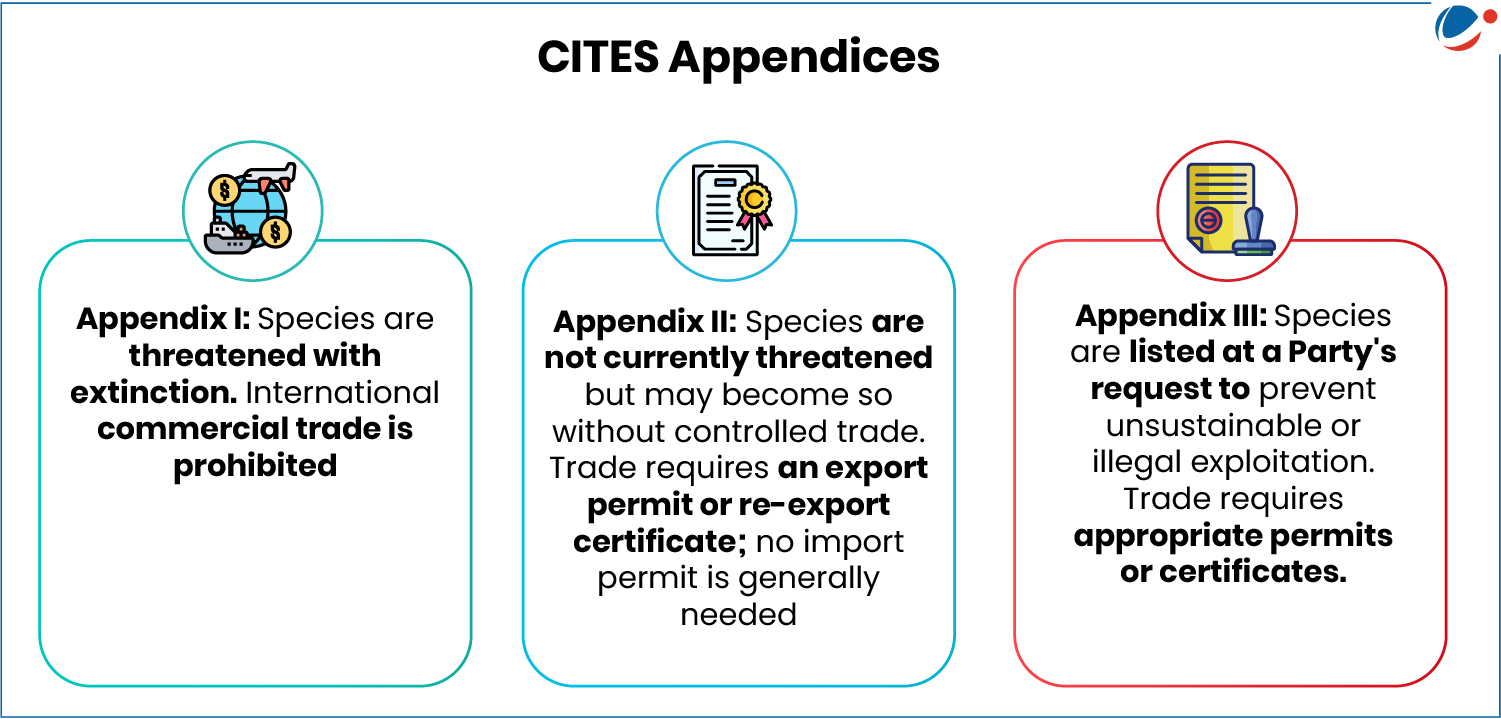
  • CITES Appendices: Contains lists of species afforded different levels or types of protection from over-exploitation. 
A graphic titled "CITES Appendices" with three sections. Appendix I: Species are threatened with extinction. Trade is prohibited. Appendix II: Species are not threatened but trade requires permits. Appendix III: Species trade requires permits by request of a country.


Watch Video News Today

Explore Related Content

Discover more articles, videos, and terms related to this topic

RELATED VIDEOS

3
News Today (Jul 14-15, 2024)

News Today (Jul 14-15, 2024)

YouTube HD
Carbon Markets

Carbon Markets

YouTube HD
What is Artificial Rain? | Deep Dive With VisionIAS

What is Artificial Rain? | Deep Dive With VisionIAS

YouTube HD
Title is required. Maximum 500 characters.

Search Notes

Filter Notes

Loading your notes...
Searching your notes...
Loading more notes...
You've reached the end of your notes

No notes yet

Create your first note to get started.

No notes found

Try adjusting your search criteria or clear the search.

Saving...
Saved

Please select a subject.

Referenced Articles

linked

No references added yet

Subscribe for Premium Features