
“Agritech for Women Farmers: A Business Case for Inclusive Growth” Report released by WEF | Current Affairs | Vision IAS
MENU
Home

Periodically curated articles and updates on national and international developments relevant for UPSC Civil Services Examination.

Quick Links

High-quality MCQs and Mains Answer Writing to sharpen skills and reinforce learning every day.

Watch explainer and thematic concept-building videos under initiatives like Deep Dive, Master Classes, etc., on important UPSC topics.

ESC

Report by World Economic Forum (WEF) presents a global overview of gender-inclusive AgriTech and highlights how gender inclusive AgriTech can help women farmers achieve their full potential. 

Need of Gender inclusive AgriTech for Women Farmers (as highlighted in the Report)

  • Feminization of agriculture: In India, women’s participation is notably higher, nearly 50% across commercial value chains such as cotton, sugarcane, tea, coffee and cashews.
    • Despite their substantial participation, women earn up to 60% less than men and face limited access to finance, training and technology.
  • Efficiency: By transitioning to data driven planning of production, AgriTech can reduce both food loss and food waste and enable businesses to make their supply chains more efficient and resilient.
  • Business imperative: Position gender-inclusive AgriTech as a strategic business imperative for the private sector.

Challenges for Women Farmers in adapting AgriTech
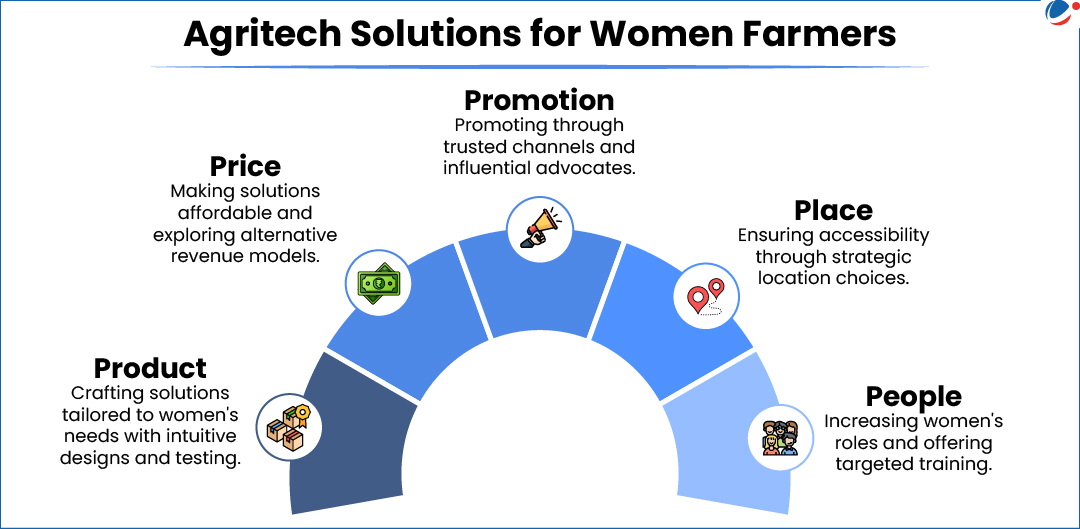
An infographic image showcasing a framework for "Agritech Solutions for Women Farmers," built around the 4Ps of marketing: Product, Price, Promotion, Place, and an added "People." Each element emphasizes tailored solutions such as affordability, strategic promotion, accessibility, intuitive designs, and enhancing women's roles through targeted training.

Demand side

  • Sociocultural barriers:  Perceptions about gender roles and biases, restrictions on mobility, and safety and security concerns.
  • Limited access to resources: Limited land ownership hinders access to formal credit and other farm extension services.
  • Literacy barriers:  low education and digital literacy restricts awareness.

Supply-side

  • Access to gender-disaggregated data: Lack of comprehensive data to differentiate between experiences of male and female farmers in accessing and using AgriTech services.
  • Support system gaps: Limited mentorship and peer learning, weak coordination between agricultural research and extension services, etc.
Watch Video News Today

Explore Related Content

Discover more articles, videos, and terms related to this topic

RELATED VIDEOS

3
Future of Jobs Report 2025 by World Economic Forum

Future of Jobs Report 2025 by World Economic Forum

YouTube HD
News Today (Dec 21, 2024)

News Today (Dec 21, 2024)

YouTube HD
News Today (Jun 13, 2025)

News Today (Jun 13, 2025)

YouTube HD
Title is required. Maximum 500 characters.

Search Notes

Filter Notes

Loading your notes...
Searching your notes...
Loading more notes...
You've reached the end of your notes

No notes yet

Create your first note to get started.

No notes found

Try adjusting your search criteria or clear the search.

Saving...
Saved

Please select a subject.

Referenced Articles

linked

No references added yet

Subscribe for Premium Features