
Tamil Nadu opposes three-language policy in schools under the NEP 2020 | Current Affairs | Vision IAS
MENU
Home

Periodically curated articles and updates on national and international developments relevant for UPSC Civil Services Examination.

Quick Links

High-quality MCQs and Mains Answer Writing to sharpen skills and reinforce learning every day.

Watch explainer and thematic concept-building videos under initiatives like Deep Dive, Master Classes, etc., on important UPSC topics.

ESC

The Centre has withheld funds for the Samagra Shiksha scheme in Tamil Nadu due to the state’s refusal to implement the three-language policy in accordance with the New Education Policy (NEP) of 2020.

  • Tamil Nadu currently follows 2 language policy (Tamil and English). 

About Three-language Policy

  • Objective: To promote multilingualism and strengthen national unity.
  • It mandates that students shall learn three languages:
    • Two must be native to India.
    • The choice of languages is left to states and students.
  • Evolution of Policy 
    • University Education Commission of 1948-49, chaired by Dr Sarvepalli Radhakrishnan: Recommendations of commission led to evolution of three-language formula for school education.
    • Kothari Commission (1964-66):  Formally proposed the three-language formula.
    • Inclusion in Education Policies 
      • It was incorporated in NEP 1968.
      • NEP 1986 & 1992 retained the three-language formula.
      • NEP 2020 also retained the three-language formula with more flexibility.
        • No explicit mention of Hindi instead two regional languages.
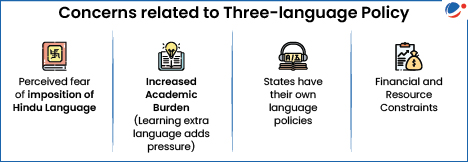
Image showing concern related with the Three language policy
Watch Video News Today

Explore Related Content

Discover more articles, videos, and terms related to this topic

RELATED VIDEOS

2
News Today (Feb 28, 2025)

News Today (Feb 28, 2025)

YouTube HD
Lateral Entry

Lateral Entry

YouTube HD
Title is required. Maximum 500 characters.

Search Notes

Filter Notes

Loading your notes...
Searching your notes...
Loading more notes...
You've reached the end of your notes

No notes yet

Create your first note to get started.

No notes found

Try adjusting your search criteria or clear the search.

Saving...
Saved

Please select a subject.

Referenced Articles

linked

No references added yet