
Ocean acidification breaches planetary boundary, putting marine ecosystems at severe risk: Study | Current Affairs | Vision IAS
MENU
Home

Periodically curated articles and updates on national and international developments relevant for UPSC Civil Services Examination.

Quick Links

High-quality MCQs and Mains Answer Writing to sharpen skills and reinforce learning every day.

Watch explainer and thematic concept-building videos under initiatives like Deep Dive, Master Classes, etc., on important UPSC topics.

ESC

Ocean acidification refers to a reduction in the pH of the ocean over an extended period of time, caused primarily by uptake of carbon dioxide (CO2) from the atmosphere.

  • Ocean acidification has been called the "evil twin of global warming" and "the other CO2 problem".
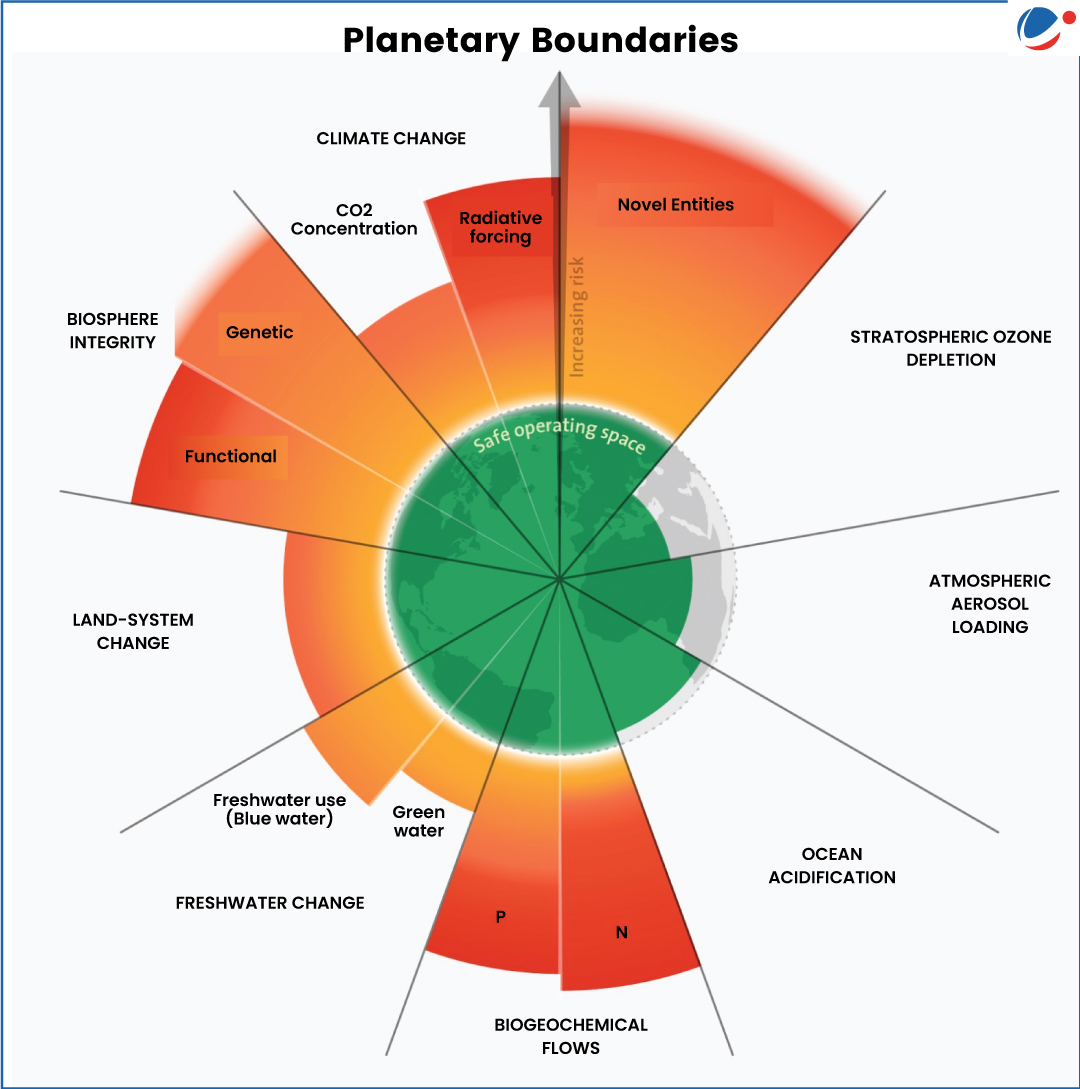
A circular diagram titled "Planetary Boundaries" depicting nine critical Earth system processes. The central green area represents the "Safe Operating Space" for humanity. Surrounding this are colored wedges indicating increasing risk (yellow to red) for each boundary. The categories shown are:  Climate Change (subdivided into CO₂ concentration and radiative forcing),  Novel Entities,  Stratospheric Ozone Depletion,  Atmospheric Aerosol Loading,  Ocean Acidification,  Biogeochemical Flows (phosphorus - P, and nitrogen - N),  Freshwater Change (blue water and green water),  Land-System Change,  Biosphere Integrity (genetic and functional diversity)

Ocean Acidification Process

  • Carbon dioxide (CO2) from the atmosphere dissolves in the ocean, creating aqueous carbon dioxide (CO2 (aq)).
    • This dissolved CO2 reacts with water (H2O) to form carbonic acid (H2CO3).
  • Carbonic acid then breaks down into bicarbonate (HCO3-) and hydrogen ions (H+). 
    • The increase in hydrogen ions makes the ocean more acidic.

Causes of ocean acidification

  • Ocean absorbs around 25% of annual anthropogenic CO2 Emission. 
  • Natural CO2 emission like Submarine Volcanic Activity, Ocean Circulation, Ocean Sediment Breakdown etc.

Impact of Ocean Acidification

  • Acidic waters lead to dissolution of calcium carbonate structures (Affecting organisms like corals, shellfish, and plankton) and Ecosystem alterations affecting fisheries and coastal protection.
  • Ocean acidification harms phytoplankton, thus reducing ocean’s productivity.
  • Ocean acidification can indirectly affect cloud formation by impacting the production of dimethyl sulfide (DMS) by phytoplankton.
    • DMS is a sulfur compound that acts as a cloud condensation nucleus, meaning it helps form cloud droplets.

Planetary Boundaries

  • Planetary boundaries are natural limits for key global systems like climate, water, and wildlife. 
    • When crossed, these systems can no longer maintain a healthy planet. 
Watch Video News Today

Explore Related Content

Discover more articles, videos, and terms related to this topic

RELATED VIDEOS

3
News Today (Jun 10, 2025)

News Today (Jun 10, 2025)

YouTube HD
Carbon Markets

Carbon Markets

YouTube HD
What is Artificial Rain? | Deep Dive With VisionIAS

What is Artificial Rain? | Deep Dive With VisionIAS

YouTube HD
Title is required. Maximum 500 characters.

Search Notes

Filter Notes

Loading your notes...
Searching your notes...
Loading more notes...
You've reached the end of your notes

No notes yet

Create your first note to get started.

No notes found

Try adjusting your search criteria or clear the search.

Saving...
Saved

Please select a subject.

Referenced Articles

linked

No references added yet

Subscribe for Premium Features