
The Environment Ministry Eases Flue Gas Desulphurisation (FGD) Systems Norms for Thermal Power Plants | Current Affairs | Vision IAS
MENU
Home

Periodically curated articles and updates on national and international developments relevant for UPSC Civil Services Examination.

Quick Links

High-quality MCQs and Mains Answer Writing to sharpen skills and reinforce learning every day.

Watch explainer and thematic concept-building videos under initiatives like Deep Dive, Master Classes, etc., on important UPSC topics.

ESC

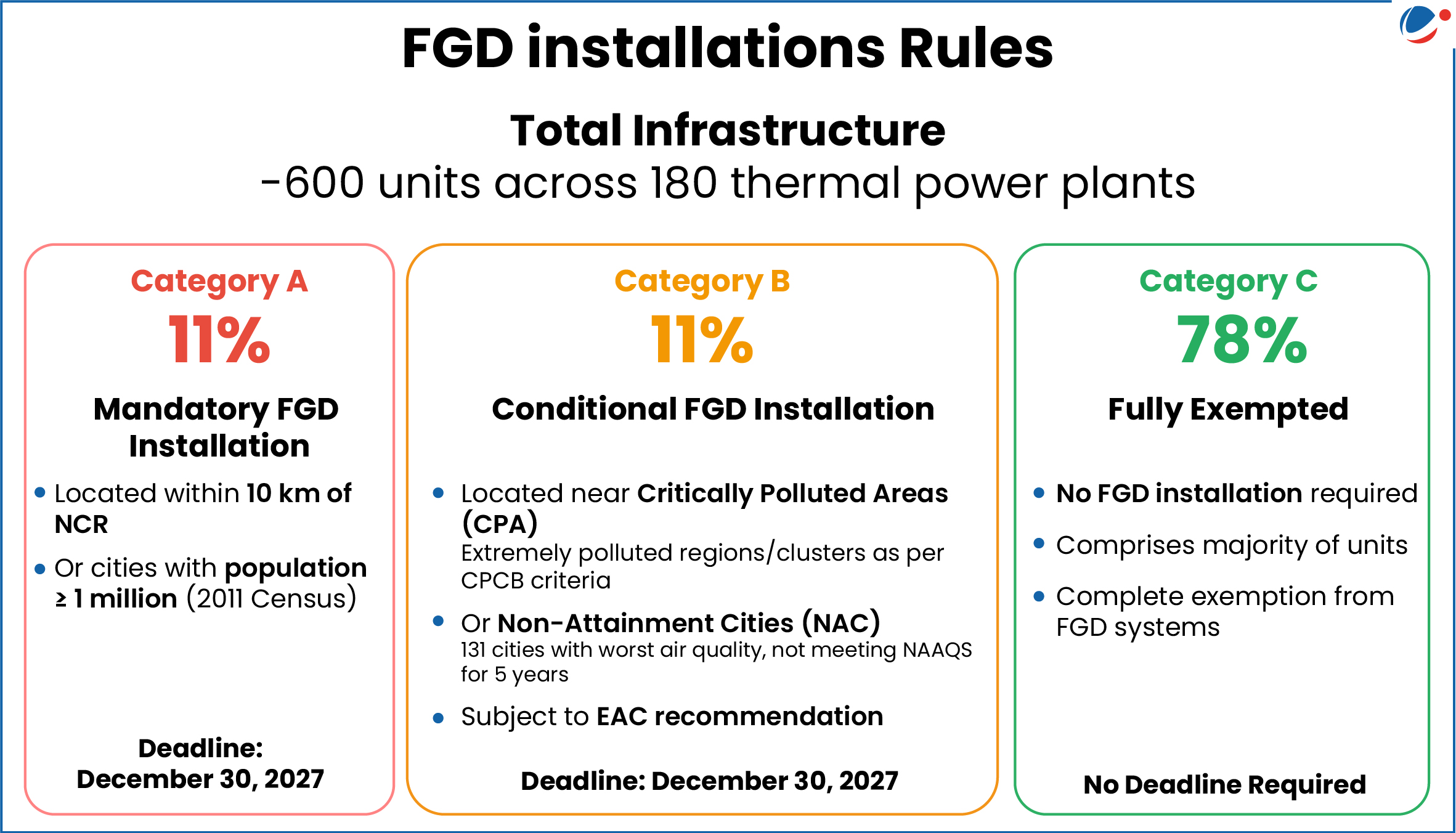
The updated rules (see image) regarding the installation of FGD are in line with the recommendations of an expert committee constituted by Principal Scientific Adviser to the Government.

Rationale for the Ease of FGD Systems Norms
  • Ambient SO₂ levels in India range between 10–20 µg/m³, well below the national standard of 80 µg/m³.
  • Indian coal is naturally low in sulphur.
  • Sulphates have a “beneficial side-effect”: They may suppress global warming by reflecting solar radiation and offsetting the warming effect of greenhouse gas emissions.
    • While the IPCC notes that sulphates reduce warming, it never presents this as entirely positive or without downsides.
  • Other Reasons: High installation costs, Limited number of qualified vendors; Potential electricity tariff hike.

About Flue Gas Desulphurisation (FGD) Systems

  • Definition: FGD is a scrubbing technique that uses an alkaline reagent (typically a sodium- or calcium-based alkaline regent) to remove SO2 from flue gas.
  • Flue gas: It is emitted as a byproduct of combustion of fossil fuels. It mainly contains pollutants such as carbon dioxide (CO2), sulphur dioxide (SO2), nitrogen oxides, particulate matter, etc. 
    • FGD units specifically target the SO2 emissions in flue gas. 
    • SO2 is an acidic gas, and is treated with a basic compound in the FGD unit to neutralise the pollutant.
  • There are three types of FGD systems: Dry Sorbent Injection, Wet Limestone Treatment & Seawater Treatment.

About Sulphur Dioxide as a Pollutant

  • Effects of SO2
  • Health: Respiratory problems. E.g., Bronchitis.
  • Environmental: Cause Acid rain.
  • Largest Source of SO2: Burning of fossil fuel by power plants and other industrial facilities.
  • Smaller Sources: Industrial processes such as extracting metal from ore; natural sources such as volcanioes, etc.
Watch Video News Today

Explore Related Content

Discover more articles, videos, and terms related to this topic

RELATED VIDEOS

2
What is Artificial Rain? | Deep Dive With VisionIAS

What is Artificial Rain? | Deep Dive With VisionIAS

YouTube HD
Carbon Markets

Carbon Markets

YouTube HD
Title is required. Maximum 500 characters.

Search Notes

Filter Notes

Loading your notes...
Searching your notes...
Loading more notes...
You've reached the end of your notes

No notes yet

Create your first note to get started.

No notes found

Try adjusting your search criteria or clear the search.

Saving...
Saved

Please select a subject.

Referenced Articles

linked

No references added yet

Subscribe for Premium Features
