‘Solar PV Potential Assessment of India (Ground-Mounted)’ Report Launched | Current Affairs | Vision IAS
MENU
Home

Periodically curated articles and updates on national and international developments relevant for UPSC Civil Services Examination.

Quick Links

High-quality MCQs and Mains Answer Writing to sharpen skills and reinforce learning every day.

Watch explainer and thematic concept-building videos under initiatives like Deep Dive, Master Classes, etc., on important UPSC topics.

ESC

In Summary

The report by NISE outlines a policy-driven framework highlighting India's solar potential of 3,343 GWp, addressing challenges like land, grid, costs, and promoting initiatives for sustainable, large-scale solar development. 

In Summary

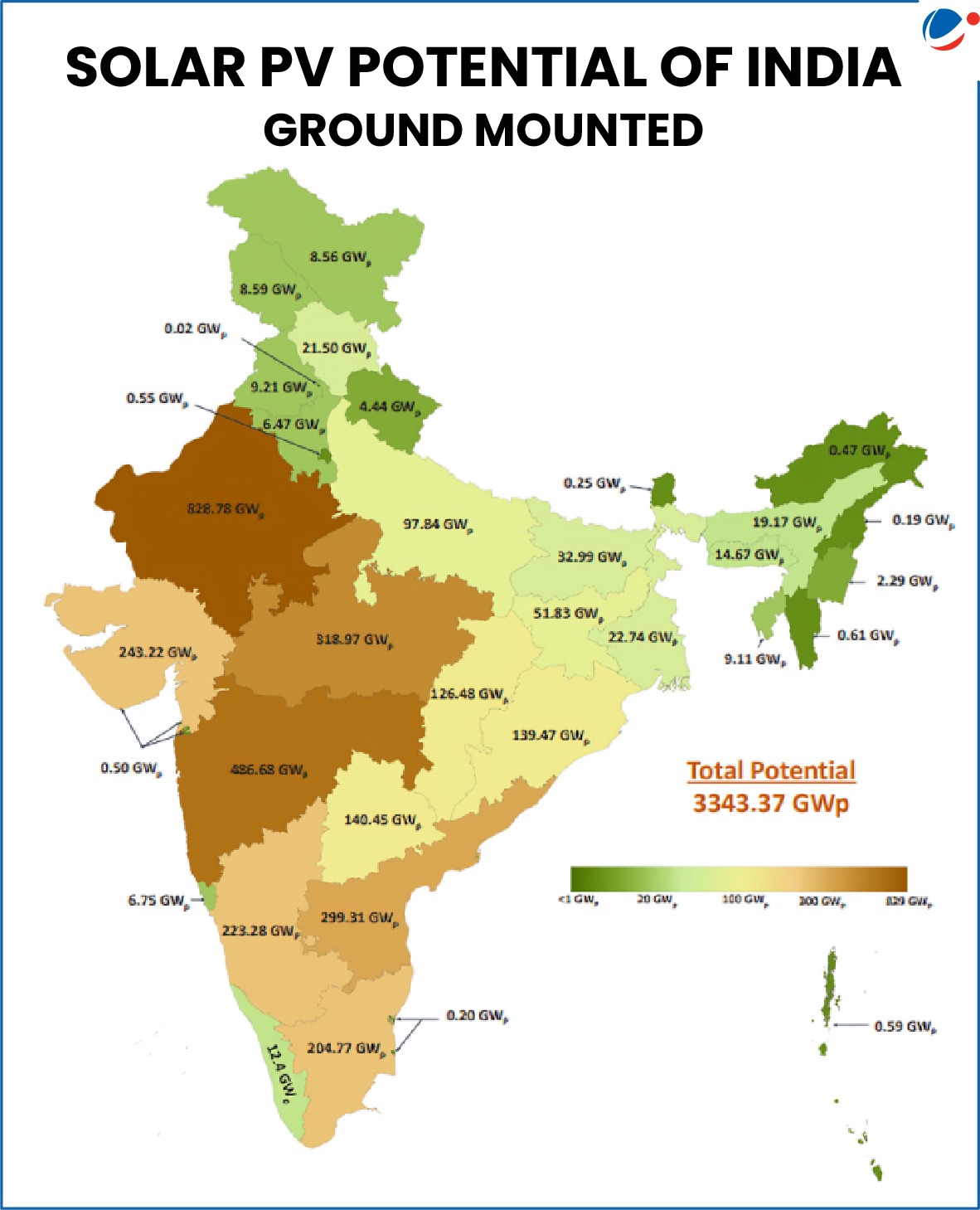
Map showing the ground-mounted solar PV potential of Indian states in gigawatts (GWₚ).

The report released by the National Institute of Solar Energy (NISE) under the Ministry of New & Renewable Energy provides a policy-linked, investment-ready framework to guide project siting, infrastructure development, and private sector participation. 

  • The report aims at realizing India’s Panchamrit commitments, support goals of energy independence by 2047 and net-zero emissions by 2070.

Key Highlights of the Report

  • Updated National Solar Potential Assessment: To approximately 3,343 GWp from 749 GWp in 2014.
  • Geographic Distribution: Other than Rajasthan and Maharashtra, many other states too have very high potential. (Refer image)
    • Approximately 6.69% of the total identified feasible wasteland in the country can be utilized.

Challenges to full realization of solar energy in India

  • Land Acquisition: Large-scale solar parks require significant land, often in ecologically sensitive or agriculturally important areas
    • E.g. Rajasthan and Gujarat face conflicts over grazing land and biodiversity-rich desert ecosystems.
  • Grid Integration: Lack of affordable large-scale energy storage technologies limits the integration of weather- dependent solar power.
  • High Initial Capital Cost: Despite declining module prices, upfront project costs remain high.
  • Other: Financial stress in DISCOMs; Import dependency for solar modules (~80% from China); policy and regulatory uncertainty, shortage of skilled workforce, etc.

Initiatives Launched

  • Training Program on Solar Cell and Module Manufacturing at NISE, Gurugram to build technical capacity and develop a skilled workforce.
  • Solar Didi Vision: Training women as leaders and ambassadors of a sustainable future.
  • PM Surya Ghar (Muft Bijli Yojana): Aims to promote rooftop solar adoption across the country by providing up to 300 units of free electricity per month to 1 crore households.
Watch Video News Today

Explore Related Content

Discover more articles, videos, and terms related to this topic

RELATED VIDEOS

3
News Today (Nov 06, 2024)

News Today (Nov 06, 2024)

YouTube HD
Deep Dive with VisionIAS | How India Achieved 50% Clean Energy 5 Years Ahead of Global

Deep Dive with VisionIAS | How India Achieved 50% Clean Energy 5 Years Ahead of Global

YouTube HD
Deep Dive with VisionIAS | How India Achieved 50% Clean Energy 5 Years Ahead of Global

Deep Dive with VisionIAS | How India Achieved 50% Clean Energy 5 Years Ahead of Global

YouTube HD
Title is required. Maximum 500 characters.

Search Notes

Filter Notes

Loading your notes...
Searching your notes...
Loading more notes...
You've reached the end of your notes

No notes yet

Create your first note to get started.

No notes found

Try adjusting your search criteria or clear the search.

Saving...
Saved

Please select a subject.

Referenced Articles

linked

No references added yet

Subscribe for Premium Features