World Meteorological Organization (WMO) Congress calls for accelerated implementation of Early Warnings for All (EW4All) | Current Affairs | Vision IAS
MENU
Home

Periodically curated articles and updates on national and international developments relevant for UPSC Civil Services Examination.

Quick Links

High-quality MCQs and Mains Answer Writing to sharpen skills and reinforce learning every day.

Watch explainer and thematic concept-building videos under initiatives like Deep Dive, Master Classes, etc., on important UPSC topics.

ESC

In Summary

The WMO Congress urges rapid action on Early Warnings for All by 2027, aiming for universal multi-hazard alerts to reduce disaster impacts, gaps in forecasting, and improve global resilience.

In Summary

At the Congress, WMO alsoreleased “Early Warnings for All in Focus: Hazard Monitoring and Forecasting” report, tracking progress in detection, monitoring, and forecasting capabilities.

  • Report highlights gaps in basic forecasting capacity, low compliance with Global Basic Observation Network (GBON), and limited satellite data usage. 
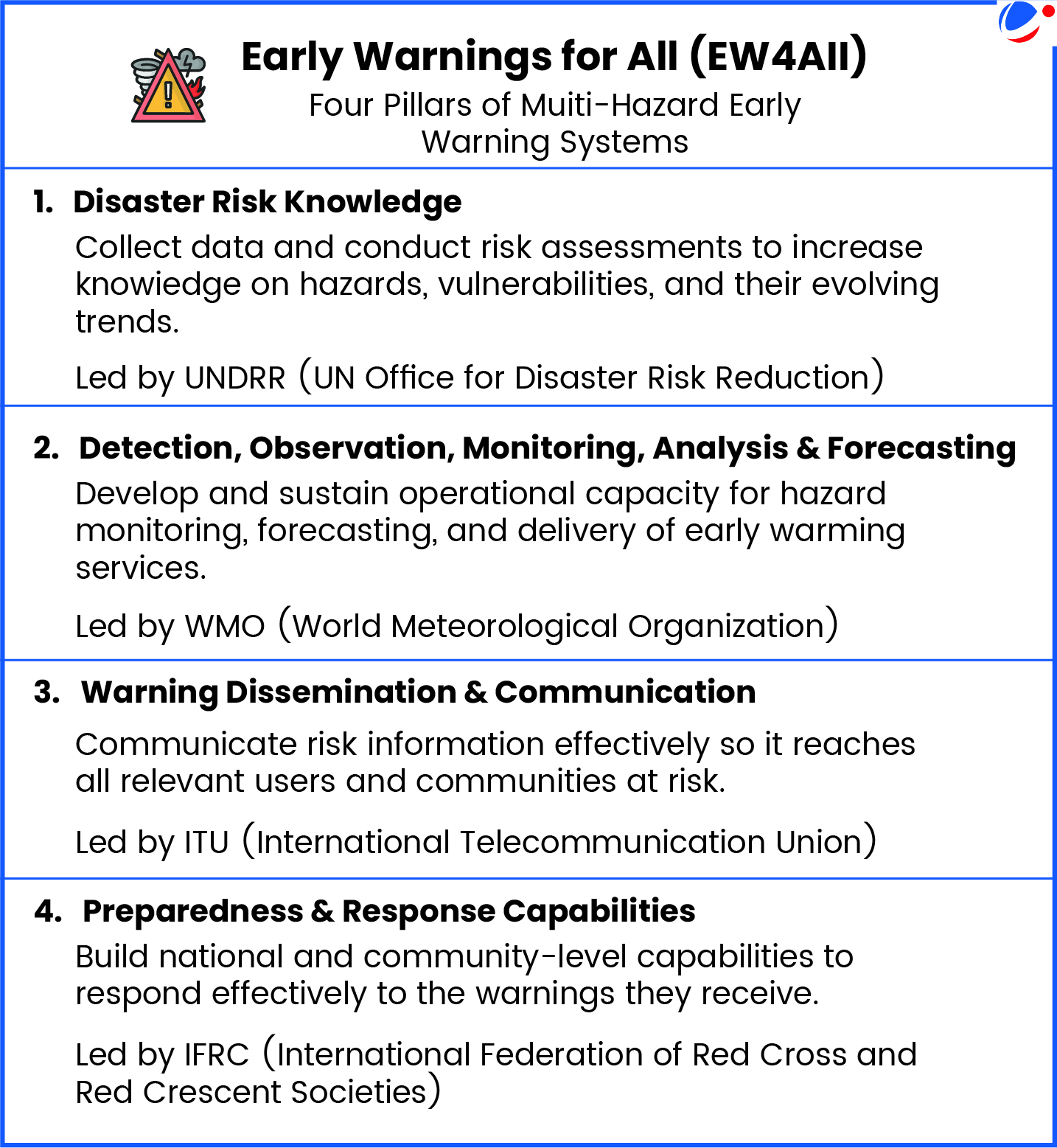
Early Warnings for All (EW4All) initiative

  • Aim: Ensure universal protection from hazardous hydrometeorological, climatological and related environmental events through life-saving multi-hazard early warning systems by 2027.
  • Launched: At COP27 of UNFCCC in 2022 by the UN Secretary-General.
  • Organizations: It is jointly led by WMO, UNDRR, ITU and IFRC.
  • Coverage: Initially focused on 30 high-risk countries, EW4All has since expanded to more than 100 participating nations.

About Early Warning System (EWS)

  • EWS is an integrated system of hazard monitoring, forecasting, disaster risk assessment, communication and preparedness which aims at enabling early action to save and protect lives, livelihoods and assets of people at risk.
  • Need for Early Warning
    • The damage caused by a disaster can be reduced by 30% if an early warning is issued within 24 hours. 
    • Disaster mortality is six times higher and the number of people affected is four times higher in countries with limited multi-hazard early warning systems.  
    • Economic damages from extreme weather events continue to surge, with over US$4 trillion in losses globally since 1970.
Watch Video News Today

Explore Related Content

Discover more articles, videos, and terms related to this topic

RELATED VIDEOS

3
News Today (Sep 06, 2025)

News Today (Sep 06, 2025)

YouTube HD
Carbon Markets

Carbon Markets

YouTube HD
What is Artificial Rain? | Deep Dive With VisionIAS

What is Artificial Rain? | Deep Dive With VisionIAS

YouTube HD
Title is required. Maximum 500 characters.

Search Notes

Filter Notes

Loading your notes...
Searching your notes...
Loading more notes...
You've reached the end of your notes

No notes yet

Create your first note to get started.

No notes found

Try adjusting your search criteria or clear the search.

Saving...
Saved

Please select a subject.

Referenced Articles

linked

No references added yet

Subscribe for Premium Features