
Inadequate Laws to Protect Domestic Workers in India | Current Affairs | Vision IAS
MENU
Home

Periodically curated articles and updates on national and international developments relevant for UPSC Civil Services Examination.

Quick Links

High-quality MCQs and Mains Answer Writing to sharpen skills and reinforce learning every day.

Watch explainer and thematic concept-building videos under initiatives like Deep Dive, Master Classes, etc., on important UPSC topics.

ESC

In Summary

The Indian government lacks comprehensive laws for domestic workers' rights, with existing frameworks fragmented. Uniform enforcement and a central legislation are urgently needed for better protection.

In Summary

As highlighted in the news recently, Union Government is yet to frame a comprehensive domestic workers’ rights law as directed by the Supreme Court in January, 2025. 
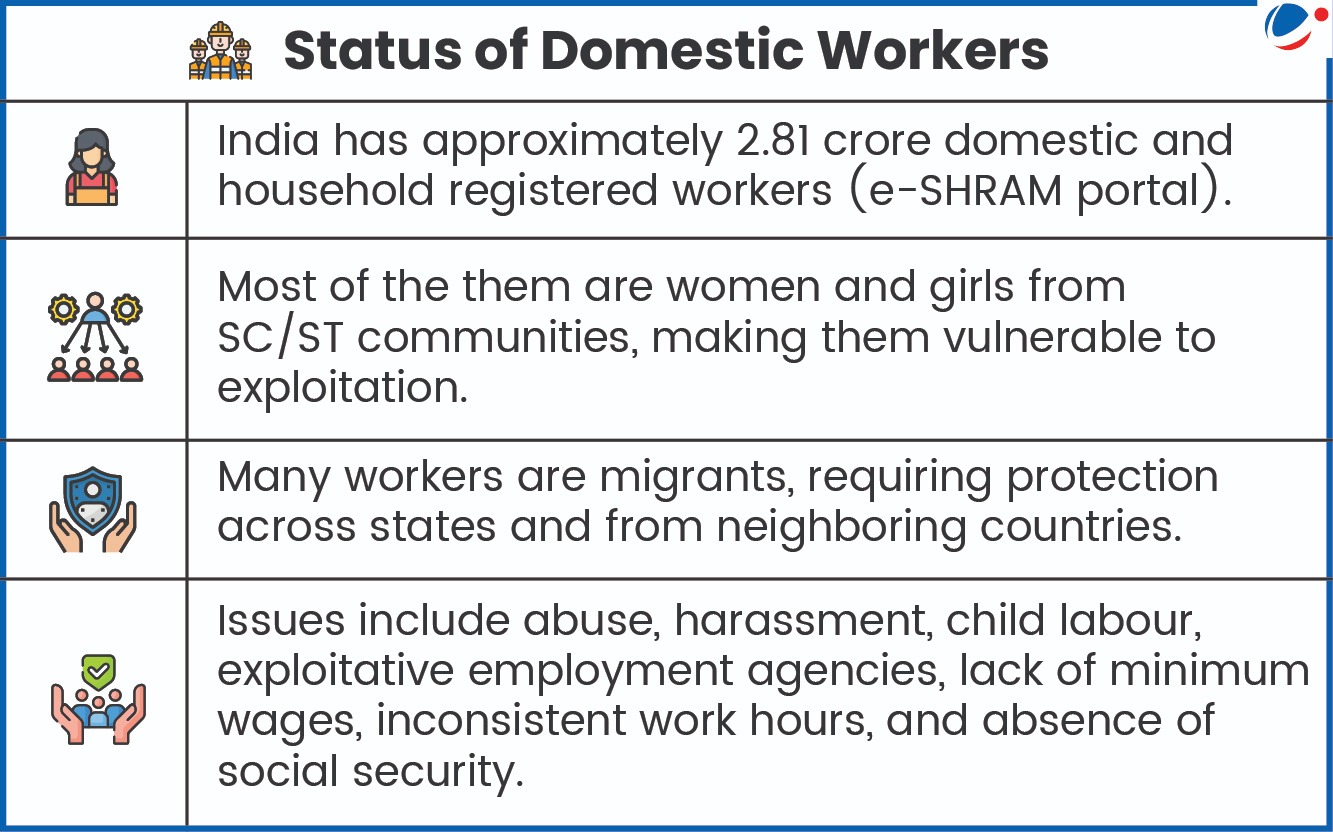
Other Legal Frameworks Available

  • Right to Fair Wages: Workers must receive at least the state-prescribed minimum wage under the Minimum Wages Act, 1948.
  • Right to Safe Working Conditions: Employers must provide an abuse-free environment (POSH Act, 2013).
  • Protection from abuse/exploitation: Bharatiya Nari Suraksha (BNS) Act, 2023 provides protection against all forms of abuse; enables legal remedies and complaint mechanisms.
  • State-Level Initiatives: Tamil Nadu provides welfare benefits and minimum wages under the Manual Worker Act, 1982, while Karnataka’s 2025 Bill mandates worker registration, contracts, minimum wages etc. to a welfare fund.

Issues in Implementation of Legal Protection

  • Patchy State Regulation: Minimum wages and labour protections vary across states; enforcement is weak.
  • Exclusion under Labour Codes: Defines a “worker” in relation to establishments or industries, excluding workers employed in private households, such as domestic workers.
  • Limited Organising: Dispersed workplaces, migratory status, poor socio-economicconditions, etc. make unionisation difficult.
  • Data and Definition Issues: Lack of credible data and contested definitions of domestic work complicate policy-making.

Way Forward

  • Minimum wages: All states must stipulate and update wages.
  • Compulsory Registration: Employers, agencies, and workers should be compulsorily registered at the state level.
  • Legislative action: Comprehensive Central legislation to enforce rights, wages, social security, and welfare for domestic workers.
Watch Video News Today

Explore Related Content

Discover more articles, videos, and terms related to this topic

RELATED VIDEOS

1
Lateral Entry

Lateral Entry

YouTube HD
Title is required. Maximum 500 characters.

Search Notes

Filter Notes

Loading your notes...
Searching your notes...
Loading more notes...
You've reached the end of your notes

No notes yet

Create your first note to get started.

No notes found

Try adjusting your search criteria or clear the search.

Saving...
Saved

Please select a subject.

Referenced Articles

linked

No references added yet

Subscribe for Premium Features
