
The Land Gap Report 2025 highlights reliance of governments’ climate pledges on Land-Based Carbon Removal (LBCR) | Current Affairs | Vision IAS
MENU
Home

Periodically curated articles and updates on national and international developments relevant for UPSC Civil Services Examination.

Quick Links

High-quality MCQs and Mains Answer Writing to sharpen skills and reinforce learning every day.

Watch explainer and thematic concept-building videos under initiatives like Deep Dive, Master Classes, etc., on important UPSC topics.

ESC

In Summary

Governments rely heavily on land-based carbon removal, risking ecological and social trade-offs, while aiming to address climate change through methods like reforestation, soil sequestration, and bioenergy. 

In Summary

Present government climate pledges propose using approximately 1.01 billion ha of land for Land Based Carbon Removal.

About Land Based Carbon Removal (LBCR)

LBCR refers to strategies that use terrestrial ecosystems primarily forests, soils, wetlands, and agricultural landscapes to absorb and store carbon dioxide from the atmosphere.

Methods of LBCR
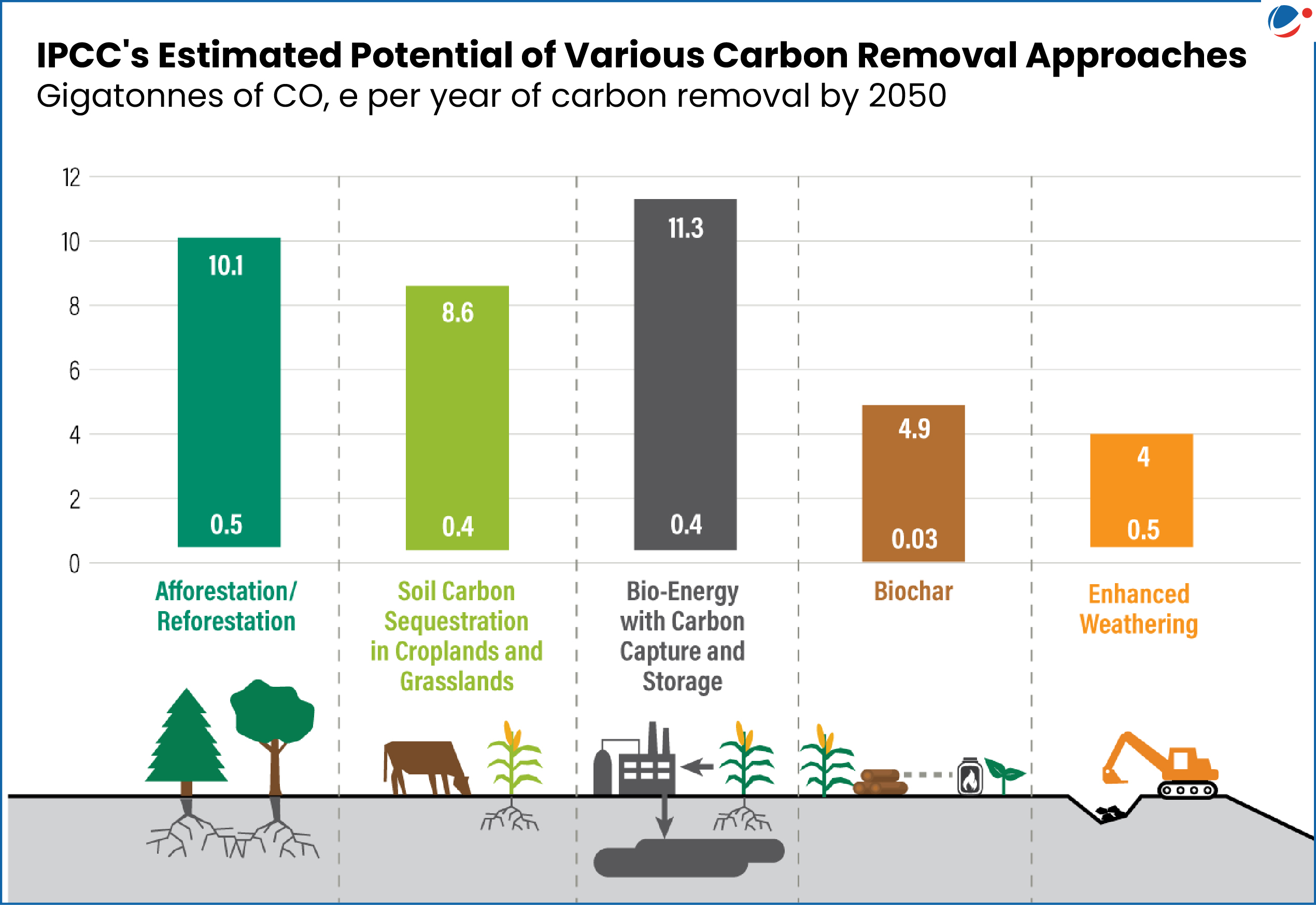
  • Reforestation and Afforestation: According to the IPCC, reforestation and afforestation can mitigate 0.5–10.1 gigatonnes of CO₂ per year.
  • Soil Carbon Sequestration: It refers to the process of capturing atmospheric CO₂ and storing it in soils in the form of soil organic carbon (SOC).
  • Bioenergy with Carbon Capture and Storage (BECCS): In BECCS, energy crops like silvergrass are grown, which are burned as fuel for bioenergy, and the resulting CO₂ emissions are captured and stored underground. 
  • Geologic Carbon Sequestration: Captured CO₂ either from direct air capture or biogenic sources is injected deep underground into porous rock formations for long-term storage. 
  • Biochar: Burning biomass in an oxygen-limited environment producing more stable form of carbon, which can then be applied to soils – adding nutrients and increasing soil’s carbon stocks. 
  • Enhanced Weathering: Accelerating the natural reaction between carbon dioxide and reactive sources, such as certain types of rocks, to increase carbon uptake.

Other Key Highlights of Land Gap Report

  • Land Gap: Climate pledges rely excessively on LBCR requiring 1 billion ha of land. 
    • Land conversion at this scale would displace food production, threaten biodiversity, and disrupt livelihoods, leading to severe social and ecological trade-offs.
  • Forest Gap: Difference between commitments to halt and reverse deforestation and forest degradation by 2030 – amounting to loss or degradation of around 20 million ha forest each year by 2030. 
Watch Video News Today

Explore Related Content

Discover more articles, videos, and terms related to this topic

RELATED VIDEOS

2
Carbon Markets

Carbon Markets

YouTube HD
What is Artificial Rain? | Deep Dive With VisionIAS

What is Artificial Rain? | Deep Dive With VisionIAS

YouTube HD
Title is required. Maximum 500 characters.

Search Notes

Filter Notes

Loading your notes...
Searching your notes...
Loading more notes...
You've reached the end of your notes

No notes yet

Create your first note to get started.

No notes found

Try adjusting your search criteria or clear the search.

Saving...
Saved

Please select a subject.

Referenced Articles

linked

No references added yet

Subscribe for Premium Features