
White Paper on ‘Strengthening AI Governance Through Techno-Legal Framework’ | Current Affairs | Vision IAS
MENU
Home
Quick Links

High-quality MCQs and Mains Answer Writing to sharpen skills and reinforce learning every day.

Watch explainer and thematic concept-building videos under initiatives like Deep Dive, Master Classes, etc., on important UPSC topics.

ESC

In Summary

  • White Paper proposes a techno-legal model for AI governance, emphasizing design-stage integration, flexibility, risk-proportionate controls, human oversight, and lifecycle governance.
  • Challenges include balancing privacy with performance, distinguishing AI users from subjects, cross-border alignment, and maintaining system accuracy with compliance measures.
  • Way forward involves institutional mechanisms like AIGG and TPEC, technological enablers such as Machine Unlearning and Synthetic Data, and DEPA integration for consent-driven data sharing.

In Summary

The White Paper released by the Office of the Principal Scientific Adviser (OPSA) proposes a shift from traditional "command-and-control" regulations to a “techno-legal model” for AI governance.

Key principles of the techno-legal framework 

  • Governance by Design: Legal and ethical requirements are embedded into AI systems at the design stage.
  • Pro-Innovation and Flexible Regulation: Risk mitigation is balanced with innovation.
  • Risk-Proportionate Controls: The intensity of governance varies according to the scale and potential harm of AI deployment.
  • Human Oversight: Human supervision is retained at critical decision points to prevent automated harm.
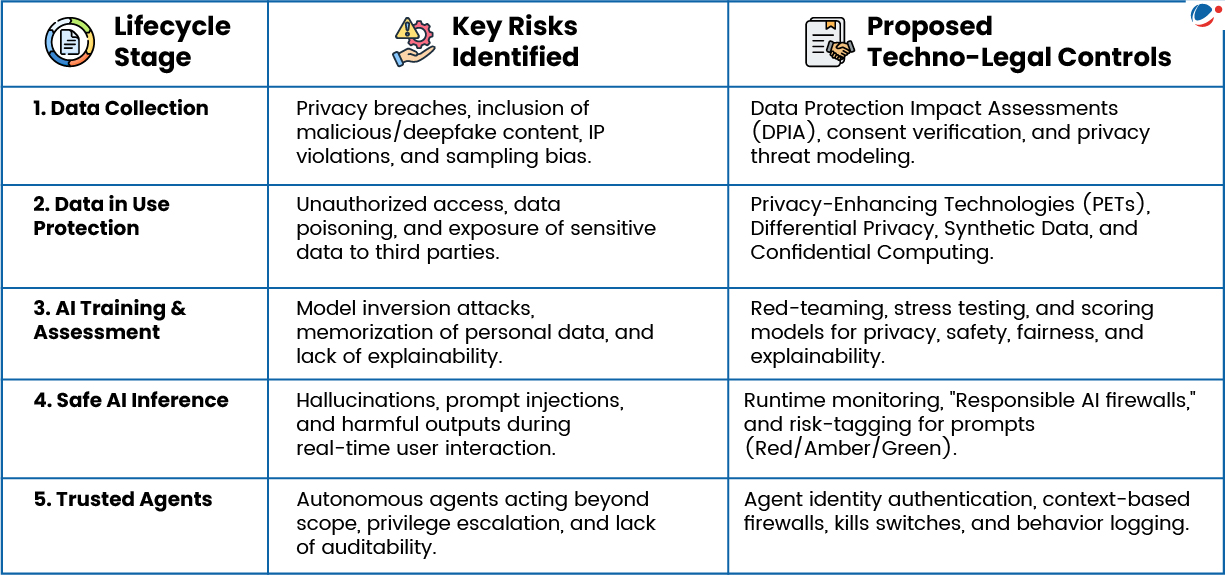
  • Lifecycle-Based Governance: Safeguards operate across the entire AI lifecycle; from data collection and training to deployment and use (refer infographic). 
Challenges in Implementation

  • Privacy vs. Performance: Large-scale data erasure can reduce model performance, especially for underrepresented linguistic and cultural groups.
  • Distinction Between AI Users and AI Subjects: In Indian welfare contexts like healthcare and public safety, citizens are often subjects rather than users, lacking the ability to contest outcomes.
  • Cross-Border Alignment and Enforcement: A model trained abroad may not incorporate Indian safeguards, creating a regulatory gap. 
  • Balancing Compliance with System Accuracy: Introducing techno-legal measures can potentially affect the performance of AI systems

Way Forward

  • Institutional Mechanisms: A "whole-of-government" approach supported by specific institutional bodies, such as
    • AI Governance Group (AIGG) to coordinate across ministries,
    • Technology and Policy Expert Committee (TPEC) to pool expertise in law, policy, and AI safety, etc.
  • Technological Enablers: Using Machine Unlearning (for right to erasure), Synthetic Data (for privacy), and Content Provenance (watermarking/metadata for deepfake detection) along with DPI integration (e.g., Aadhaar, UPI).
  • DEPA Integration: Using the Data Empowerment and Protection Architecture (DEPA) to enforce consent-driven data sharing and trusted execution environments.
Watch Video News Today

Explore Related Content

Discover more articles, videos, and terms related to this topic

RELATED TERMS

3

Technology and Policy Expert Committee (TPEC)

An expert body envisioned to consolidate knowledge and provide guidance on AI governance by bringing together professionals from law, policy, and AI safety disciplines.

AI Governance Group (AIGG)

A proposed institutional mechanism to coordinate AI governance efforts across different government ministries and departments, ensuring a cohesive and unified approach to AI policy and regulation.

DEPA (Data Empowerment and Protection Architecture)

An architectural framework that facilitates secure and consent-driven data sharing between individuals and various service providers, enabling greater control over personal data and fostering trusted data ecosystems.

Title is required. Maximum 500 characters.

Search Notes

Filter Notes

Loading your notes...
Searching your notes...
Loading more notes...
You've reached the end of your notes

No notes yet

Create your first note to get started.

No notes found

Try adjusting your search criteria or clear the search.

Saving...
Saved

Please select a subject.

Referenced Articles

linked

No references added yet