


Data released in Lok Sabha revealed that less than half of the students trained under PM-DAKSH scheme between 2021 and 2024 were placed.
- Institutes must provide employment to 70% of trainees from Short Term Training Courses, or forfeit 30% of the training cost per candidate.
About PM DAKSH (2020-21)
- Type: Central Sector Scheme
- Aim: To provide free of cost skills through quality institutions so that candidates from its target group can find employment.
- Target group: SC, OBC, Economically Weaker Sections (EWS), and De-notified Tribes Safai Karamcharis including waste pickers, Transgenders.
- Eligibility
- Age Criterion: 18-45 years
- OBC and EWS: Annual income family below Rs.3 lakh.
Note: It has been merged with the Pradhan Mantri Kaushal Vikas Yojana of Ministry of Skill Development and Entrepreneurship.
Recently ADR released an analysis of electoral trusts FY 2024-25
- It revealed that 82.5% of the donations by them went to the ruling party.
- Maharashtra emerged as the largest contributor state.
About Electoral trust
- Origin: Based on the Electoral Trusts Scheme, 2013 and Income Tax Rules, 1962 these are non-profit companies.
- Objective: To receive contributions from donors and distribute them to registered political parties facilitating transparent political funding.
- Transparency: Donations above ₹20,000 must be disclosed to Election Commission of India, but the amount given to each political party remains confidential.
- Registration: By Central board of Direct Taxes.
- They need to distribute at least 95% of the contributions received during the year to eligible political parties.
The government lifted the wheat export ban after four years to ensure remunerative prices for farmers.
About Wheat
- Type: Rabi Crop
- Regions: Tropical sub-tropical zones, temperate zone
- Climatic requirement: Cool and moist weather during the vegetative growth period followed by dry, warm weather for the grain to mature and ripening
- Optimum temperature: 20-25 Degrees Celsius
- Ideal Rainfall: 50-75 cm
- Status of India: World’s 2nd-largest producer ( ~14% of global output), world’s largest area.
- Top 3 Producers: Uttar Pradesh, Madhya Pradesh, Punjab.
Article Sources
1 sourceA ₹1 lakh-crore Urban Challenge Fund (UCF) was approved by the Union Cabinet
About Urban Challenge Fund
- Announced in the Union Budget 2025–26
- Focus Areas:
- Cities as Growth Hubs
- Creative Redevelopment of Cities
- Water and Sanitation
- Funding Mechanism:
- UCF will finance up to 25% of project costs.
- At least 50% of funding must come from market sources like:
- Municipal bonds
- Bank loans
- Public–Private Partnerships (PPPs)
Article Sources
1 sourceResearch suggests that desert winds from the west and northwest of India can be used to predict monsoon break periods.
About Monsoon Breaks
- Meaning: During the south-west monsoon, after having rains for a few days, if rain fails to occur for one or more weeks, it is known as break in the monsoon.
- These dry spells are quite common during the rainy season.
- Reasons for Monsoon Break:
- In northern India, rains are likely to fail if the rain-bearing storms are not very frequent along the monsoon trough or the ITCZ over this region.
- Movement of monsoon trough towards Himalayas creates dry spells in plains.
- Over the west coast the dry spells are associated with days when winds blow parallel to the coast.
- In northern India, rains are likely to fail if the rain-bearing storms are not very frequent along the monsoon trough or the ITCZ over this region.
Scientists have captured the clearest view of a star collapsing directly into a black hole without exploding as a supernova.
About Life Cycle of Star
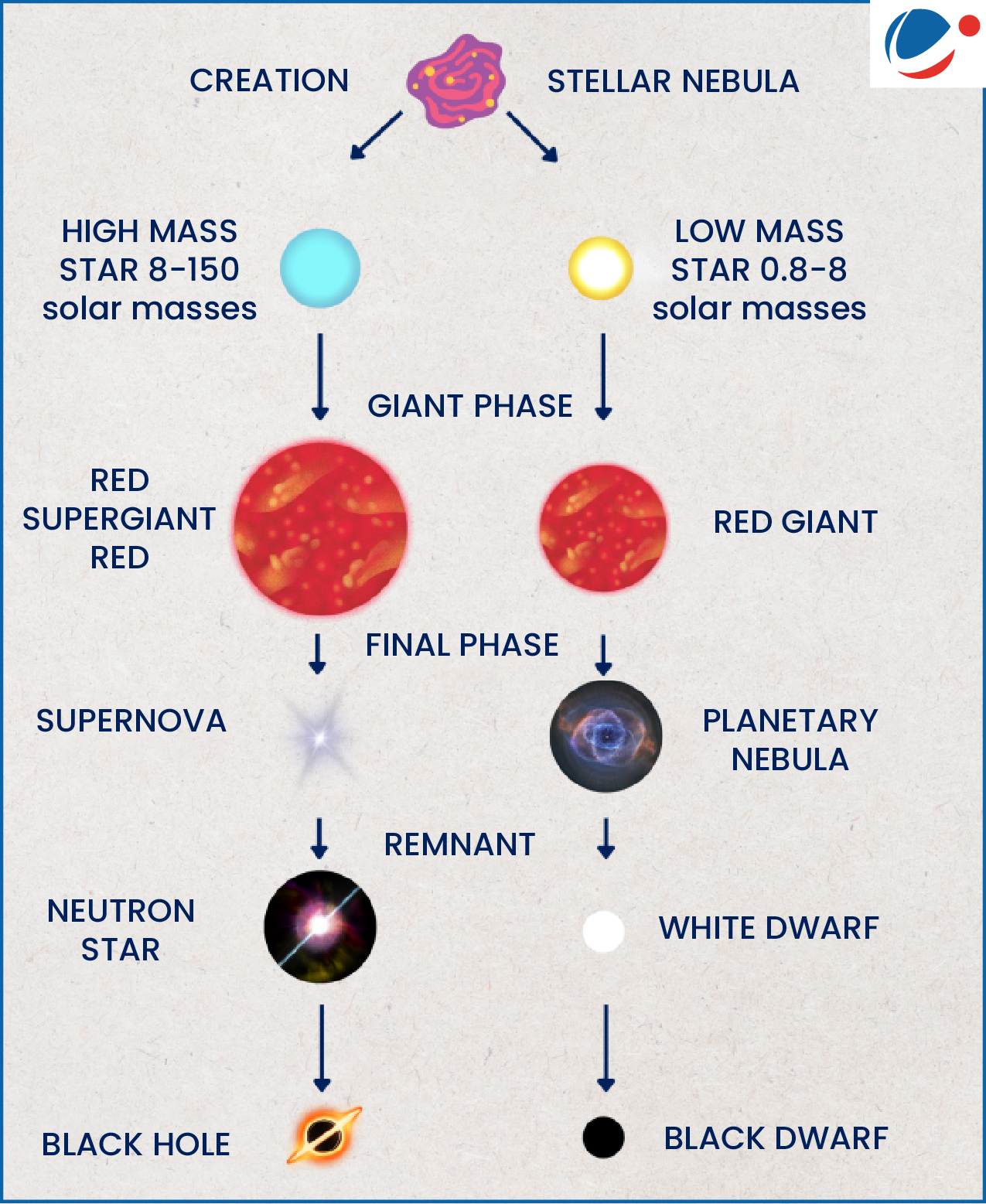
Birth
- Molecular Clouds: Stars form deep within massive, cold clouds of gas and dust.
- Protostar Formation: Gravity causes high-density pockets within these clouds to clump and collapse creating a "protostar".
Life
- Main Sequence: Nuclear fusion ignites in the core and releases huge amounts of energy. This stable period is the longest phase of a star's life.
Death
- Low-Mass Stars: Sun-like stars expand into giants, shed their outer layers as a planetary nebula, and leave behind a cooling white dwarf core.
- High-Mass Stars: These stars fuse elements up to iron, after which the core collapses, triggering a supernova that leaves behind a neutron star or a black hole.
The Appellate Tribunal for Electricity allowed the Central Electricity Regulatory Commission (CERC) to proceed with framing regulations on power market coupling.
- Market coupling is a model where buy bids and sell bids from all power exchanges in the country will be aggregated and matched to discover a uniform MCP (Market clearing prices).
- India has three power exchanges-Indian Energy Exchange (IEX), Power Exchange India Limited (PXIL) and Hindustan Power Exchange Limited (HPX).
About CERC:
- Overview: Statutory body functioning under Section 76 of the Electricity Act 2003.
- Objective:
- To promote competition, efficiency and economy in bulk power markets
- Improve the quality of supply
- Advise the government on the removal of institutional barriers to bridge the demand supply gap.

