
PM Highlighted the need for Water Conservation on World Water Day (22nd march) | Current Affairs | Vision IAS

Upgrade to Premium Today

Start Now
MENU
Home
Quick Links

High-quality MCQs and Mains Answer Writing to sharpen skills and reinforce learning every day.

Watch explainer and thematic concept-building videos under initiatives like Deep Dive, Master Classes, etc., on important UPSC topics.

A short, intensive, and exam-focused programme, insights from the Economic Survey, Union Budget, and UPSC current affairs.

ESC

In Summary

  • Efficient water governance is crucial for India due to water scarcity, economic growth, and climate resilience, requiring Integrated Water Resource Management (IWRM).
  • Challenges include fragmented governance, groundwater over-exploitation, inequitable access, and climate change impacts, necessitating a forward-looking approach.
  • Way forward involves IWRM, promoting behavioral change, community participation, circular water economy, and gender-responsive governance, empowering local bodies like Gram Panchayats.

In Summary

This underscores the critical role of water governance for sustainable use of water.

Need of efficient water governance 
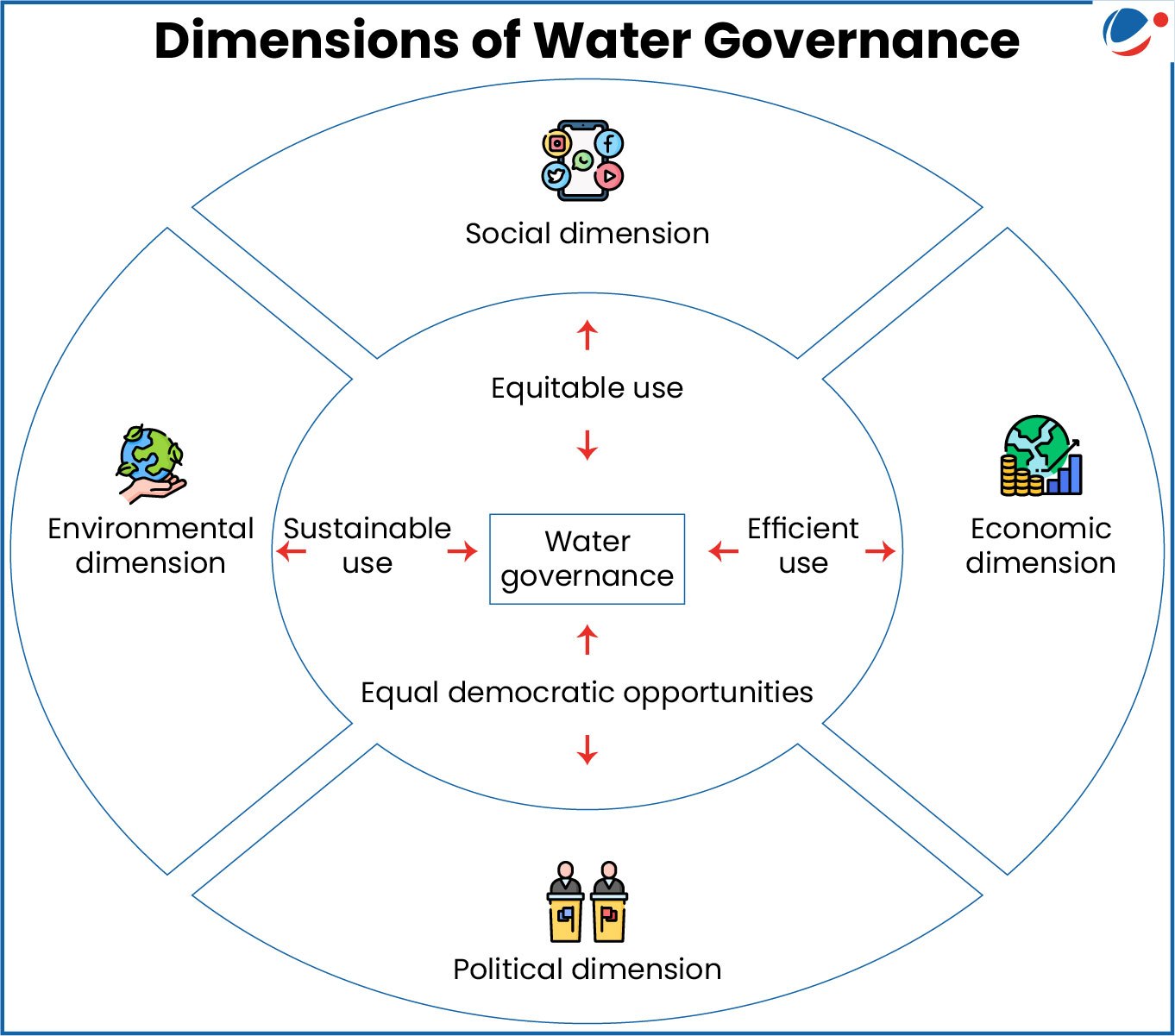
  • Manage Scarcity: India supports ~18% of world's population but has only 4% of freshwater resources.
  • Economic Growth: Inefficient water management could lead to a 6% loss in GDP by 2050. (NITI Aayog) 
  • Climate resilience: Integrated Water Resource Management (IWRM) is needed to maintain the eco-hydrological cycle and sustain biodiversity.

Challenges in water governance 

  • Fragmented Governance: In silos water management (e.g. Groundwater, surface water, irrigation, and domestic use) by institutions like CGWB, CWC, etc.
  • Over-Exploitation: Severe depletion of groundwater aquifers due to subsidized power and lack of regulation.
  •  Lack of Equitable Access: Lack of access to sustainable water sources hinders development of vulnerable sections. E.g. Women and sanitation needs
  • Climate change: impacts the hydrological cycle.

Way Forward

  • Integrated Water Resource Management: Treating river basins as units and linking land, water, and ecosystems.
  • Promoting Behavioural change, Community participation, Circular Water Economy and Gender-Responsive Water Governance.

o E.g Jan Bhagidari- empower Gram Panchayats and village committees to manage local water systems.

Water Governance in India 

  • Constitutional status: Water is a State subject under the 7th schedule while Regulation and development of Inter-State rivers is a Union Subject.

o Article 262: Parliament can provide for adjudication inter-state river disputes.

  • Legal framework:

o Inter-State River Water Disputes (ISRWD) Act,1956 (constitution of Tribunals)

o River Boards Act, 1956 (establishment of River Boards for regulating inter-state rivers)

o Water (Prevention and Control of Pollution) Act, 1974

Initiatives for Ground water governance

  • Ministry of Jal Shakti (2019): For Integrated approach and holistic planning.
  • Jal Jeevan Mission (JJM): Functional household tap connections with Jal Samitis requiring at least 50% participation from local women.
  •  Namami Gange: An integrated conservation mission focused on river rejuvenation
  • Atal Bhujal Yojna: Groundwater management through community participation
 
Watch Video News Today

Explore Related Content

Discover more articles, videos, and terms related to this topic

RELATED VIDEOS

1
Lateral Entry

Lateral Entry

YouTube HD

RELATED TERMS

3

Namami Gange

An integrated conservation mission launched by the Government of India to achieve the objectives of effective abatement of pollution and conservation of the river Ganga. It focuses on a multi-sectoral approach for river rejuvenation.

Jal Samitis

Village-level committees formed under the Jal Jeevan Mission, tasked with managing and maintaining the local water supply system, ensuring its functionality and sustainability. They require significant participation from local women.

Ministry of Jal Shakti

A government ministry established in 2019 by merging the Ministry of Water Resources, River Development and Ganga Rejuvenation, and the Ministry of Drinking Water and Sanitation. It is responsible for policies and programs related to water resources, sanitation, and drinking water in India.

Title is required. Maximum 500 characters.

Search Notes

Filter Notes

Loading your notes...
Searching your notes...
Loading more notes...
You've reached the end of your notes

No notes yet

Create your first note to get started.

No notes found

Try adjusting your search criteria or clear the search.

Saving...
Saved

Please select a subject.

Referenced Articles

linked

No references added yet