
Pradhan Mantri Awaas Yojana – Gramin (PMAY-G) completed 10 years | Current Affairs | Vision IAS

Upgrade to Premium Today

Start Now
MENU
Home
Quick Links

High-quality MCQs and Mains Answer Writing to sharpen skills and reinforce learning every day.

Watch explainer and thematic concept-building videos under initiatives like Deep Dive, Master Classes, etc., on important UPSC topics.

A short, intensive, and exam-focused programme, insights from the Economic Survey, Union Budget, and UPSC current affairs.

ESC

Launched in 2016, PMAY-G was restructured from Indira Awas Yojana, which was started in 1996. 
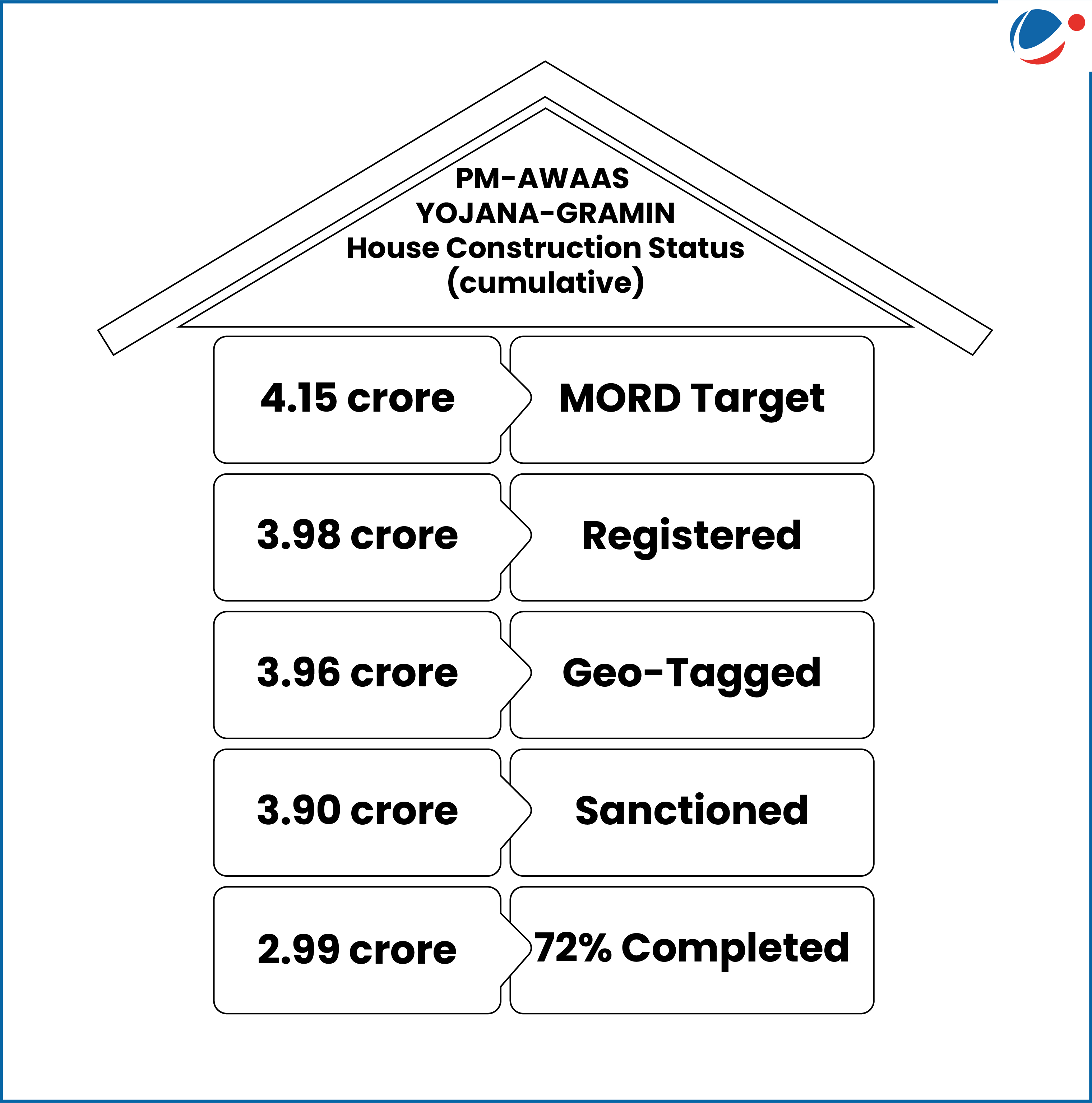
Key Features of PMAY-G

  • Aim: Provide “Housing for All” in Rural Areas
    • It helps financial assistance to eligible rural households, including houseless families and those living in zero, one, or two-room kutcha houses, to construct pucca homes with basic amenities. 
  • Targets: Government initially set a target of 2.95 crore houses for FY 2016– 17 to FY 2023–24 and approved continuation for another five years (FY 2024–25 to FY 2028–29) with an additional target of 2 crore houses.
  • Financial Assistance: Minimum Unit Size of 25 sq. m. and Rs. 1.20 lakh in plain and Rs 1.30 lakh in hilly states.
  • Funding: Cost of unit assistance is to be shared between Central and State Government in the ratio 60:40 in plain areas and 90:10 for North Eastern and the Himalayan States. 
  • Beneficiary Selection: Using housing deprivation parameters in the Socio Economic and Caste Census (SECC), 2011, which is to be verified by the Gram Sabhas. 
  • Programme Monitoring: Implementation and monitoring through end to end e-Governance model- Using AwaasSoft and Awaas App. 
    • Monitoring also through community participation (Social Audit), Member of Parliament (DISHA Committee), Central and State Government officials, National Level Monitors etc.

Reforms in the Scheme

  • Direct Benefit Transfer (DBT): Financial assistance is released directly into the beneficiary’s bank account. 
  • Geo‑tagging of Houses: At every stage of construction, time and date-stamped photographs are uploaded, allowing real-time monitoring of progress. 
  • Village‑level Functionaries: Each sanctioned house is tagged to a local functionary who follows up with the beneficiary.
  • Block and District Inspections: Officers at the block level inspect around 10% of houses, while district officers inspect 2% at each stage of construction. 
  • Social Audits: Every Gram Panchayat conducts a formal social audit at least once a year.
Watch Video News Today

Explore Related Content

Discover more articles, videos, and terms related to this topic

RELATED TERMS

3

Geo-tagging

Geo-tagging is the process of adding geographical identification metadata to various media like photos or videos. In PMAY-G, it is used to monitor construction progress with time and date-stamped photographs.

Direct Benefit Transfer (DBT)

A system initiated by the Government of India to transfer subsidies directly to the bank accounts of beneficiaries, aiming to reduce leakages and improve efficiency.

DISHA Committee

District Development Coordination and Implementation Committee (DISHA) is chaired by a Member of Parliament from the Lok Sabha representing the district. It reviews the implementation of centrally sponsored schemes and other development programs at the district level.

Title is required. Maximum 500 characters.

Search Notes

Filter Notes

Loading your notes...
Searching your notes...
Loading more notes...
You've reached the end of your notes

No notes yet

Create your first note to get started.

No notes found

Try adjusting your search criteria or clear the search.

Saving...
Saved

Please select a subject.

Referenced Articles

linked

No references added yet