
TRAI releases Consultation Paper on Regulatory Framework for Vehicle-to-Everything (V2X) Communication | Current Affairs | Vision IAS

Upgrade to Premium Today

Start Now
MENU
Home
Quick Links

High-quality MCQs and Mains Answer Writing to sharpen skills and reinforce learning every day.

Watch explainer and thematic concept-building videos under initiatives like Deep Dive, Master Classes, etc., on important UPSC topics.

A short, intensive, and exam-focused programme, insights from the Economic Survey, Union Budget, and UPSC current affairs.

ESC

In Summary

  • V2X communication exchanges real-time vehicle data with other vehicles, infrastructure, and pedestrians, enhancing road safety and traffic efficiency.
  • Cellular-V2X (C-V2X) is preferred over DSRC, leveraging 4G/5G networks for applications like collision avoidance and autonomous vehicle support.
  • Challenges include standardization, security, high infrastructure costs, and regulatory/legal uncertainties regarding liability and data ownership.

In Summary

It identifies Cellular-V2X (C-V2X) as the preferred technology, leveraging existing 4G and 5G networks.
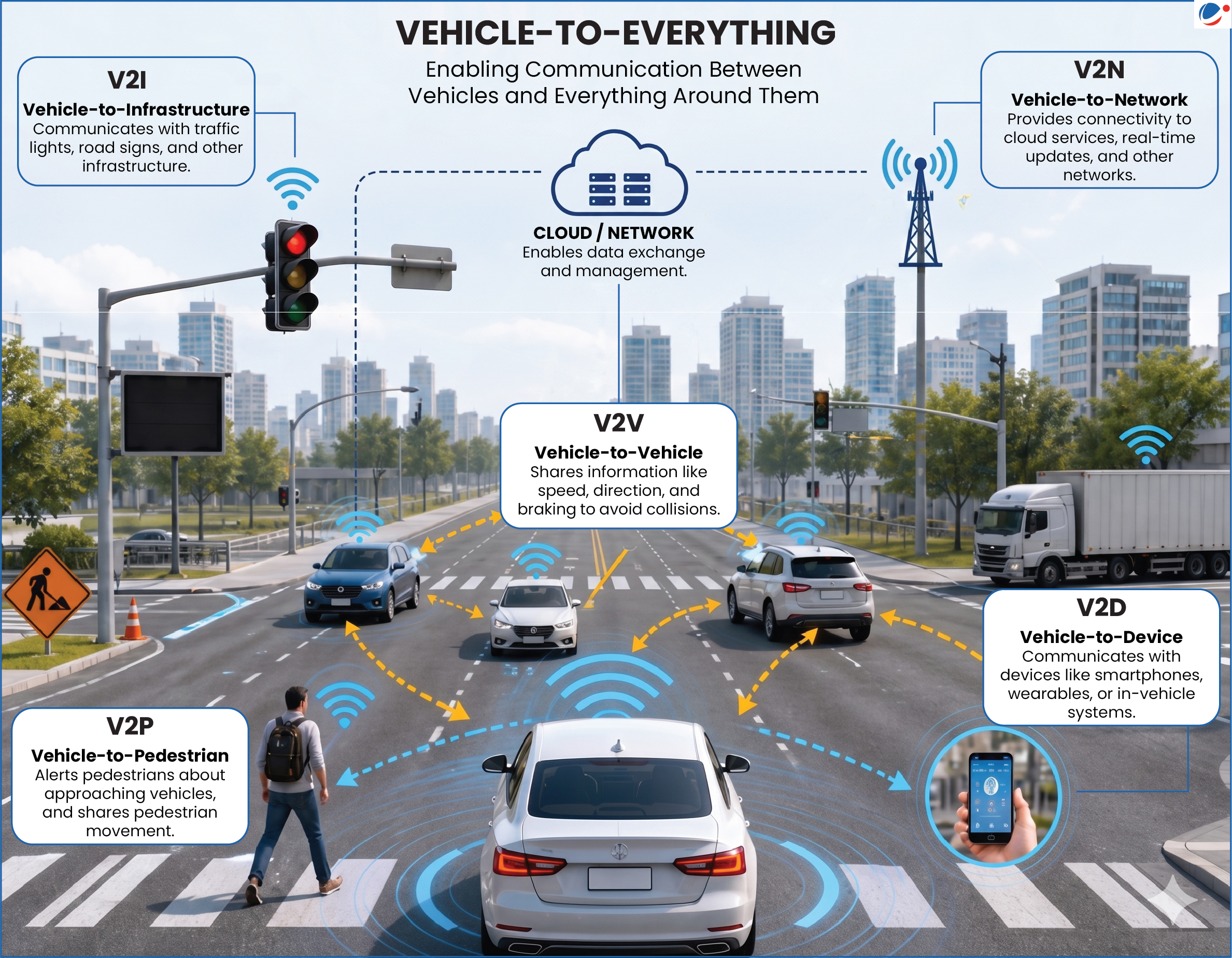
  • V2X relies on two main wireless technologies: Dedicated Short-Range Communication (DSRC) and C-V2X.
    • DSRC uses Wi-Fi whereas C-V2X is a more comprehensive standard, leveraging cellular networks.

About V2X Communication

  • V2X refers to a communication system where a vehicle exchanges real-time information (E.g. position, speed) with other vehicles, infrastructure, pedestrians, and networks using short-range and/ or direct communications. 
  • It is a core component of Intelligent Transport Systems and connected mobility.

Significance of V2X

  • Road Safety: Enables safety applications like collision avoidance, intersection management, and emergency vehicle warning systems, reducing accidents and fatalities.
    • SDG 3.6 aims to halve global road traffic deaths and injuries by 2030.
    • E.g. Forward Collision Warning System (USA) showed a 9% decrease in rate of forward collision conflicts.
  • Traffic Efficiency: Optimizes traffic flow and reduces congestion through smart signal coordination.
  • Autonomous Vehicle Support: Enhances decision-making for self-driving systems with external data inputs.
  • Environmental Benefits: Lowers fuel consumption and emissions contributing to UN SDGs.
  • 5G & Smart City Integration: Enables low-latency communication for connected urban mobility systems.

Challenges of V2X

  • Standardization: Lack of unified communication protocols hinders interoperability and large-scale adoption.
  • Security & Privacy: Vulnerability to cyberattacks necessitates strong encryption and data protection mechanisms.
  • Infrastructure Investment: High costs of upgrading traffic systems and deploying roadside units.
  • Regulatory & Legal Issues: Unclear laws on liability, data ownership, and insurance.
Watch Video News Today

Explore Related Content

Discover more articles, videos, and terms related to this topic

RELATED VIDEOS

2
Simplified: Net Neutrality 2.0: Deciphering the Impact of OTT Regulation in India

Simplified: Net Neutrality 2.0: Deciphering the Impact of OTT Regulation in India

YouTube HD
News Today (May 1st, 2026)

News Today (May 1st, 2026)

YouTube HD

RELATED TERMS

3

Roadside Units (RSUs)

Infrastructure deployed along roadsides that enable communication with vehicles equipped with V2X technology. These units are essential for implementing advanced traffic management and safety features.

Connected mobility

The concept of vehicles being connected to each other, to infrastructure, and to networks, enabling the exchange of data for improved transportation services. V2X is fundamental to realizing connected mobility.

SDG 3.6

Sustainable Development Goal 3.6, which targets a significant reduction in global road traffic deaths and injuries by the year 2030. V2X technology is seen as a key enabler for achieving this goal.

Title is required. Maximum 500 characters.

Search Notes

Filter Notes

Loading your notes...
Searching your notes...
Loading more notes...
You've reached the end of your notes

No notes yet

Create your first note to get started.

No notes found

Try adjusting your search criteria or clear the search.

Saving...
Saved

Please select a subject.

Referenced Articles

linked

No references added yet