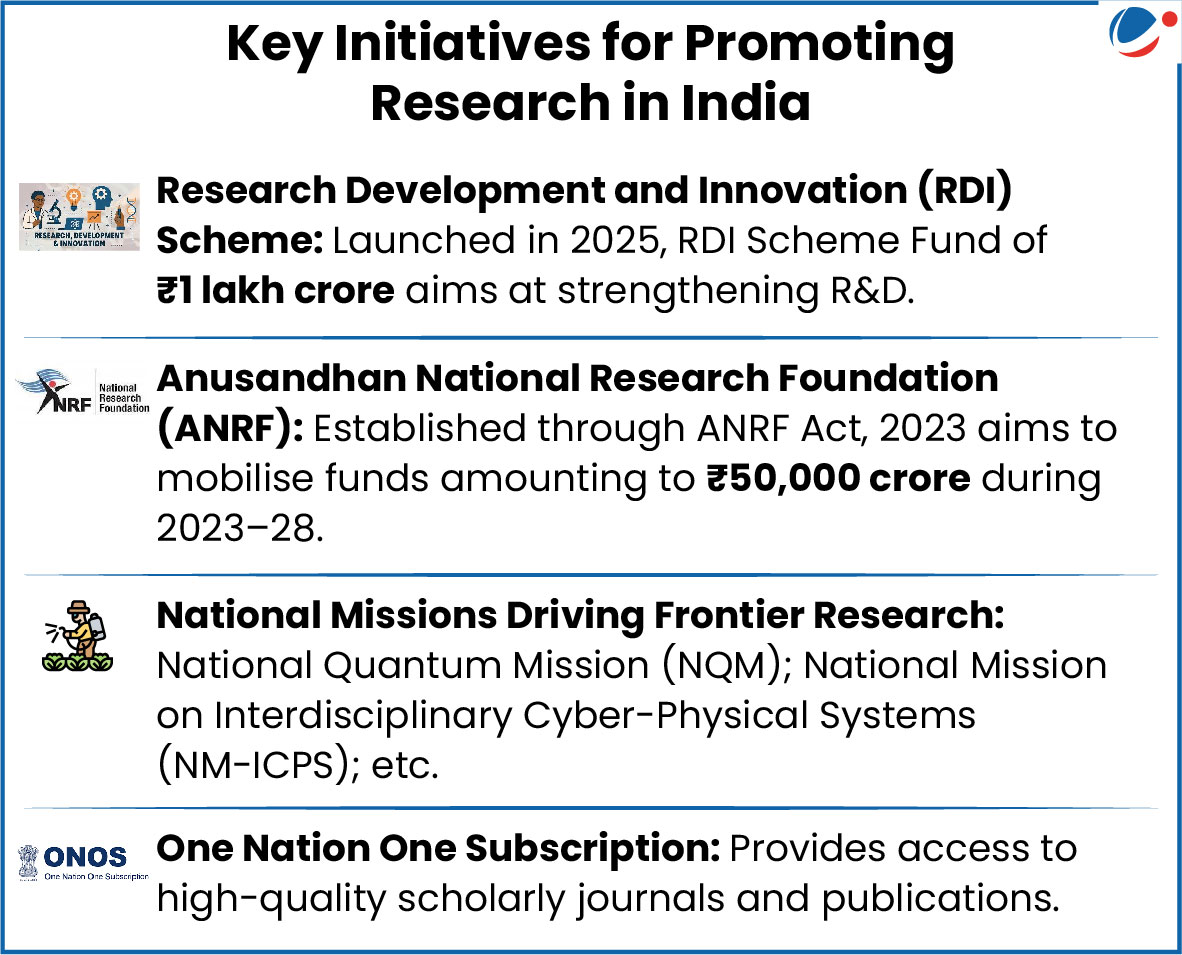
As per the report, India’s Gross Expenditure on Research and Development (GERD) stands at around 0.65% of GDP, lower than USA (~3.5%), China (~2.4%), and Republic of Korea (~4.5%).
- Further, Global Innovation Index (GII) report 2025, shows the number of Full-Time Equivalent (FTE) researchers in India remains 262 per million, compared to USA (4,821), China (1,585).
Key Challenges across India’s R&D ecosystem
- Inadequate R&D Funding: Not only GERD in India is low, it is heavily dependent on public funding (~64%), compared to other leading economies having 60% of R&D budget contributed by private sector.
- Attracting and Retaining Quality Human Resource: Due to instances of delays in scholarships disbursal, Lack of incentive for researchers to translate their patents/publications into products.
- Technology Translation & Commercialization: Few R&D institutions, like CSIR labs, have Independent Business Divisions (IBD) to deal with translational aspect of technologies.
- R&D in State Institutions: Poor R&D funding and Infrastructure along with burden of Affiliations which consumes maximum time and energy of faculty.
Key Recommendations
- Enhance Gross Expenditure on R&D to increase to at least 2% in next four to five years.
- Create ‘Vigyan Nidhi’, unified Fellowship system to address fellowship funding and disbursal delays.
- Establish State-level RDI Clusters by integrating HEIs, R&D institutions, MSMEs, PSUs, and industry.
- National Institute for Science Policy and Governance (NISPG) similar to STEPI (South Korea) and NISTEP (Japan) may be established to bridge policy, implementation and monitoring gaps.