
RBI Steps up Record Dollar Sales to Counter Rupee Depreciation | Current Affairs | Vision IAS

Upgrade to Premium Today

Start Now
MENU
Home
Quick Links

High-quality MCQs and Mains Answer Writing to sharpen skills and reinforce learning every day.

Watch explainer and thematic concept-building videos under initiatives like Deep Dive, Master Classes, etc., on important UPSC topics.

A short, intensive, and exam-focused programme, insights from the Economic Survey, Union Budget, and UPSC current affairs.

ESC

In Summary

  • RBI recorded net sales of $53.1 billion in FY26, an increase of $12 billion from FY25.
  • Measures to prevent rupee depreciation include a $5 billion USD/INR buy/sell swap and restricting domestic banks from rupee NDF contracts.
  • Factors driving depreciation include global economic conditions like high crude oil prices and US Fed rate hikes, alongside capital outflows and increased gold import bills.

In Summary

Reserve Bank of India (RBI) recorded a total net sale of $53.1 billion in FY26, an increase of $12 billion, compared to net sales of $41.1 billion in FY25.

Other measures taken by RBI to prevent Rupee Depreciation

  • Liquidity Injections & Swaps: RBI has initiated a $5 billion USD/INR buy/sell swap to boost rupee liquidity and enhance market stability.
  • Offshore NDF & Derivative Limits: The central bank is restricting domestic banks from rupee Non-Deliverable Forward (NDF) contracts to decouple from volatile offshore markets.
    • It has capped net open forex positions for banks at $100 million to curb speculative trading.

About Currency Depreciation

  • Definition: Depreciation of a currency occurs when its value declines relative to foreign currencies in the open market. 
  • Factors Driving Depreciation of Indian Rupee
    • Other: Gold import bill has almost doubled to $72 billion in 2025-26 in two years; Outflow under LRS for foreign travel accounted for $15 billion in FY26, etc.
  • Global economic factors: Such as high crude oil prices (past $100 per barrel) due to the Strait of Hormuz crisis, US Federal Reserve interest rate hikes, etc. have led to higher demand for foreign currency, weakening the rupee.
  • Capital Outflows: For e.g. total outflows by Foreign Portfolio Investors (FPIs) from the equity market have crossed ₹2 lakh crore in 2026.
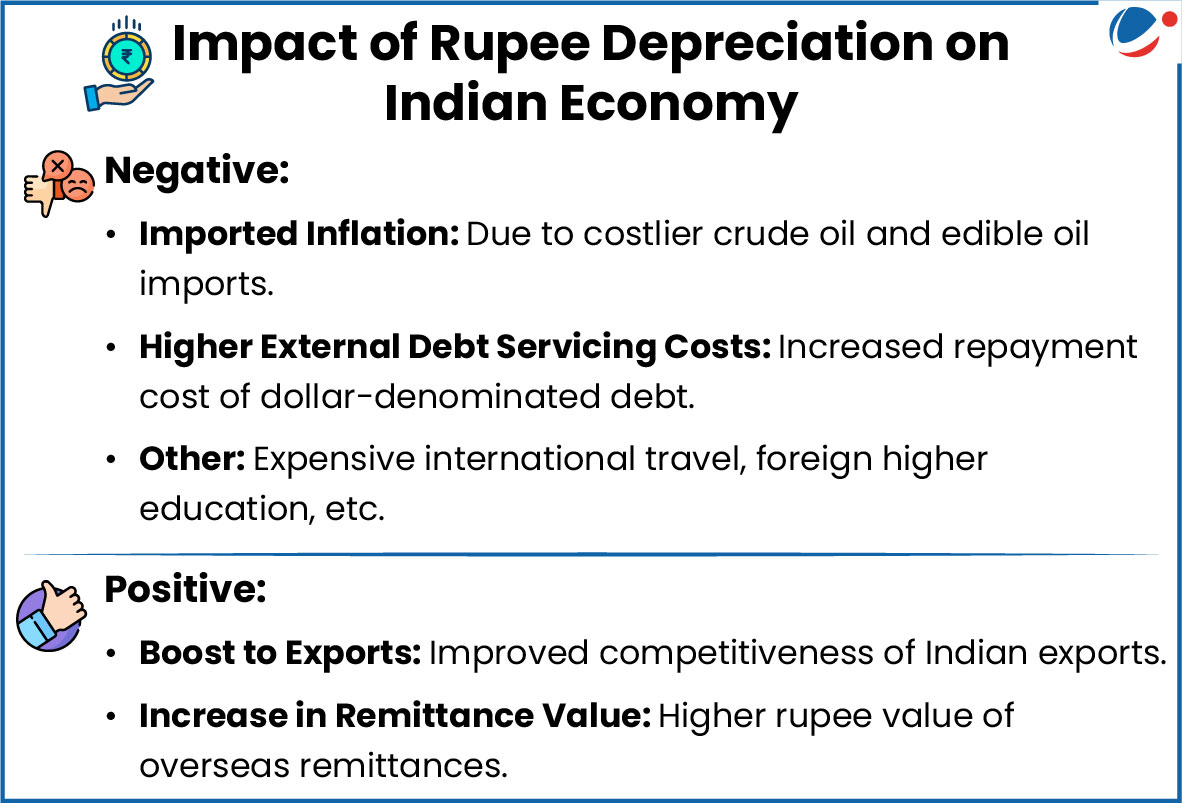
Watch Video News Today

Explore Related Content

Discover more articles, videos, and terms related to this topic

RELATED VIDEOS

3
News Today (Aug 18-19-20, 2024)

News Today (Aug 18-19-20, 2024)

YouTube HD
The Challenge of Currency Depreciation

The Challenge of Currency Depreciation

YouTube HD
News Today (May 30, 2025)

News Today (May 30, 2025)

YouTube HD

RELATED TERMS

3

Foreign Portfolio Investors (FPIs)

Investors who invest in the securities of a country, including stocks, bonds, and other financial assets, without actively participating in the management of the company or government. They are typically institutional investors like mutual funds, hedge funds, and pension funds.

US Federal Reserve interest rate hikes

Increases in the benchmark interest rate set by the US central bank. Such hikes can attract capital towards the US, leading to outflows from emerging markets like India and weakening their currencies.

Strait of Hormuz

A vital international waterway connecting the Persian Gulf to the Gulf of Oman. It is a critical chokepoint for global oil transport, with approximately 20% of the world's oil passing through it annually.

Title is required. Maximum 500 characters.

Search Notes

Filter Notes

Loading your notes...
Searching your notes...
Loading more notes...
You've reached the end of your notes

No notes yet

Create your first note to get started.

No notes found

Try adjusting your search criteria or clear the search.

Saving...
Saved

Please select a subject.

Referenced Articles

linked

No references added yet
