IMD issued Red Alert as risk of urban floods rises across India | Current Affairs | Vision IAS

Upgrade to Premium Today

Start Now
MENU
Home
Quick Links

High-quality MCQs and Mains Answer Writing to sharpen skills and reinforce learning every day.

Watch explainer and thematic concept-building videos under initiatives like Deep Dive, Master Classes, etc., on important UPSC topics.

A short, intensive, and exam-focused programme, insights from the Economic Survey, Union Budget, and UPSC current affairs.

ESC

Heavy monsoon rainfall triggered flooding in cities such as Delhi and Surat, disrupting normal life and drawing attention to the recurring challenge of urban floods in India

What is Urban Flooding?

  • Definition: Urban flooding is the temporary inundation of land or property in urban areas caused by excessive runoff overwhelming the drainage system.
  • Differs from rural flooding: as urbanization increases flood peaks by 1.8–8 times and flood volumes by up to 6 times (as per NDMA).
  • Impact: displacement, loss of life & property; damage to critical infrastructure (power, water supply); Public health hazards (water-borne diseases, contamination); Environmental degradation (Pollutes water bodies), etc.

 Causes of Urban Flooding 

  • Extreme Rainfall & Climate Change: High-intensity rainfall, cloudbursts and changing monsoon patterns, e.g., Mumbai 2005.
  • Unplanned Urbanisation: Rapid concretisation and expansion of impervious surfaces reduce infiltration and increase surface runoff.
  • Encroachment of Natural Drainage & Water Bodies: Encroachment of lakes, wetlands, floodplains, and storm water drains, e.g., Bengaluru has lost 65 lakes in last two decades.
  • Inadequate Storm-Water Drainage: Poorly designed, undersized and poorly maintained drainage systems, often clogged with solid waste.
  • Poor Urban Water Management: Sudden release of water from reservoirs/dams and loss of natural catchments, e.g.,2015 Chennai floods due to Chembarambakkam reservoir.

Way Forward

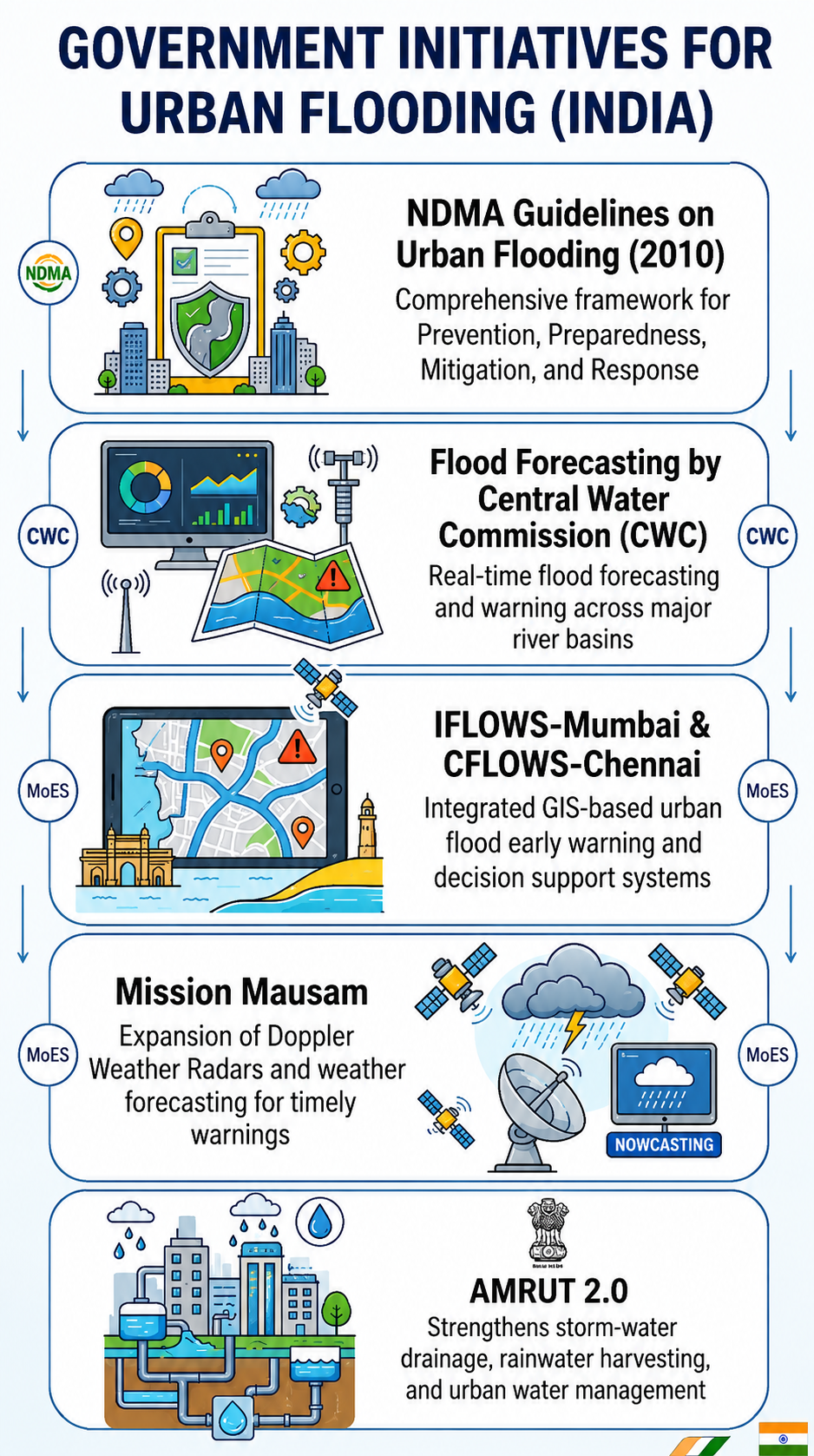
  • Data-Driven Forecasting & Mapping:
    • Enhance Tech & Early Warning: Expand Doppler radars, automatic gauges, and real-time monitoring.
    • Deploy GIS Mapping: Create city-wide contour maps, drainage inventories, and flood-hazard zones to guide risk assessment.
  • Integrated & Nature-Based Infrastructure:
    • Upgrade Grey Infrastructure: Modernize storm-water drains, ensure regular desilting, and clear structural encroachments.
    • Adopt Eco-Sensitive Planning: Implement watershed-based drainage design alongside China’s "Sponge City" concepts (permeable pavements, green roofs, and rain gardens) to naturally absorb and reuse runoff.
  • Institutional Governance & Preparedness:
    • Strengthen Management: Form dedicated Urban Flood Cells and localized Disaster Management Plans.
    • Boost Collaboration: Improve coordination across agencies and foster community-level participation at the urban local body (ULB) level.
Watch Video News Today

Explore Related Content

Discover more articles, videos, and terms related to this topic

RELATED VIDEOS

3
News Today (Feb 05, 2026)

News Today (Feb 05, 2026)

YouTube HD
Carbon Markets

Carbon Markets

YouTube HD
What is Artificial Rain? | Deep Dive With VisionIAS

What is Artificial Rain? | Deep Dive With VisionIAS

YouTube HD

RELATED TERMS

3

Urban Local Body (ULB)

The administrative unit responsible for governance and service delivery in urban areas, such as municipalities and corporations. Effective coordination at the ULB level is essential for disaster preparedness and response.

Sponge City

An urban planning concept, pioneered in China, that aims to make cities more resilient to extreme rainfall by integrating natural and man-made systems to absorb, clean, and reuse rainwater. It involves features like permeable pavements, green roofs, and rain gardens.

Grey Infrastructure

Refers to traditional, resource-intensive infrastructure built using conventional materials like concrete and asphalt, as opposed to sustainable or 'green' alternatives.

Title is required. Maximum 500 characters.

Search Notes

Filter Notes

Loading your notes...
Searching your notes...
Loading more notes...
You've reached the end of your notes

No notes yet

Create your first note to get started.

No notes found

Try adjusting your search criteria or clear the search.

Saving...
Saved

Please select a subject.

Referenced Articles

linked

No references added yet