
Cloudburst triggers flash floods in Jammu & Kashmir | Current Affairs | Vision IAS

Upgrade to Premium Today

Start Now
MENU
Home
Quick Links

High-quality MCQs and Mains Answer Writing to sharpen skills and reinforce learning every day.

Watch explainer and thematic concept-building videos under initiatives like Deep Dive, Master Classes, etc., on important UPSC topics.

A short, intensive, and exam-focused programme, insights from the Economic Survey, Union Budget, and UPSC current affairs.

ESC

In Summary

  • Cloudbursts are defined by IMD as rainfall of 100 mm/hour over an area less than 100 sq. km, occurring via orographic lift or sudden condensation.
  • Doppler radars can forecast cloudbursts 6-14 hours in advance, with impacts including flash floods, landslides, and infrastructure damage.
  • NDMP 2019 emphasizes state responsibility for ULBs/PRIs and central responsibility for database management and expanding radar networks under 'Mission Mausam'.

In Summary

Unlike typical monsoon rains that are steady and widespread, cloudbursts are localized, affecting small areas.

What is a Cloud Burst? 

  • According to the IMD, if rainfall of about 100 mm or above per hour is recorded over a place that is roughly less than 100 sq.km area, it is classified as a cloudburst event.
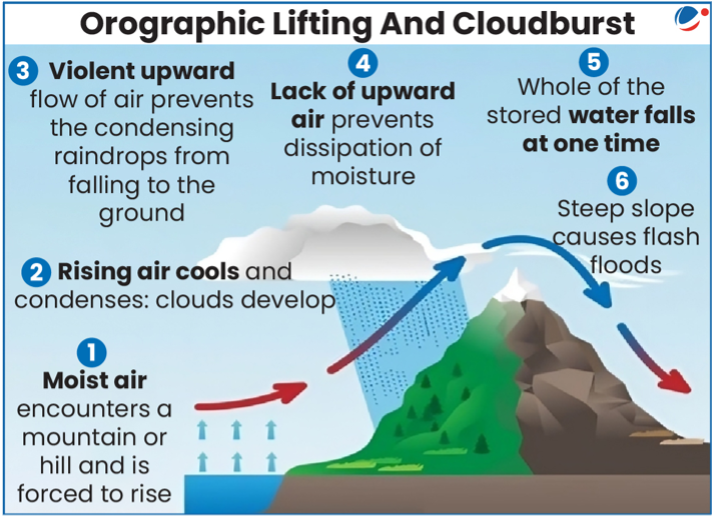
  • They are infrequent as they occur only via : 
    • Orographic lift (See infographics)
    • Occasionally when a warm air parcel mixes with cooler air, resulting in sudden condensation.
  • Forecasting: Using Doppler radars it is possible to forecast the possibility of cloudbursts about six hours and sometimes 12-14 hours in advance.
  • Impact: Leads to flash floods, dam breaches, mudslides, and landslides, resulting in casualties, damage to homes, roads, public infrastructure, and ecosystems.

Way forward:

  • National Disaster Management Plan (NDMP) 2019
    • State responsibility: Enhancing capabilities of Urban Local Bodies and Panchayati Raj Institutions to prepare and cope with events like cloudbursts and hailstorms.
    • Centre  responsibility: Develop Database management system relating to Hailstorm, Cloudburst & Climate Change
  • Under the ‘Mission Mausam’, India also plans to more than double its radar network, from the current 40 or so, and use artificial intelligence to better predict hyperlocal events
Watch Video News Today

Explore Related Content

Discover more articles, videos, and terms related to this topic

RELATED TERMS

3

Mission Mausam

A comprehensive initiative aimed at advancing India's capabilities in weather and climate science, research, and services. It involves key meteorological institutions like IMD, Indian Institute of Tropical Meteorology, and the National Centre for Medium-Range Weather Forecasting.

Panchayati Raj Institutions (PRIs)

The system of local self-governance in rural India, encompassing Gram Panchayats, Block Panchayats, and Zila Panchayats, which are entrusted with powers and responsibilities for local development and governance.

Urban Local Bodies (ULBs)

Municipal governments responsible for providing basic services in urban areas, including water supply, sanitation, and waste management. In India, ULBs often face capacity constraints in managing wastewater effectively.

Title is required. Maximum 500 characters.

Search Notes

Filter Notes

Loading your notes...
Searching your notes...
Loading more notes...
You've reached the end of your notes

No notes yet

Create your first note to get started.

No notes found

Try adjusting your search criteria or clear the search.

Saving...
Saved

Please select a subject.

Referenced Articles

linked

No references added yet