


Test demonstrated the missile’s operational readiness and confirmed that all critical systems performed in line with expected parameters.
Agni Missiles
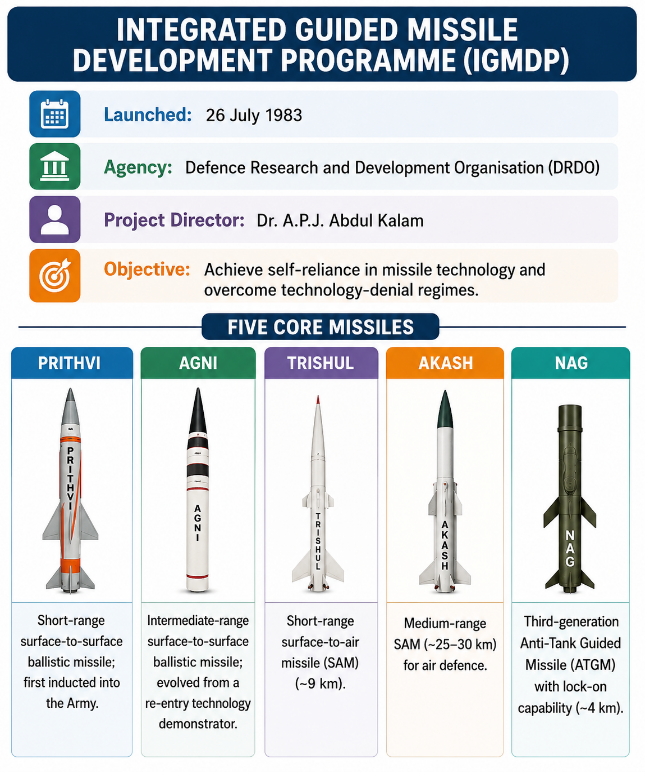
- Agni Programme: Evolved from a re-entry vehicle technology demonstrator into a family of ballistic missiles with varying ranges under India’s Integrated Guided Missile Development Programme (IGMDP).
- Agni-I:Two-stage liquid-solid propulsion missile; operationally limited by long deployment time and mobility constraints.
- Agni-II: Two-stage, solid-propellant design with range of approximately 2,500 km.
- Agni-III:3,500 km range, designed to strengthen India's strategic deterrence, especially against China.
- Agni-4:Medium-Range Ballistic Missile (MRBM) under the Strategic Forces Command (SFC), enhancing India's credible minimum deterrence.
- Range of approx. 4,000 km, can carry a 1,000 kg payload.
- Agni-5: ICBM with solid fuel three stage propulsion design and equipped with MIRV (Multiple Independently Targetable Re-entry Vehicle) capability.
About Ballistic Missiles
- Ballistic missiles are powered by rockets initially but then they follow an unpowered, free-falling trajectory toward their targets.
- Classification:
- Short-Range Ballistic Missile (SRBM): Range below 1,000 km
- Medium-Range Ballistic Missile (MRBM): Range 1,000–3,000 km
- Intermediate-Range Ballistic Missile (IRBM): Range 3,000–5,500 km
Intercontinental Ballistic Missile (ICBM): Range above 5,500 km


