
World Economic Forum (WEF) released ‘Global Gender Gap Report 2024’ | Current Affairs | Vision IAS
MENU
Home

Periodically curated articles and updates on national and international developments relevant for UPSC Civil Services Examination.

Quick Links

High-quality MCQs and Mains Answer Writing to sharpen skills and reinforce learning every day.

Watch explainer and thematic concept-building videos under initiatives like Deep Dive, Master Classes, etc., on important UPSC topics.

ESC

The report is based on the Global Gender Gap Index (GGGI) which annually benchmarks the current state and evolution of gender parity based on 14 indicators across four key dimensions.
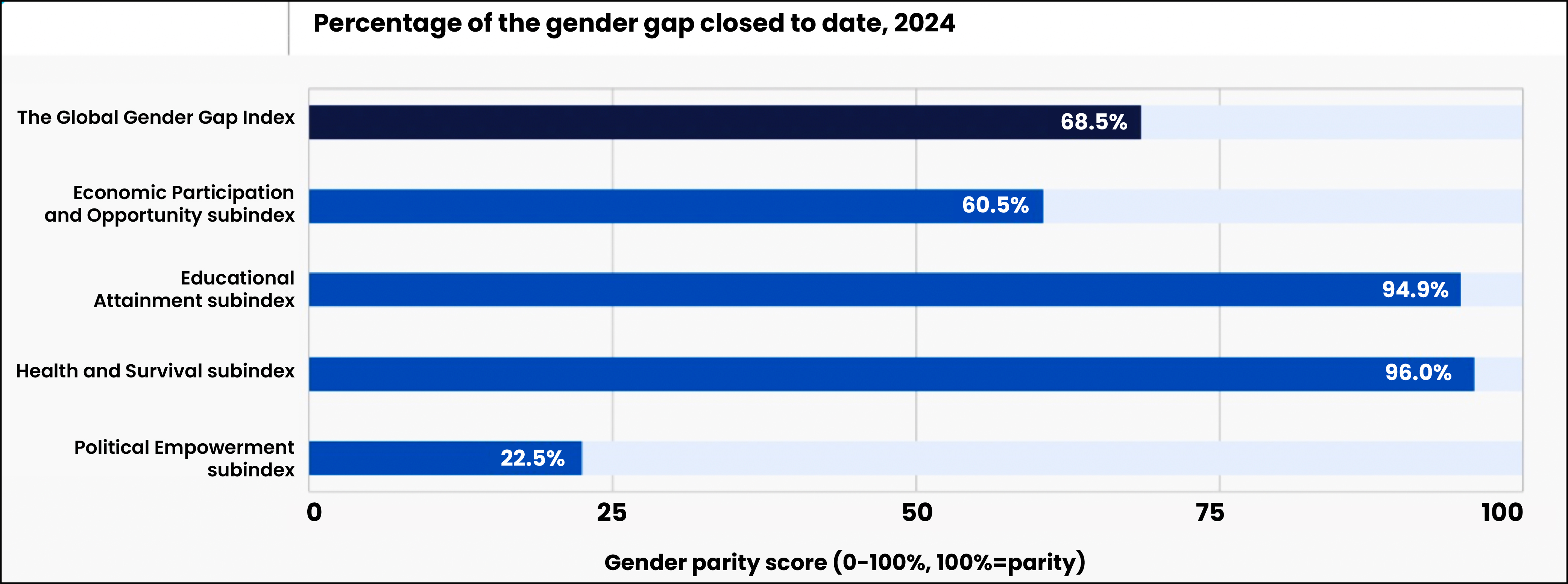
A bar chart showing the percentage of the gender gap closed to date in 2024 across various indices. The Global Gender Gap Index is 68.5%, Economic Participation and Opportunity is 60.5%, Educational Attainment is 94.9%, Health and Survival is 96.0%, and Political Empowerment is 22.5%.

Key findings

  • Global 
    • Among 146 countries, Iceland, Finland, Norway, New Zealand, and Sweden are the top five countries.
    • The share of women in parliamentary positions has shown an almost uninterrupted positive trajectory since 2006.
    • At the current rate of progress, it will take 134 years to reach full parity. 
    • Women constitute 28.2% of the STEM workforce and 47.3% of the non-STEM workforce.
  • India 
    • Overall, India was ranked 129th (ranked 127 in 2023), and 5th in South Asia after Bangladesh, Nepal, Sri Lanka and Bhutan.
    • Saw small declines in Educational Attainment and Political Empowerment while Economic Participation and Opportunity slightly improved.
    • Shares of women are high in primary, secondary and tertiary education enrolments. 

Recommendation

  • Achieving gender parity by 2030 would require a collective investment of $360 billion per year. 
  • Targeted interventions and ensuring equitable access to emerging technological competencies are needed.
  • Businesses need to have effective diversity, equity and inclusion policies and upskilling. 

NOTE: Gender Inequality Index (GII), released by UNDP, is also a composite metric of gender inequality based on three dimensions: reproductive health, empowerment and the labour market.

Watch Video News Today

Explore Related Content

Discover more articles, videos, and terms related to this topic

RELATED VIDEOS

2
News Today (Jun 13, 2025)

News Today (Jun 13, 2025)

YouTube HD
Transformation of Family Structures in India

Transformation of Family Structures in India

YouTube HD
Title is required. Maximum 500 characters.

Search Notes

Filter Notes

Loading your notes...
Searching your notes...
Loading more notes...
You've reached the end of your notes

No notes yet

Create your first note to get started.

No notes found

Try adjusting your search criteria or clear the search.

Saving...
Saved

Please select a subject.

Referenced Articles

linked

No references added yet

Subscribe for Premium Features