
India State of Forest Report (ISFR) 2023 released by Minister for Environment, Forest and Climate Change (MoEFCC) | Current Affairs | Vision IAS
MENU
Home

Periodically curated articles and updates on national and international developments relevant for UPSC Civil Services Examination.

Quick Links

High-quality MCQs and Mains Answer Writing to sharpen skills and reinforce learning every day.

Watch explainer and thematic concept-building videos under initiatives like Deep Dive, Master Classes, etc., on important UPSC topics.

ESC

ISFR is a biennial publication of Forest Survey of India (FSI), MoEFCC. It was 1st published in 1987 (ISFR 2023 is 18th report).
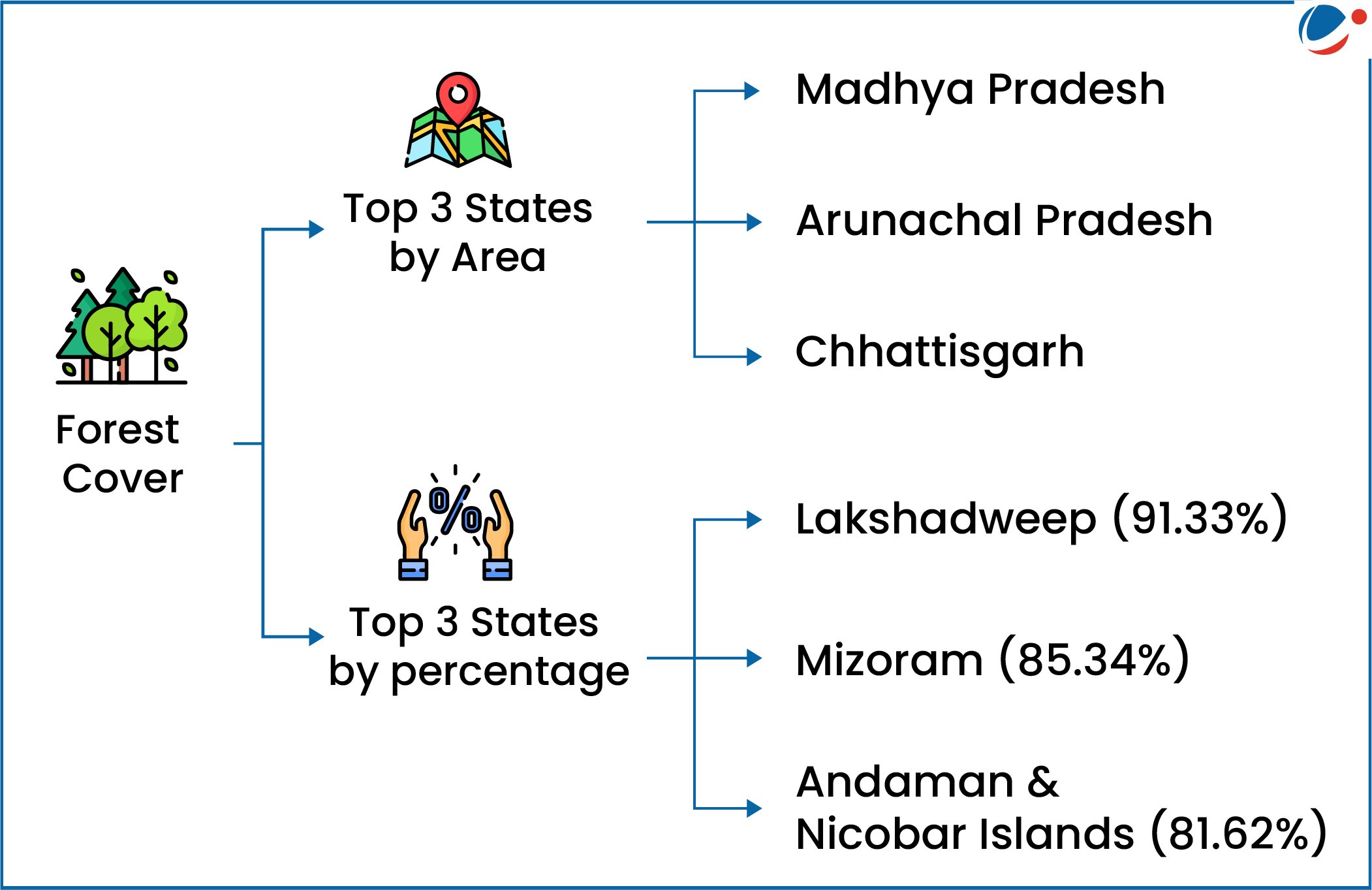
Area wise top three states having largest forest cover are Madhya Pradesh (77,073 sq km) followed by Arunachal Pradesh (65,882 sq km) and Chhattisgarh (55,812 sq km).In terms of percentage of forest cover with respect to total geographical area, Lakshadweep (91.33 percent) has the highest forest cover followed by Mizoram (85.34 percent) and Andaman & Nicobar Island (81.62 percent).

Key Findings of Report:

  • Total forest and tree cover: Increased to 25.17% of geographical area compared to 2021 assessment (24.62%).
    • It includes 21.76% Forest cover and 3.41% Tree cover.
    • Maximum increase: Chhattisgarh, Uttar Pradesh, Odisha, and Rajasthan.
  • 19 states/UTs have forest cover above 33% of area. Out of these eight states/UTs namely Mizoram, Lakshadweep, A & N Island, Arunachal Pradesh, Nagaland, Meghalaya, Tripura, and Manipur have forest cover above 75 percent.
    • National Forest Policy, 1988 provides for having a minimum of 1/3rd  of total land area of country under forest or tree cover as a national goal.
  • Mangrove cover: Total mangrove cover is 4,992 km2 in country (Decrease of 7.43 km2 compared to 2021). 
    • Gujarat saw a decrease whereas Andhra Pradesh and Maharashtra saw an increase.
  • Target under Nationally Determined Contributions: Carbon stock has reached 30.43 Bt of CO2 equivalent, indicating that India has reached 2.29 Bt of additional carbon sink (compared to 2005) as against target of 2.5 to 3.0 Bt by 2030.
  • Extent of bamboo bearing area: Estimated at 1, 54,670 km2 (Increase of 5,227 km2 as compared to 2021).
Watch Video News Today

Explore Related Content

Discover more articles, videos, and terms related to this topic

RELATED VIDEOS

2
Carbon Markets

Carbon Markets

YouTube HD
What is Artificial Rain? | Deep Dive With VisionIAS

What is Artificial Rain? | Deep Dive With VisionIAS

YouTube HD
Title is required. Maximum 500 characters.

Search Notes

Filter Notes

Loading your notes...
Searching your notes...
Loading more notes...
You've reached the end of your notes

No notes yet

Create your first note to get started.

No notes found

Try adjusting your search criteria or clear the search.

Saving...
Saved

Please select a subject.

Referenced Articles

linked

No references added yet