
20 years of devastating Indian Ocean Tsunami | Current Affairs | Vision IAS
MENU
Home

Periodically curated articles and updates on national and international developments relevant for UPSC Civil Services Examination.

Quick Links

High-quality MCQs and Mains Answer Writing to sharpen skills and reinforce learning every day.

Watch explainer and thematic concept-building videos under initiatives like Deep Dive, Master Classes, etc., on important UPSC topics.

ESC

A magnitude 9.1 earthquake near Sunda Trench (Indonesia) in 2004 triggered Indian Ocean tsunami that devastated almost14 countries.

  • Sunda Trench is situated on Pacific "Ring of Fire" (Arc of intense seismic activity stretching from Japan through Southeast Asia and across Pacific basin).

About Tsunami

  • Series of enormous waves created by an underwater disturbance caused by violent seafloor movement associated with earthquakes, landslides, lava entering sea, seamount collapse, or meteorite impact.

Features of Tsunami Waves: 

  • Not noticed by ships in deep oceans because their amplitude is negligible when compared with their wavelength. 
    • However when tsunamis approach shallow water, wave amplitude increases.
  • Their speed depends on ocean depth, not distance from wave's source.
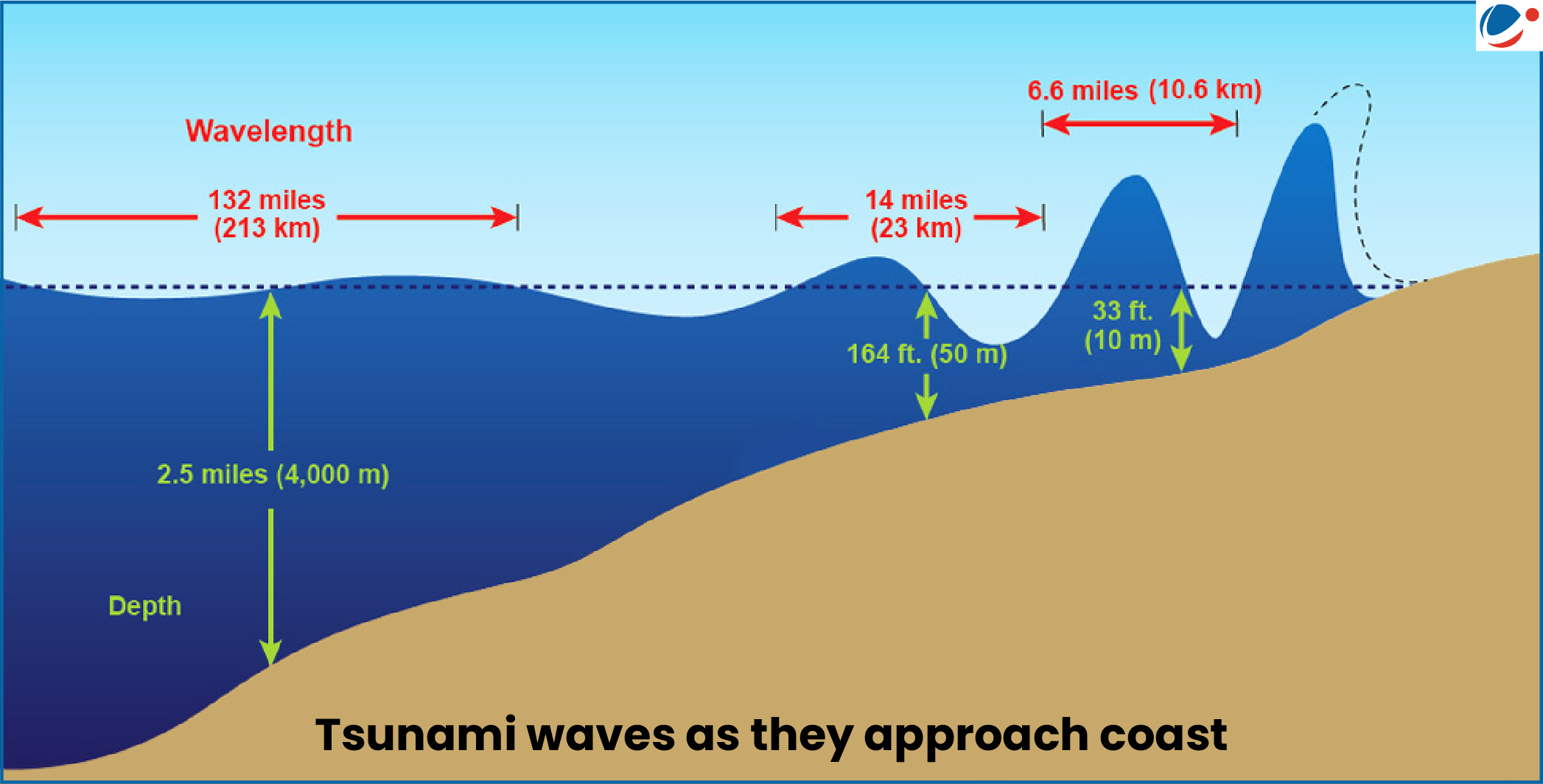
Diagram showing the transformation of tsunami waves as they move from deep ocean to shallow coastal waters. In deep water (2.5 miles or 4,000 meters depth), the wavelength is long (132 miles or 213 kilometers), and the wave height is minimal. As the waves approach shallower waters, their wavelength shortens to 14 miles (23 kilometers), and the wave height increases to 33 feet (10 meters). Closer to the coast, the wavelength further shortens to 6.6 miles (10.6 kilometers), and the wave height dramatically rises to 164 feet (50 meters). The image emphasizes the wave amplification due to decreasing depth.

Steps taken for Tsunami preparedness 

  • Globally 
    • UNESCO-IOC Tsunami Ready Recognition Programme: Voluntary, international community-based effort to bolster risk prevention across global coastal zones.
    • Tsunami United Programme: Flagship initiative of UNESCO to increase preparedness.
    • Global Tsunami Early Warning and Mitigation Programme: IOC-UNESCO Programme supports Member States in assessing tsunami risk, implementing Early Warning Systems etc.
  • India
    • Indian Tsunami Early Warning Centre (ITEWC): Established at Indian National Centre for Ocean Information Sciences, Hyderabad is national authority to issue tsunami advisories.
    • NDMA Guidelines on Management of Tsunamis in India.
    • Development of Apps and devices: E.g. GEMINI device for warnings and alerts in sea.
Watch Video News Today

Explore Related Content

Discover more articles, videos, and terms related to this topic

RELATED VIDEOS

3
News Today (Jun 25, 2024)

News Today (Jun 25, 2024)

YouTube HD
News Today (Apr 20-21, 2025)

News Today (Apr 20-21, 2025)

YouTube HD
News Today (Jul 23, 2025)

News Today (Jul 23, 2025)

YouTube HD
Title is required. Maximum 500 characters.

Search Notes

Filter Notes

Loading your notes...
Searching your notes...
Loading more notes...
You've reached the end of your notes

No notes yet

Create your first note to get started.

No notes found

Try adjusting your search criteria or clear the search.

Saving...
Saved

Please select a subject.

Referenced Articles

linked

No references added yet