Union Commerce Minister highlights lack of deep-tech innovation in Indian Startups | Current Affairs | Vision IAS
MENU
Home

Periodically curated articles and updates on national and international developments relevant for UPSC Civil Services Examination.

Quick Links

High-quality MCQs and Mains Answer Writing to sharpen skills and reinforce learning every day.

Watch explainer and thematic concept-building videos under initiatives like Deep Dive, Master Classes, etc., on important UPSC topics.

ESC

While appreciating growth of consumer-driven ventures (e.g. Food-delivery and Q-commerce apps) in India, minister highlighted lack of innovation in deep-tech startups. 

  • Deep-tech startups are high-risk, long-gestation ventures that leverage advanced technologies like AI/ML, block chain etc. to create novel solutions for complex problems. E.g. Skyroot Aerospace, Sarvam AI.
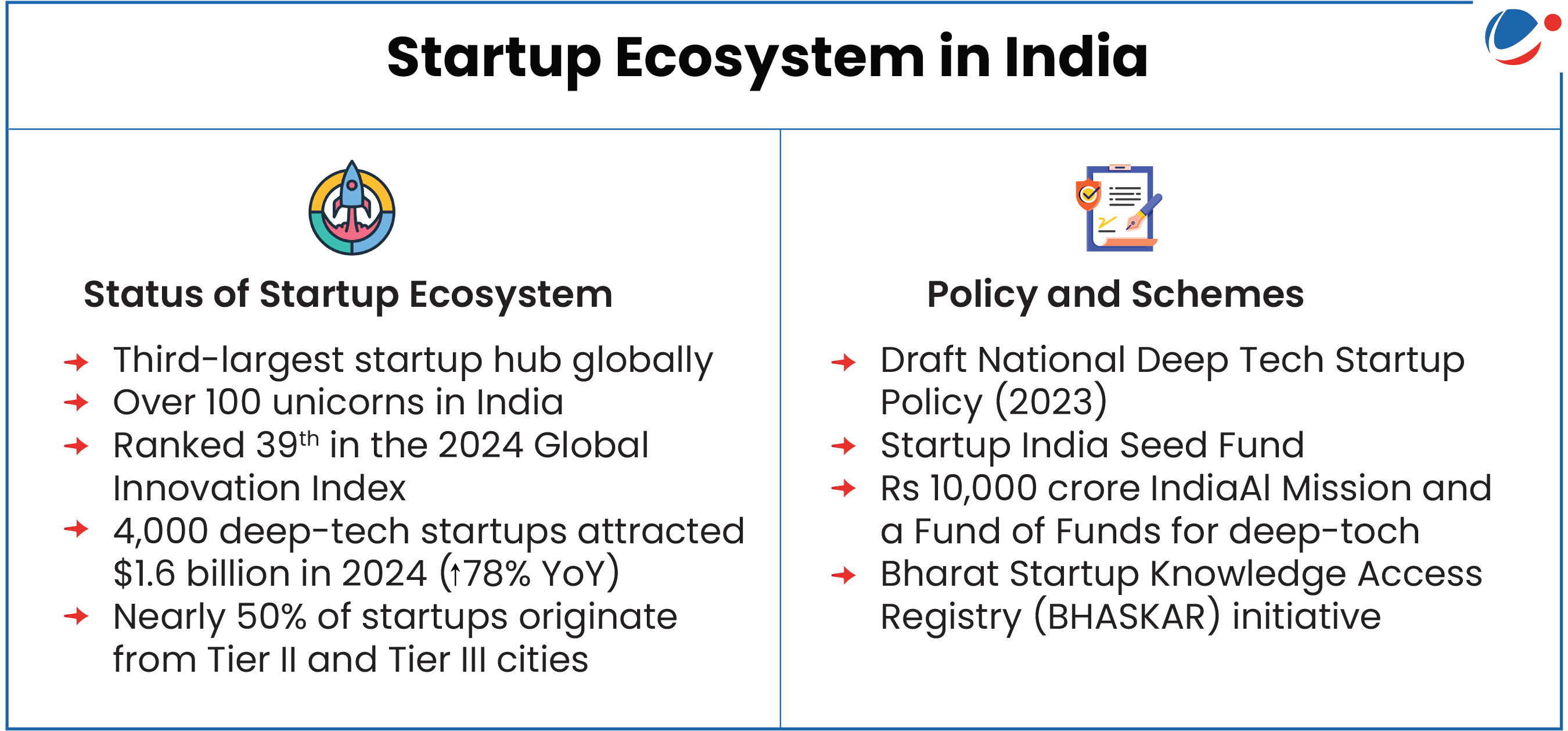
Infographic titled "Startup Ecosystem in India" is divided into two sections:  Status of Startup Ecosystem:  India is the third-largest startup hub globally.  Over 100 unicorns are present in India.  Ranked 39th in the 2024 Global Innovation Index.  4,000 deep-tech startups attracted $1.6 billion in 2024 (78% year-on-year increase).  Nearly 50% of startups originate from Tier II and Tier III cities.  Policy and Schemes:  Draft National Deep Tech Startup Policy (2023).  Startup India Seed Fund.  ₹10,000 crore IndiaAI Mission and a Fund of Funds for deep-tech.  Bharat Startup Knowledge Access Registry (BHASKAR) initiative.

Issues with the Startup ecosystem in India

  • Funding: Low government and private capital investment and a risk-averse investment culture stifle startups aiming to tackle complex problems. 
    • The total tech investment in India during 2014-2024 is estimated at $160 billion, against China’s $845 billion. 
    • India’s venture capital (VC) landscape prioritizes quick returns over patient capital.
  • Education and research infrastructure: Lag in ecosystem development due to subpar quality, lack of industry-academia linkages, lack of skilled workforce, brain drain etc.
  • Governance: Policy uncertainty and regulatory hurdles hinder ease of doing business. 
    • E.g. Access to credit, taxation and import barriers on raw materials, red tape and corruption in getting approvals etc.

Way Forward

  • Policy reforms: Provide grants/access to regulatory sandboxes to test prototypes, logistical support for commercialization, deep-tech focused skill development programs.
  • Investment promotion: Setting up deep-tech innovation funds; establish co-investment programs with VCs. 
  • Education reform: Promoting quality research by building strong academia-start-up bridges.

Watch Video News Today

Explore Related Content

Discover more articles, videos, and terms related to this topic

RELATED VIDEOS

3
News Today (Jan 16, 2025)

News Today (Jan 16, 2025)

YouTube HD
Circularity in Textile Structure

Circularity in Textile Structure

YouTube HD
Growth of Tier 2 and Tier 3 Cities in India

Growth of Tier 2 and Tier 3 Cities in India

YouTube HD
Title is required. Maximum 500 characters.

Search Notes

Filter Notes

Loading your notes...
Searching your notes...
Loading more notes...
You've reached the end of your notes

No notes yet

Create your first note to get started.

No notes found

Try adjusting your search criteria or clear the search.

Saving...
Saved

Please select a subject.

Referenced Articles

linked

No references added yet

Subscribe for Premium Features