
One Year of New Criminal Laws which Came into Force on 1st July 2024 | Current Affairs | Vision IAS
MENU
Home

Periodically curated articles and updates on national and international developments relevant for UPSC Civil Services Examination.

Quick Links

High-quality MCQs and Mains Answer Writing to sharpen skills and reinforce learning every day.

Watch explainer and thematic concept-building videos under initiatives like Deep Dive, Master Classes, etc., on important UPSC topics.

ESC

The three new criminal laws introduced with aim to make the justice system not only affordable, accessible, and approachable, but also simple, consistent, and transparent
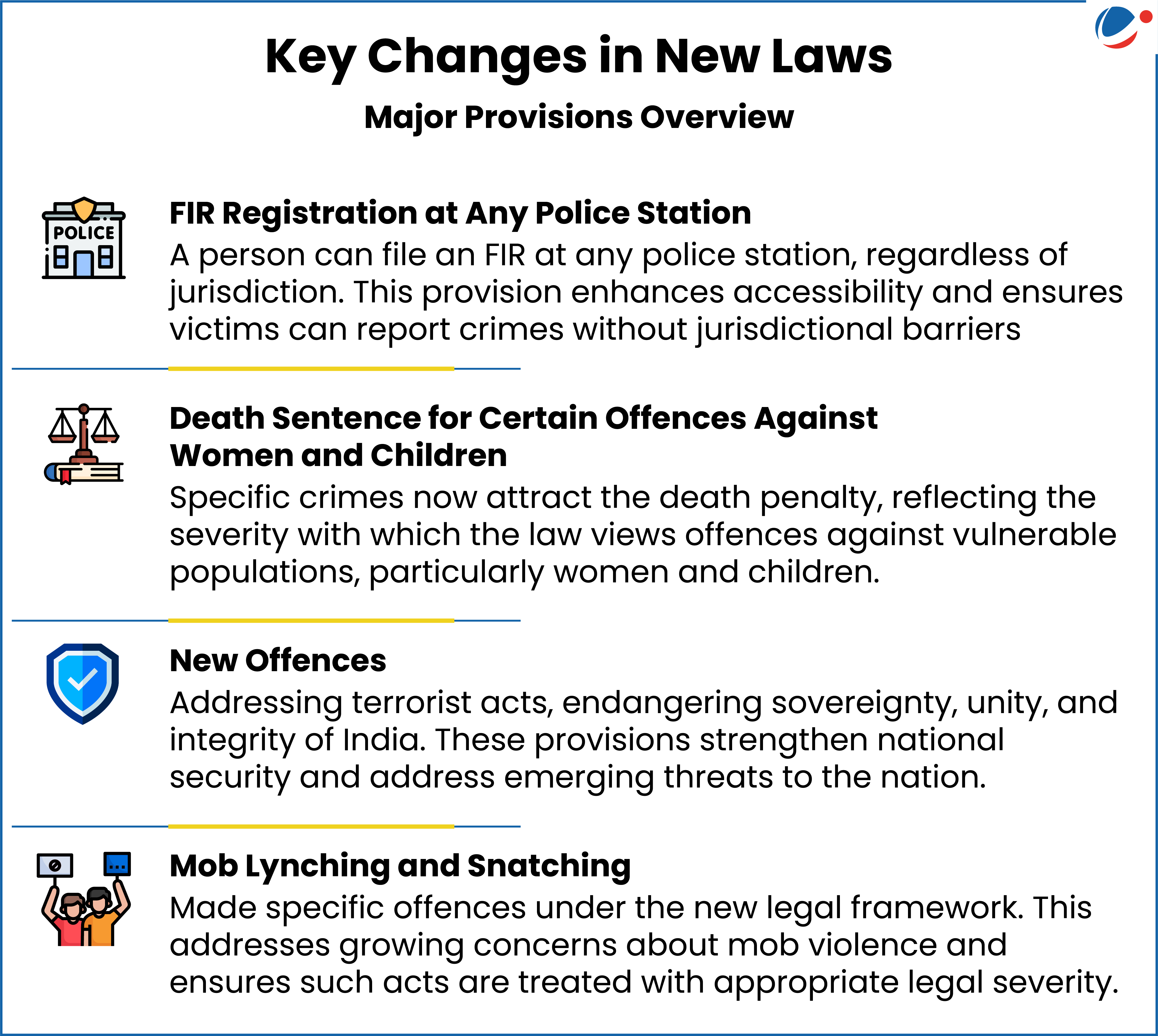
  • New Laws Replacing Colonial-Era Framework
  • Indian Penal Code (IPC, 1860): Bharatiya Nyay Sanhita, 2023 (BNS).
  • Criminal Procedure Code (CrPC, 1973): Bharatiya Nagarik Suraksha Sanhita, 2023 (BNSS).
  • Indian Evidence Act (1872): Bharatiya Sakshya Adhiniyam, 2023 (BSA).

Key Reforms in the Past One Year

  • Technology-Driven Justice System
    • e-Sakshya (e-evidence) and e-Summons notified in 11 States/UTs.
    • Nyaya Shruti (enables courts to hear witness testimonies via video conferencing) implemented in 6 States/UTs.
    • Crime and Criminal Tracking Network & Systems (CCTNS) network: Covers over 14,000 police stations, 22,000 courts are online.
  • Capacity Building and Training: 23 States/UTs have completed 100% capacity-building.
  • Community service introduced as a penalty in 12 States/UTs.

Challenges in Implementing the New Criminal Laws (BNS, BNSS, BSA)

  • lack of adequate infrastructural support: E.g., Several police stations, courts and prisons lack basic access to the internet and tools enabling digital access. 
  • BNSS sets justice timelines but lacks enforcement: E.g., 22% vacancies in police and district judiciary make deadlines hard to meet.
  • BNSS and BSA emphasize forensics, but implementation suffers: Due to 47% administrative and 49% scientific vacancies.

Key Supreme Court Judgments on BNS, BNSS

  • Case: Re-Inhuman Conditions In 1382 Prisons v. Director General of Prisons: Retrospective application of BNSS Section 479 (Undertrial Detention).
  • CaseBadshah Majid Malik v. Directorate of Enforcement: Granted bail under PMLA as the accused had served one-third of the maximum sentence under BNSS
  • Case: Re-Inhuman Conditions In 1382 Prisons: Jail authorities must identify eligible women prisoners for release under Section 479 BNSS.
Watch Video News Today

Explore Related Content

Discover more articles, videos, and terms related to this topic

RELATED VIDEOS

1
Lateral Entry

Lateral Entry

YouTube HD
Title is required. Maximum 500 characters.

Search Notes

Filter Notes

Loading your notes...
Searching your notes...
Loading more notes...
You've reached the end of your notes

No notes yet

Create your first note to get started.

No notes found

Try adjusting your search criteria or clear the search.

Saving...
Saved

Please select a subject.

Referenced Articles

linked

No references added yet

Subscribe for Premium Features