
Kavach is strengthening Railway Safety in India | Current Affairs | Vision IAS

Upgrade to Premium Today

Start Now
MENU
Home
Quick Links

High-quality MCQs and Mains Answer Writing to sharpen skills and reinforce learning every day.

Watch explainer and thematic concept-building videos under initiatives like Deep Dive, Master Classes, etc., on important UPSC topics.

ESC

In Summary

  • Kavach, an indigenous Automated Train Protection system, has been implemented on over 2,200 route km, significantly reducing train accidents.
  • Key safety features include preventing SPAD, all collision types, automatic horn activation, and real-time monitoring via UHF radio and RFID.
  • Other AI-driven initiatives include an Intrusion Detection System using DAS and predictive maintenance for enhanced railway safety.

In Summary

The Kavach system has now been implemented on more than 2,200 route kilometres, helping reduce train accidents sharply, from 135 in 2014–15 to 31 in 2024–25, and further to 11 in 2025–26.

About Kavach

  • It is an indigenously developed Automated Train Protection (ATP) system that provides Train Protection and Collision Prevention capabilities for trains.
  • Developed by: Research Designs & Standards Organization (RDSO) of Indian Railways.
  • Continuous improvements: Adopted as the National Automatic Train Protection (ATP) system in 2020, Kavach Version 4.0 approved in 2024.
    • Vande Bharat 4.0 is envisaged to incorporate Kavach 5.0
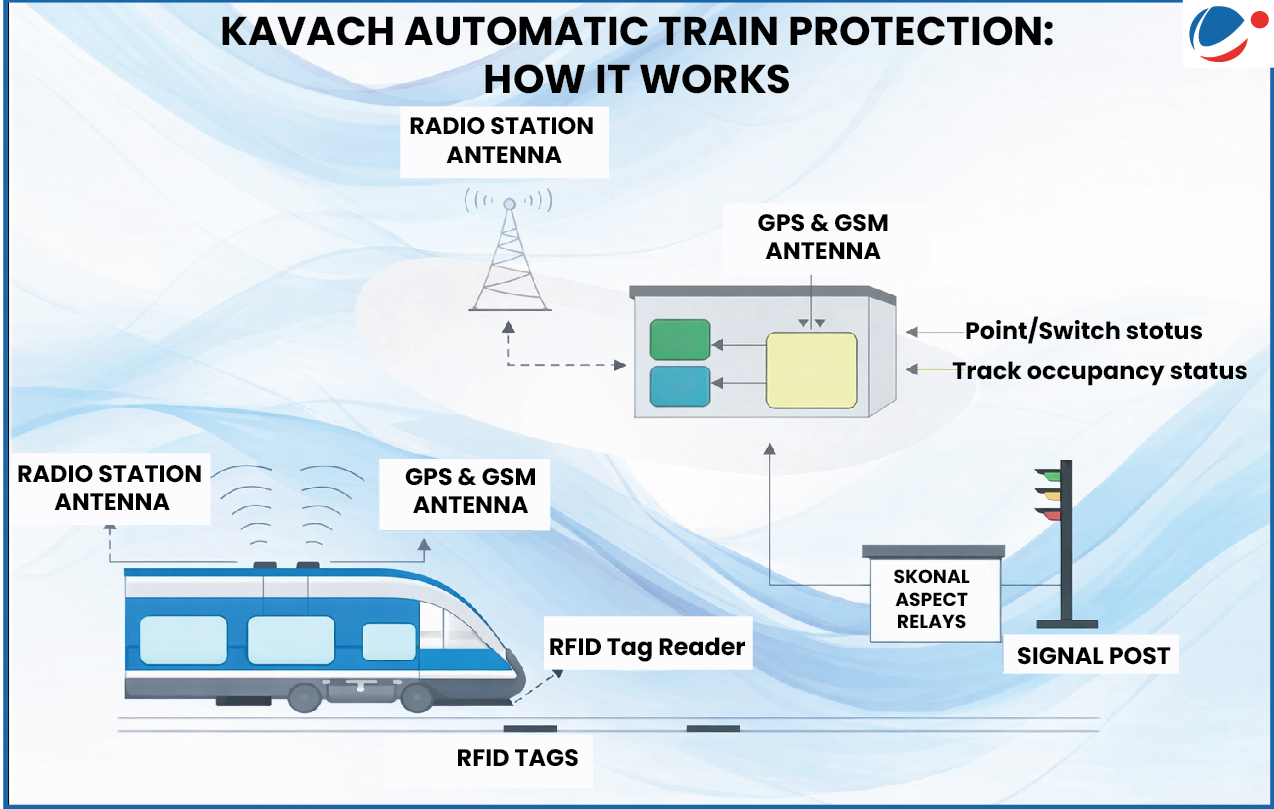
  •  Key Safety Features:
    • Detection and prevention of Signal Passing at Danger (SPAD): Automatically stops the train before the signal.
    • Cab signaling with display of movement authority, target distance, speed, and signal aspects.
    • Prevention of all types of train collisions: head-on, rear-end, and side-on.
    • Continuous real-time updates to the locomotive.
    • Automatic horn activation when approaching Level Crossing Gates.
    • Emergency Stop-on-Sight (SoS) messages in critical situations.
    • Centralized live monitoring of train movements through the Network Management System (NMS).
  • Working Principle: Continuous real-time communication between trackside systems and locomotives using secure Ultra High Frequency (UHF) radio antenna and track-mounted Radio Frequency Identification (RFID) tags.

Other Technology-led and AI Railway Safety Initiatives

  • AI-enabled Intrusion Detection System (IDS) based on Distributed Acoustic Sensing (DAS) technology to detect the presence of wild animals on railway tracks.
  • AI-driven Predictive Maintenance and Inspection Video Surveillance System (VSS),
  • GPS-based Fog Safety Device (FSD) etc.
Watch Video News Today

Explore Related Content

Discover more articles, videos, and terms related to this topic

RELATED VIDEOS

3
Sovereign AI | Paritosh Parmar Sir

Sovereign AI | Paritosh Parmar Sir

YouTube HD
Simplified: Virtual influencers revolutionizing creator marketing

Simplified: Virtual influencers revolutionizing creator marketing

YouTube HD
Simplified | Seeing is not Believing: The DeepFake Dilemma

Simplified | Seeing is not Believing: The DeepFake Dilemma

YouTube HD

RELATED TERMS

3

Fog Safety Device (FSD)

A GPS-based device used in railways to assist train drivers in maintaining safe speeds and adhering to signals, particularly in low visibility conditions like fog.

Distributed Acoustic Sensing (DAS)

A technology that uses fiber optic cables to detect vibrations and acoustic signals, enabling the identification of events like intrusions or ground movement along the cable's path.

AI-enabled Intrusion Detection System (IDS)

An artificial intelligence-powered system that uses sensors like Distributed Acoustic Sensing (DAS) to detect unauthorized presence, such as animals, on railway tracks.

Title is required. Maximum 500 characters.

Search Notes

Filter Notes

Loading your notes...
Searching your notes...
Loading more notes...
You've reached the end of your notes

No notes yet

Create your first note to get started.

No notes found

Try adjusting your search criteria or clear the search.

Saving...
Saved

Please select a subject.

Referenced Articles

linked

No references added yet
