


The test was conducted by DRDO with the ISRO and Aerial Delivery Research and Development Establishment.
- The test proves India’s expertise in designing and manufacturing of high strength ribbon parachutes.
- Crew Escape System (CES): CES is a safety mechanism designed to save the astronauts’ lives if something goes wrong during launch.
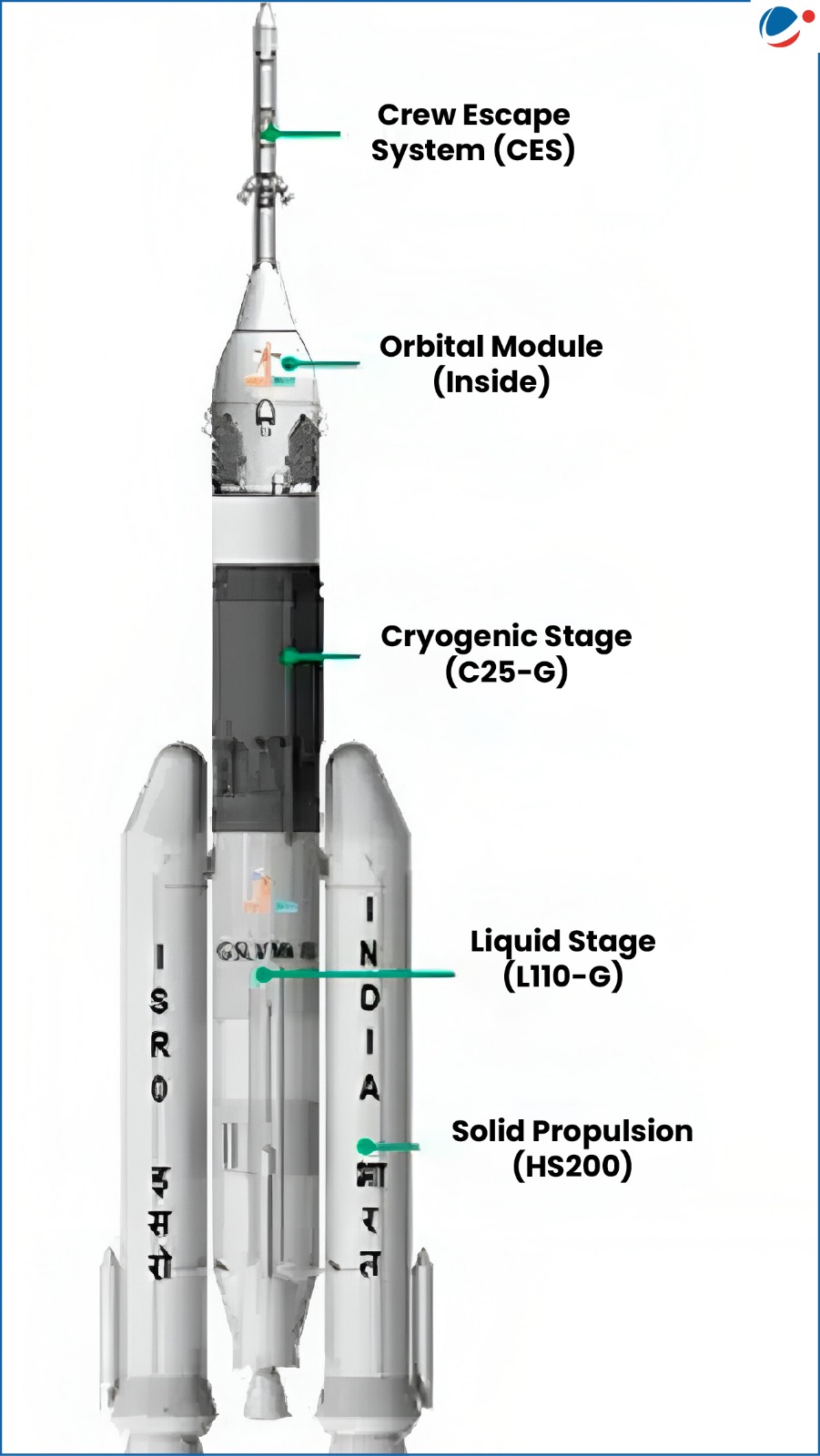
About Gaganyaan Mission
- Objective: Demonstration of human spaceflight capability by launching a crew of 3 members to a Low Earth Orbit of 400 km for a 3 days mission and bringing them back safely to earth, by landing in Indian sea waters.
- Components of the Mission
- Human Rated Launch Vehicle (HLVM-3): Formerly known as the GSLV Mk-III, it is a three-stage rocket:
- First stage: Two solid-fuel boosters strapped to the rocket core.
- Second stage: Powered by two liquid-fuelled, clustered Vikas 2 engines.
- Third stage: Equipped with the CE-20 indigenous cryogenic engine, using liquid hydrogen and liquid oxygen as fuel and oxidiser, respectively.
- The Orbital Module: two main parts
- Crew module: Include environmental control and life support systems (ECLSS), parachutes.
- Service module: An unpressurised bus carrying propulsion, power, thermal radiators, and water and oxygen tanks.
Significance of the Gaganyaan Mission for India
|




