
Union Finance Minister launches National Monetisation Pipeline 2.0 (NMP 2.0) | Current Affairs | Vision IAS

Upgrade to Premium Today

Start Now
MENU
Home
Quick Links

High-quality MCQs and Mains Answer Writing to sharpen skills and reinforce learning every day.

Watch explainer and thematic concept-building videos under initiatives like Deep Dive, Master Classes, etc., on important UPSC topics.

A short, intensive, and exam-focused programme, insights from the Economic Survey, Union Budget, and UPSC current affairs.

ESC

In Summary

  • NITI Aayog's National Monetisation Pipeline (NMP) 2.0 targets ₹16.72 lakh crore from 12 sectors by FY30, focusing on core public assets.
  • NMP 1.0 aimed for ₹6 lakh crore (FY22-FY25) and has achieved 90% of its target, with highways, railways, and power being key sectors.
  • Asset monetisation leverages existing infrastructure to generate revenue without increasing fiscal pressure, utilizing models like DBFOT for private sector investment.

In Summary

This second phase, developed by NITI Aayog is based on ‘Asset Monetisation Plan 2025-30’ announced in Union Budget 2025-26.

  • Asset monetisation involves leveraging existing or under-utilised infrastructure assets to generate revenue, without additional fiscal pressure on Government. 

Key Highlights of NMP 2.0

  • Purpose: Offers medium-term roadmap for public asset owners; along with visibility on potential assets to private sector.
  • Aggregate Monetisation Potential: Estimated at ₹16.72 lakh crore (including private sector investment of ₹5.8 lakh crore) belonging to 12 sectors, during 5 years (FY26-FY30). 
    • Sectors: Highways (including MMLPs, ropeways) (26%), power (17%), railways (16%),  ports (16%), petroleum and natural gas, civil aviation, warehousing and storage, urban infrastructure, coal, mines, telecom and tourism.
  • Proceeds Under NMP 2.0: Largest portion is accrued to Consolidated Fund of India, followed by direct investment (private), PSU or Port Authority allocation and State Consolidated Fund.
  • Guiding Principles for Considering Assets for Monetisation:
    • Core Vs non-core assets: In line with NMP 1.0, NMP 2.0 focuses on core assets (central to service objectives of Government) only.
      • Monetisation of non-core assets (land, building, pure play real estate assets), has been included where project envisages further development on these assets.
    • Investment by private sector in PPP projects: Models like Design-Build-Finance-Operate-Transfer (DBFOT) has been considered. 
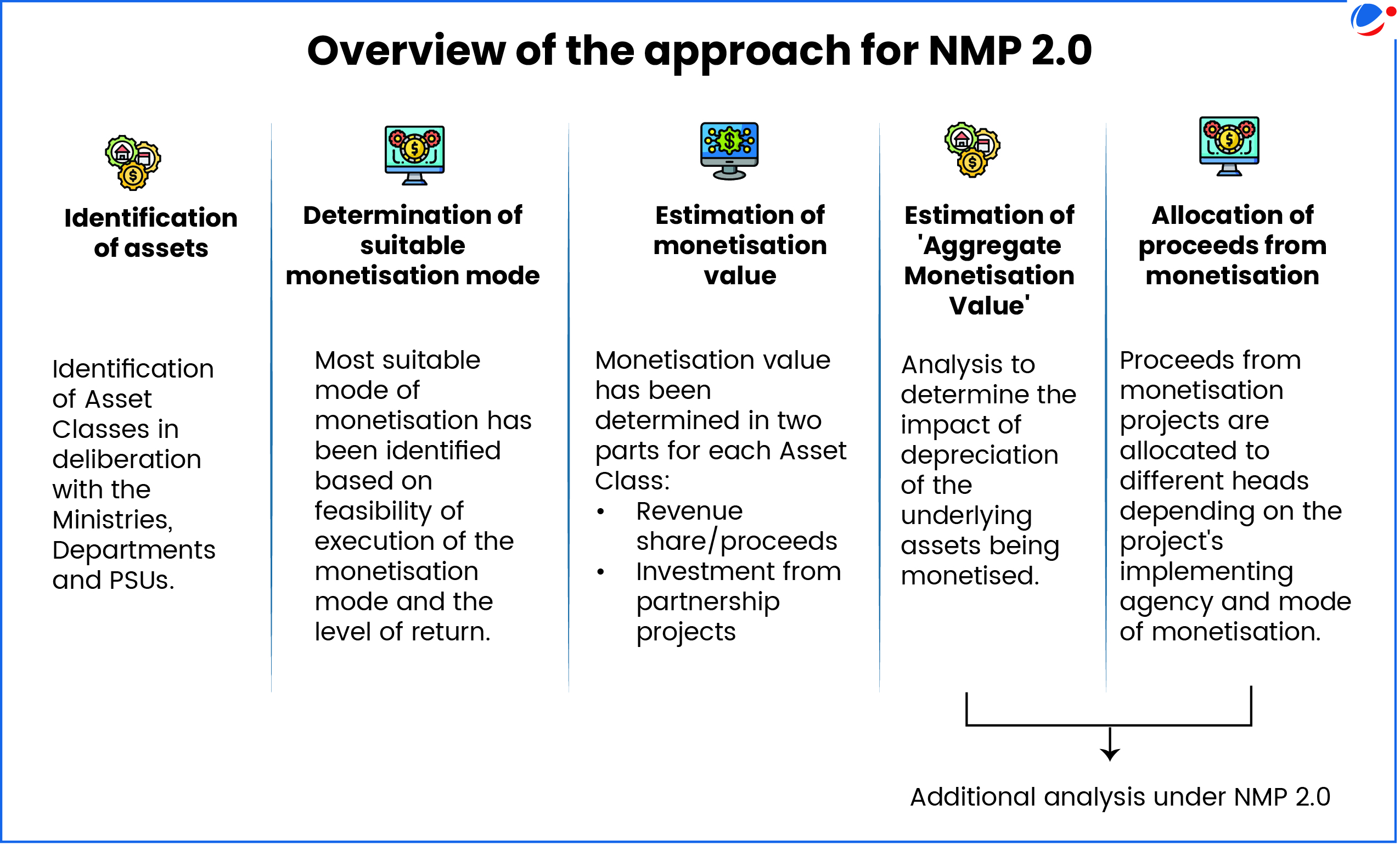
  • Stages of Asset Monetisation: Approach towards estimation of monetisation potential is divided into five stages (See infographic):
About NMP 1.0

  • Estimated aggregate asset monetisation pipeline target of INR 6 Lakh Crore over FY22 to FY25. 
    • Presently, achieved around 90% of its target.
  • Sectors (13): Highways, railways, power petroleum and natural gas pipelines, and telecom accounted for 72% of total target. 
Tags:
Watch Video News Today

Explore Related Content

Discover more articles, videos, and terms related to this topic

RELATED VIDEOS

3
News Today (Feb 24, 2026)

News Today (Feb 24, 2026)

YouTube HD
Circularity in Textile Structure

Circularity in Textile Structure

YouTube HD
Weekly Focus | India's Natural Wealth

Weekly Focus | India's Natural Wealth

YouTube HD

RELATED TERMS

3

NMP 1.0

The first phase of the National Monetisation Pipeline, which set an aggregate asset monetization pipeline target for FY22 to FY25.

DBFOT

Design-Build-Finance-Operate-Transfer. An expanded PPP model where the private partner is responsible for the design, construction, financing, operation, and eventual transfer of the infrastructure asset.

Non-core assets

Assets that are not central to the government's service objectives, such as land, buildings, or pure play real estate, which may be considered for monetization if they involve further development.

Title is required. Maximum 500 characters.

Search Notes

Filter Notes

Loading your notes...
Searching your notes...
Loading more notes...
You've reached the end of your notes

No notes yet

Create your first note to get started.

No notes found

Try adjusting your search criteria or clear the search.

Saving...
Saved

Please select a subject.

Referenced Articles

linked

No references added yet
