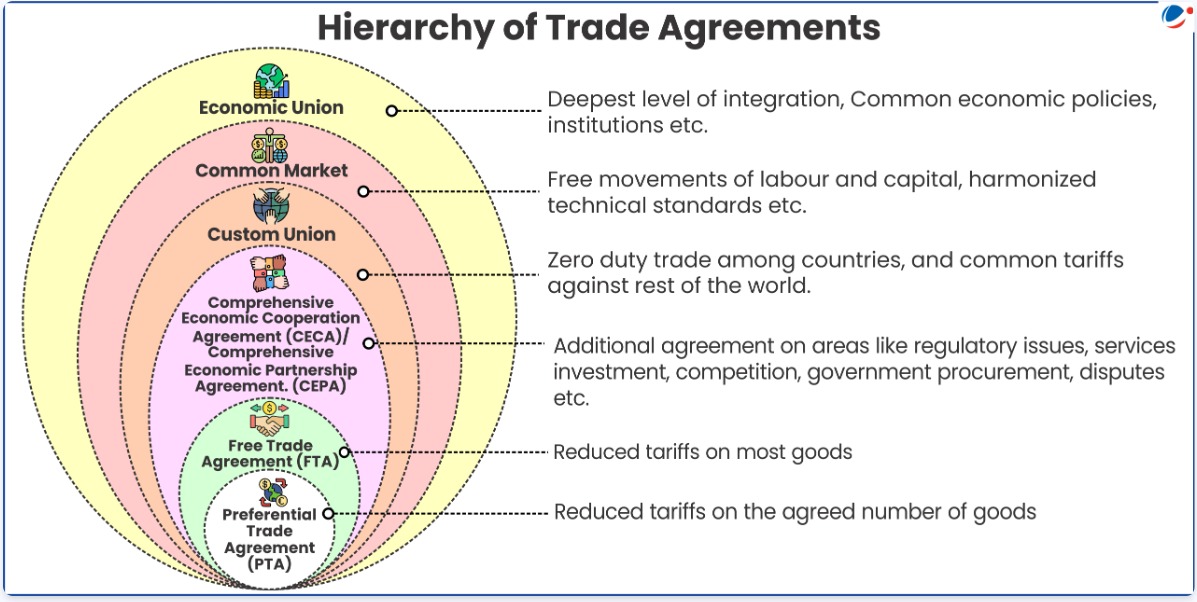
As of 2025, India has various active Free Trade Agreements (FTAs) providing India preferential trade access to nearly two-thirds of global trade.
About FTAs
- FTAs: FTAs are legally binding treaties between two or more countries aimed at reducing or eliminating trade barriers, such as tariffs, quotas, and restrictions on imports and exports.
- These agreements often include provisions for trade facilitation, intellectual property rights, and investment protections.
- India’s FTA partners: US, UK, Australia, UAE, Oman, New Zealand, Japan, Singapore, South Korea, Sri Lanka, Nepal, Bhutan, Thailand, and Malaysia.
- Regional Groupings include European Union, European Free Trade Association (EFTA), ASEAN, and SAARC.
- Ongoing FTA Negotiations: Gulf Cooperation Council (GCC), Israel, Chile, Canada, Peru, Bangladesh, Maldives, Qatar, Eurasian Economic Union (EAEU), Bahrain.
Significance of FTAs
- Trade Diversification: FTAs will enable India to geographically diversify its export and import markets, increase the value of its exports, and lower import barriers.
- Integration of Indian Industry: Better integrate India into global supply chains, increase the competitiveness of Indian businesses in developed markets, and create jobs.
- Geopolitical Strategy: They help to build broader trust with partners and contribute to multi-aligned foreign policy.
- Optimum Resource Utilization: Under FTA, each country produces those goods in which it has the best advantages.