


Sapien Labs, a not-for-profit organization released the Global Mind Health 2025 report under its Global Mind Project.
- Report is based on Mind Health Quotient (MHQ) which encompasses all aspects of mental function, emotional, cognitive, and social as well as drive and resilience.
Key findings related to India
- Young adults (18-34) with a MHQ score of 33 (global MHQ - 66.), rank 60th globally in mental health and well-being.
- In contrast, Indians aged 55 and above score 96, ranking 49th globally.
- Ultra-processed food consumption, associated with increased depression and diminished emotional and cognitive control, among the 18-34 age group is 44%.
Article Sources
1 sourceIndia expressed support for negotiations on a Fissile Material Cut-off Treaty (FMCT) based on the mandate within 2026 High-Level Segment of the Conference on Disarmament (CD) in Geneva.
- FMCT is a proposed international agreement that would prohibit the production of the two main components of nuclear weapons: Highly-Enriched Uranium (HEU) and plutonium.
About CD
- CD was recognized by the Tenth Special Session on Disarmament of the United Nations General Assembly (1978) as a single multilateral disarmament negotiating forum.
- The Conference comprises 65 member States including India.
The Intergovernmental Oceanographic Commission (IOC) of UNESCO released Integrated Ocean Carbon Research (IOC-R), 2026 report.
About IOC
- Objective: To promote international cooperation and to coordinate programmes in research, services and capacity-building in order to learn more about Oceans.
- Members: 152 (India is a member).
- Secretariat: Paris, France.
Key Highlights of Report
- Carbon Sink: Oceans absorb excess atmospheric CO₂, reducing greenhouse gas concentration.
- Solubility Pump: Cold ocean waters dissolve CO₂ and transport it to deep ocean layers for long-term storage.
- Land–Ocean–Ice Exchange: Oceans exchange carbon with rivers and melting ice, influencing global carbon distribution.
Article Sources
1 sourceKaziranga Waterbird Estimation conducted across Kaziranga–Laokhowa–Burhachapori floodplain complex reaffirms it as one of the important nodes within the Central Asian Flyway.
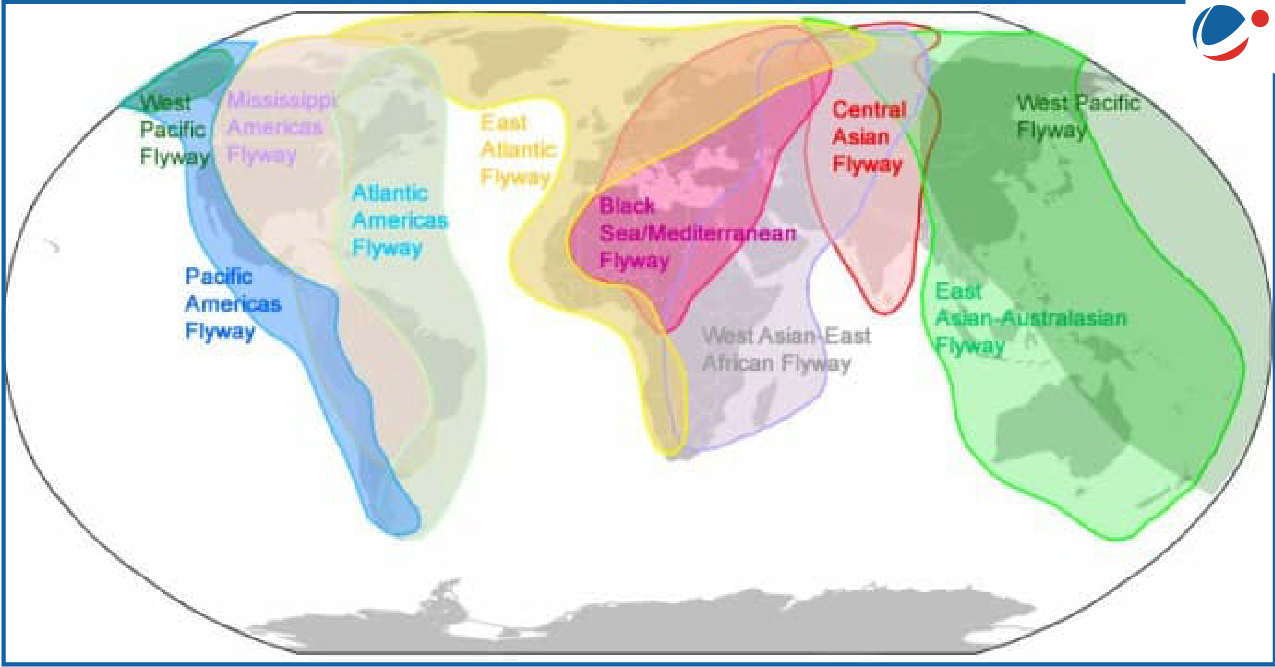
- Laokhowa and Burhachapori Wildlife Sanctuaries lie on the southern bank of Brahmaputra River. It is a notified buffer of the Kaziranga Tiger Reserve.
- They are surrounded by Kaziranga National Park (NP) (east), Orang NP and Pobitora WS (west), Pakke-Nameri NPs (north).
About Central Asian Flyway (CAF)
- The CAF comprises several important migration routes of waterbirds; is home to 605 migratory bird species.
- It extends across the central Eurasia, between the Arctic and Indian Oceans, spanning 30 countries.
- It overlaps with the African–Eurasian and East Asian–Australasian flyways.
Palamu Tiger Reserve launches 'Vanjeevi Didi' initiative for women to protect wildlife.
- The programme identifies and trains educated women to act as a bridge between the forest administration and local families.
About PTR
- Location: Located in the western Latehar district on the Chhotanagpur plateau in Jharkhand.
- It is one of the first 9 tiger reserves created in the country at inception of ‘Project Tiger’.
- Betla National Park is part of the core area of Palamau Tiger Reserve.
- Flora: Dominated by Northern Tropical Dry Deciduous Sal (Shorea robusta) forest, bamboo groves etc.
- Fauna: Tiger, Asiatic Elephant, Leopard, Grey wolf, etc.
- Rivers: Koel, Burha and Auranga.
The Union Minister for Environment, Forest and Climate Change inaugurated The Energy Research Institute (TERI’s) 25th edition World Sustainable Development Summit (WSDS) and Him-CONNECT.
- The theme of the summit is “Transformations: Vision, Voices, and Values for Sustainable Development.
About Him-CONNECT
- Aim: To creates a bridge between science and society by connecting researchers working in the Himalayan region with start-ups, industry leaders, investors and policymakers.
- A dedicated platform by MoEFCC to translate research supported under the Ministry's National Mission on Himalayan Studies (NMHS) into solutions that can be implemented at scale.
An institute of the Department of Science and Technology has synthesised a novel biosurfactant with promising antibacterial and cleansing properties.
About Biosurfactant
- They are surface-active molecules produced by various microorganisms, including bacteria, yeasts, and fungi.
- They have unique ability to reduce surface and interfacial tension between liquids, solids, and gases.
- Unlike synthetic surfactants derived from petroleum, biosurfactants are biodegradable, environmentally friendly, and often less toxic.
- Potential Applications: Bioremediation, health and medicine, foaming agents in shampoos, food processing etc.
Article Sources
1 sourceResearch showed that timings and locations of the moist heatwaves are controlled by the active and break periods of the southwest monsoon (SWM) and can be predicted weeks in advance.
About Moist Heatwave
- Moist heatwaves are triggered by a combined impact of high temperatures and elevated humidity levels in the atmosphere.
- They can be fatal because high humidity prevents sweat from evaporating, trapping heat inside your body and causing it to overheat rapidly.
- The best way to measure the combined effect of humidity and temperature is ‘wet bulb temperature’.
- Wet bulb temperature is the lowest temperature to which air can be cooled by the evaporation of water into the air at constant pressure.
