
NITI Aayog’s report on Natural Farming | Current Affairs | Vision IAS

Upgrade to Premium Today

Start Now
MENU
Home
Quick Links

High-quality MCQs and Mains Answer Writing to sharpen skills and reinforce learning every day.

Watch explainer and thematic concept-building videos under initiatives like Deep Dive, Master Classes, etc., on important UPSC topics.

A short, intensive, and exam-focused programme, insights from the Economic Survey, Union Budget, and UPSC current affairs.

ESC

In Summary

  • NITI Aayog released a toolkit on natural farming, a chemical-free, livestock-based system enhancing biodiversity and ecological harmony.
  • Natural farming offers economic benefits like reduced costs (5-55%) and higher net incomes (20-40%), alongside environmental gains like lower GHG emissions (55-85%) and water savings (50-60%).
  • Initiatives like BPKP, NMNF, PM PRANAM, SATAT, and GOBARDHAN promote natural farming, aiming to bring 1 crore farmers under its fold and establish Bio-Input Resource Centres.

In Summary

NITI Aayog has published a report titled “Empowering Farmers: Natural Farming Training Toolkit & Best Practices Guide.”

About Natural Farming

  • It is a chemical-free, livestock-based farming system rooted in ecological principles.
    • This method integrates crops, trees, and animals to maximise biodiversity, thereby maintaining environmental harmony. 
  • It relies on the natural processes occurring within and around the farm, eliminating the need for external chemical inputs.
    • This distinguishes it from organic farming, which permits the use of externally sourced, certified organic fertilizers and bio-pesticides.

Benefits of Natural Farming:
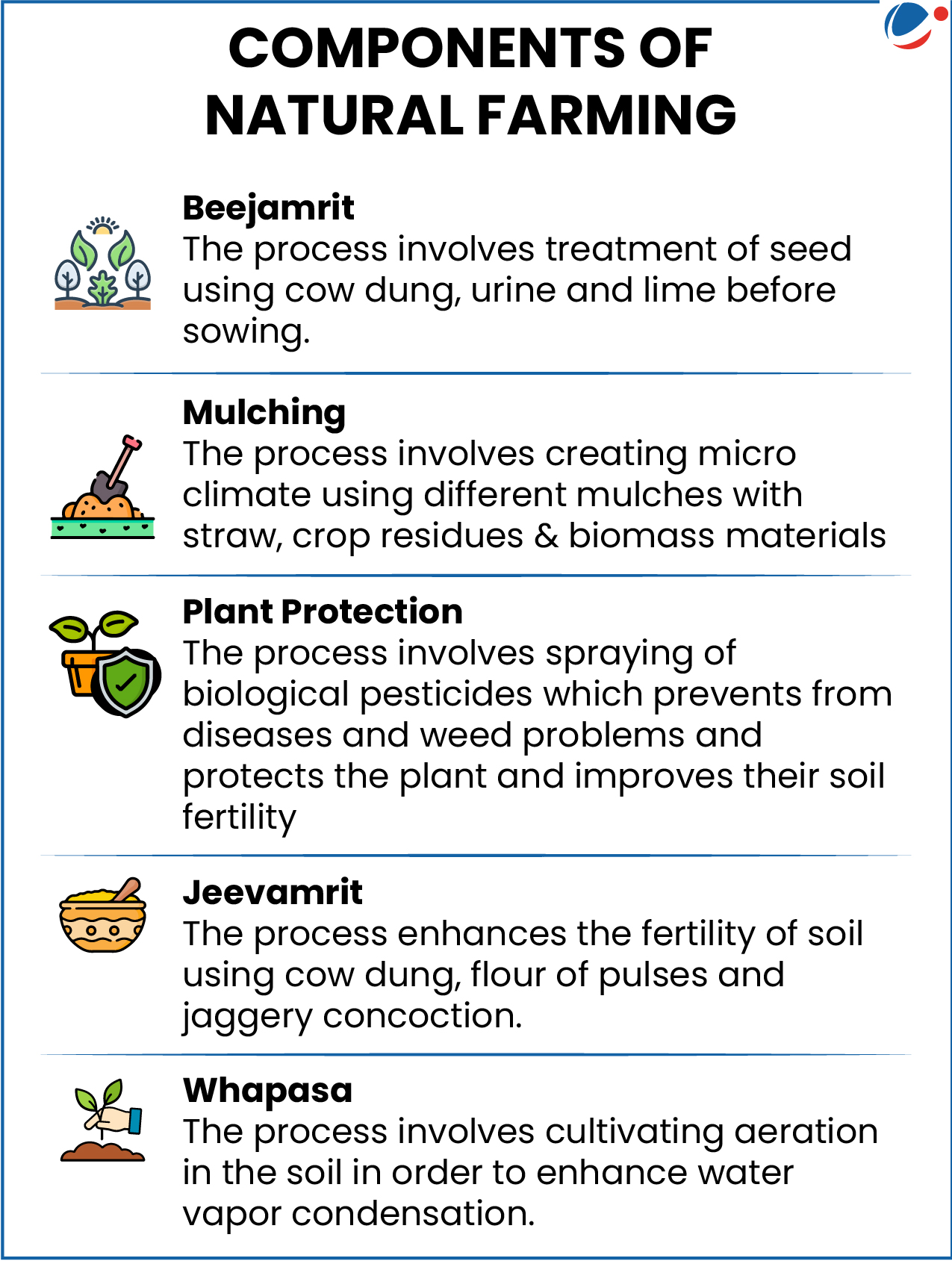
Map showing Components of Natural farming
  • Economic Benefits: Reduces the paid-out cost of cultivation by at least 5-10% across major crops, and up to 20-55% in several cases. 
    • Diversified natural farms can earn 20-40% higher net incomes compared to monocropped conventional farms. 
  • Environmental & Ecological: Lowers greenhouse gas (GHG) emissions by 55-85%. 
    • It significantly conserves resources, resulting in 50-60% savings in water and electricity.
  • Soil Health & Resilience: Increases Soil Organic Carbon (SOC) by up to 45% and boosts beneficial soil microorganisms. 
    • Improved soil health leads to stronger root development.
  • Health & Nutritional Security: Protects the health of farmers and consumers by completely avoiding synthetic pesticides and fertilizers.
  • Livestock Integration: Makes livestock economically viable by integrating them directly into the agroecological farming system, where their by-products (dung and urine) are utilized for on-farm inputs.

National-Level Initiatives to Promote Natural Farming

  • Bharatiya Prakritik Krishi Paddhati (BPKP): Launched as a sub-scheme under Paramparagat Krishi Vikas Yojana (PKVY).  
  • National Mission on Natural Farming (NMNF): A ₹2,481 crore initiative to bring 1 crore farmers under natural farming, while supporting the establishment of 10,000 Bio-Input Resource Centres (BRCs) and strengthening certification processes.
  • Other major government schemes supporting the transition from chemical to natural farming include PM PRANAM, SATAT (Sustainable Alternative Towards Affordable Transportation), and GOBARDHAN (Galvanizing Organic Bio Agro Resources Dhan). 
Watch Video News Today

Explore Related Content

Discover more articles, videos, and terms related to this topic

RELATED VIDEOS

2
Carbon Markets

Carbon Markets

YouTube HD
What is Artificial Rain? | Deep Dive With VisionIAS

What is Artificial Rain? | Deep Dive With VisionIAS

YouTube HD

RELATED TERMS

3

GOBARDHAN (Galvanizing Organic Bio Agro Resources Dhan)

A scheme focused on converting animal dung and other organic waste into biogas and bio-fertilizers, promoting a circular economy in rural areas and supporting the integration of livestock in farming systems as advocated by natural farming.

SATAT (Sustainable Alternative Towards Affordable Transportation)

An initiative by the government to promote the production and use of Compressed Bio-Gas (CBG) from agricultural waste and other organic matter, which can indirectly support natural farming by creating value for agricultural by-products.

PM PRANAM

A government scheme that aims to reduce the use of chemical fertilizers by promoting alternative fertilizers and sustainable agricultural practices, thereby supporting the transition to natural farming.

Title is required. Maximum 500 characters.

Search Notes

Filter Notes

Loading your notes...
Searching your notes...
Loading more notes...
You've reached the end of your notes

No notes yet

Create your first note to get started.

No notes found

Try adjusting your search criteria or clear the search.

Saving...
Saved

Please select a subject.

Referenced Articles

linked

No references added yet