


Union Cabinet approved the continuation of IVFRT Scheme from April 2026 to March, 2031.
About IVFRT Scheme
- Ministry: Ministry of Home Affairs under the National e-Governance Plan (NeGP)
- Objective: Modernize Immigration and Visa services and facilitates legitimate travellers while strengthening national security.
- Focus Areas: Emerging technology innovations, Transformation of core infrastructure, and Technology and service optimization.
- Integrates immigration, visa issuance, registration of foreigners and tracking of their movements in India.
- Significance: Boosting tourism, international business, 100% contactless and faceless visa process, national security etc.
Article Sources
1 sourceIndian Railways approved extension of KAVACH system across multiple zones.
About KAVACH (Automated Train Protection (ATP) system)
- It is a Train Collision Avoidance System (TCAS) that prevents collisions by automatically applying brakes if 2 trains are on a collision course.
- Developed by: Research Designs & Standards Organization (RDSO) of Indian Railways.
- Key features
- Continuous real-time updates to the locomotive.
- Prevention of all types of train collisions: head-on, rear-end, and side-on. (loco to loco communications)
- Prevents Signal Passing at Danger
- Others: Repeats line-side signal for foggy weather, Automatic horn activation, Emergency Stop-on-Sight (SoS) messages
Article Sources
1 sourceIran fired Qader cruise missiles at the USS Abraham Lincoln aircraft carrier.
About Quader cruise missile
- Qader is a medium-range shore-based anti-ship cruise missile developed by Iran.
- It is an upgraded version of the Noor Missile with a reported range of 120-300 kilometres.
International Institute for Environment and Development (IIED) published the IIED Food Security Index.
- The Index evaluates how climate change impacts the "four pillars" of food security: availability, accessibility, utilization, and sustainability.
Key Highlights
- India ranks among the most vulnerable large economies to food insecurity as global temperatures rise.
- India is positioned as most concerning in the Food security Index.
- India’s food security score could fall sharply under 1.5°C and 2°C (15% drop) warming scenarios, pushing it closer to the "critically insecure" category.
- Rising temperatures could widen the gap between richer and poorer countries’ ability to secure food.
Indian private space startup Agnikul Cosmos has reached a major milestone by successfully test-firing Agnite Engine.
About Agnite Engine
- Agnite is the world's largest single-piece 3D-printed booster engine.
- Agnite and Agnilet are Agnikul’s 3D-printed semi-cryogenic engines.
- It is made using Inconel.
- Inconel is a high-performance alloy specifically designed to endure extreme temperatures.
- The Agnite engines are built to power the booster stage of Agnikul's Agnibaan launch vehicle.
An IIT Gandhinagar study predicts a roughly 3.5% decrease in the Cauvery's water flow between the years 2026 and 2050.
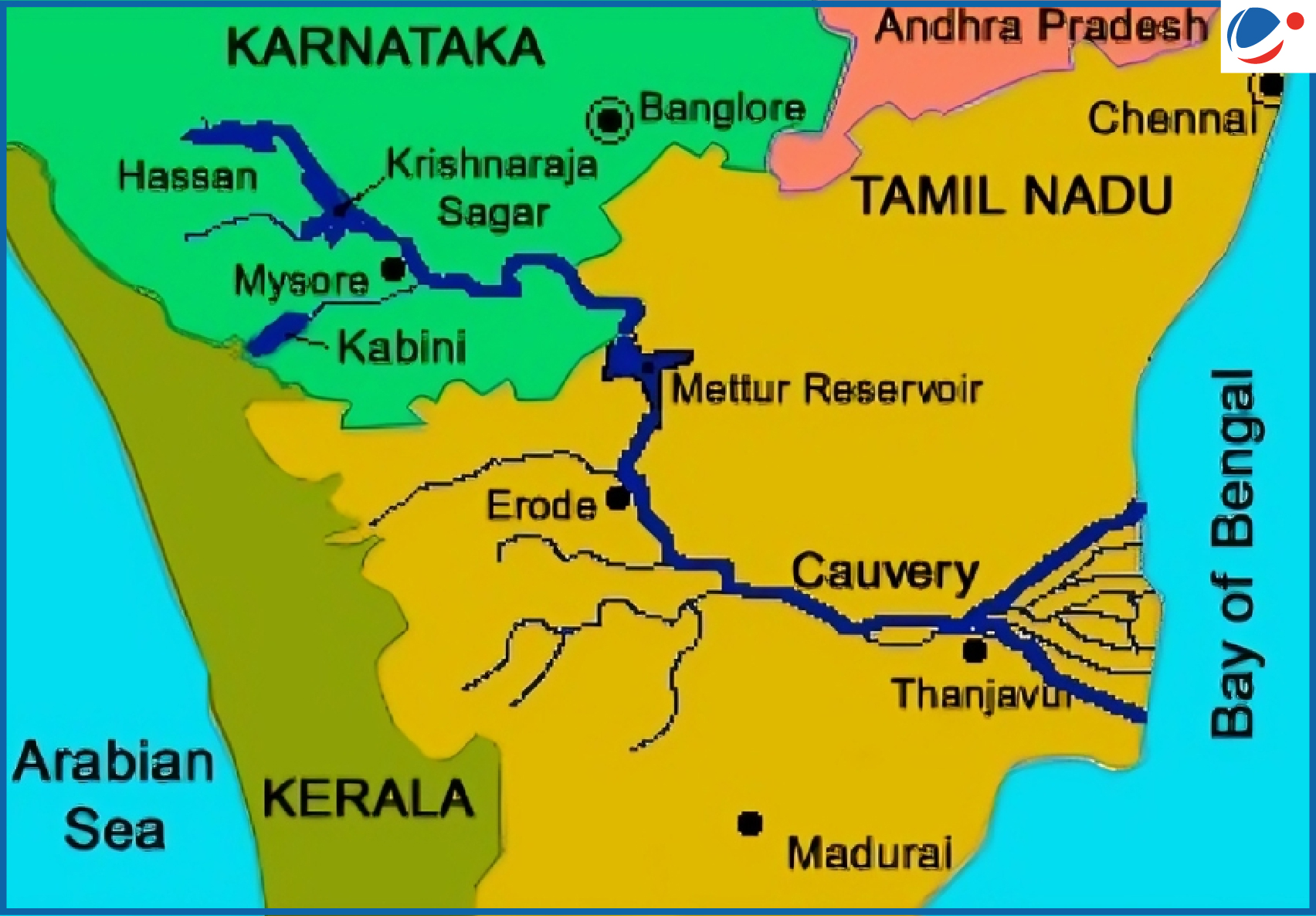
About Cauvery River
- Origin: Talakaveri in Coorg (Karnataka) in Brahmagiri Range of hills in the Western ghats.
- Drainage Area: extends over states of Tamil Nadu, Karnataka, Kerala and Union Territory of Puducherry (2.7% of the total geographical area of the country).
- Total Length: ~ 800 kms.
- Left Bank Tributaries: Harangi, Hemavati, Shimsha and Arkavati.
- Right bank Tributaries: Lakshmantirtha, Kabbani, Suvarnavati, Bhavani, Noyil and Amaravati.
- Major Waterfalls: Shivanasamudra Falls, Hogenakkal Falls.
- Major Dams: Krishnarajasagar in Karnataka, Mettur Dam in Tamil Nadu.
Researchers have developed CALM-Brain, a first-of-its-kind digital repository of data in India on brain structure and function from a range of psychiatric disorders.
About CALM-Brain
- CALM-Brain collects clinical, neuro-imaging, behavioural, genetic and other datasets on five disorders – addiction, bipolar disorder, dementia, obsessive compulsive disorder (OCD) and schizophrenia.
- It was initiated as part of the Accelerator program for Discovery in Brain disorders using Stem cells (ADBS project) jointly funded by the Department of Biotechnology and the Pratiksha Trust.
- It will be made open source helping clinicians and researchers to better understand disease onset, progression and underlying biological changes leading to disease symptoms.
A Study shows Rising sea surface temperatures in coastal waters are leading to 50–64% rise humid heatwaves over land, aggravated by atmospheric Rossby wave trains.
- Humidity spikes wet bulb temperature which above 31.5°C is harmful as the body is no longer able to cool itself by sweating.
- Wet-bulb temperature is the lowest temperature to which air can be cooled by the evaporation of water.
About Rossby Waves
- They are huge, undulating movements of the atmosphere that stretch horizontally across the planet in a westward direction.
- They are triggered by Earth's rotation and ocean-land temperature differences.
- Stalled Rossby winds trap hot, humid air over the region, leading to heatwaves.

