
Lok Sabha passes Insolvency & Bankruptcy Code Amendment Bill, 2025 | Current Affairs | Vision IAS

Upgrade to Premium Today

Start Now
MENU
Home
Quick Links

High-quality MCQs and Mains Answer Writing to sharpen skills and reinforce learning every day.

Watch explainer and thematic concept-building videos under initiatives like Deep Dive, Master Classes, etc., on important UPSC topics.

A short, intensive, and exam-focused programme, insights from the Economic Survey, Union Budget, and UPSC current affairs.

ESC

In Summary

  • Bill amends Insolvency and Bankruptcy Code 2016 to reduce delays and improve insolvency resolution.
  • Introduces Group Insolvency Framework, Cross-Border Insolvency Framework, and reinforces the 'clean-slate principle'.
  • Sets strict timelines for NCLT admission (14 days) and NCLAT appeals (3 months).

In Summary

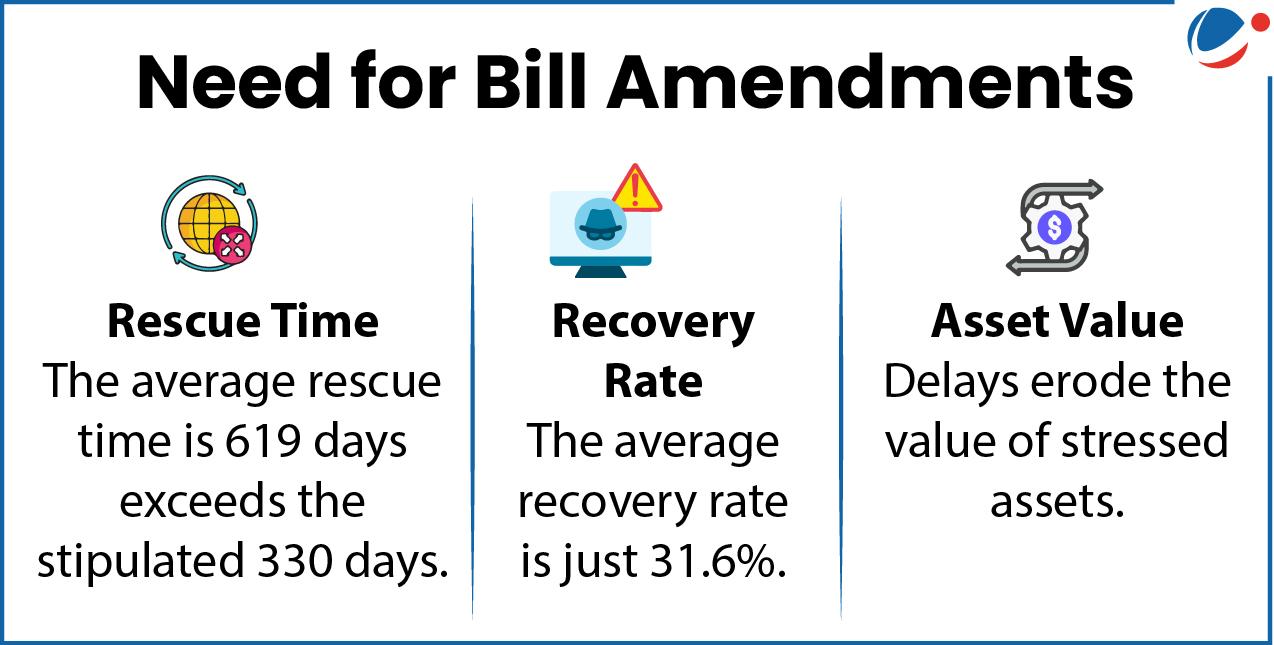
The Bill, initially referred to a Select Committee, has been introduced to amend the Insolvency and Bankruptcy Code 2016

  • The Amendment seeks to reduce delays, maximise value for all stakeholders, and introduce new provisions that follow global best practices for resolving insolvency.
    • New Creditor-Initiated Insolvency Resolution Process (CIIRP): This replaces the largely underutilised “fast-track” process with an out-of-court initiation model.
Key Highlights of the Bill

  • Group Insolvency Framework: Introduces a "voluntary group insolvency framework" to facilitate joint resolution of stressed entities within a domestic corporate group, recognizing their interconnected nature.
  • Cross-Border Insolvency Framework: Proposes a basic structure for cross-border insolvency enabling easier access for creditors to overseas assets of stressed companies and aligning with international best practices.
  • Clean Slate Principle Reinforcement: Explicitly reinforces the "clean-slate principle," stating that once a resolution plan is approved, claims against the corporate debtor are extinguished (unless specified otherwise). 
  • Strict timelines for National Company Law Tribunal (NCLT): 
    • NCLT to admit Corporate Insolvency Resolution Process (CIRP) cases within 14 days with proof of default enough to admit a case. 
    • NCLAT to dispose of appeals in 3 months.
  • Other: 
    • Sets a timeline of 180 days for completion of liquidation, extendable up to 90 days.
    • No Automatic Appointment of Resolution Professional.
    • Enhanced Role of Committee of Creditors (CoC)

Watch Video News Today

Explore Related Content

Discover more articles, videos, and terms related to this topic

RELATED VIDEOS

2
News Today (Dec 03, 2025)

News Today (Dec 03, 2025)

YouTube HD
Lateral Entry

Lateral Entry

YouTube HD

RELATED TERMS

3

Committee of Creditors (CoC)

A committee formed by financial creditors of a corporate debtor during CIRP, which has the authority to approve resolution plans and appoint the Resolution Professional.

National Company Law Appellate Tribunal (NCLAT)

An appellate body established to hear appeals against the orders of the National Company Law Tribunal (NCLT). In this case, it upheld a penalty against WhatsApp for its privacy policy.

Corporate Insolvency Resolution Process (CIRP)

The formal process under the IBC to resolve the insolvency of a corporate debtor within a stipulated time frame, involving debt restructuring and revival plans.

Title is required. Maximum 500 characters.

Search Notes

Filter Notes

Loading your notes...
Searching your notes...
Loading more notes...
You've reached the end of your notes

No notes yet

Create your first note to get started.

No notes found

Try adjusting your search criteria or clear the search.

Saving...
Saved

Please select a subject.

Referenced Articles

linked

No references added yet