


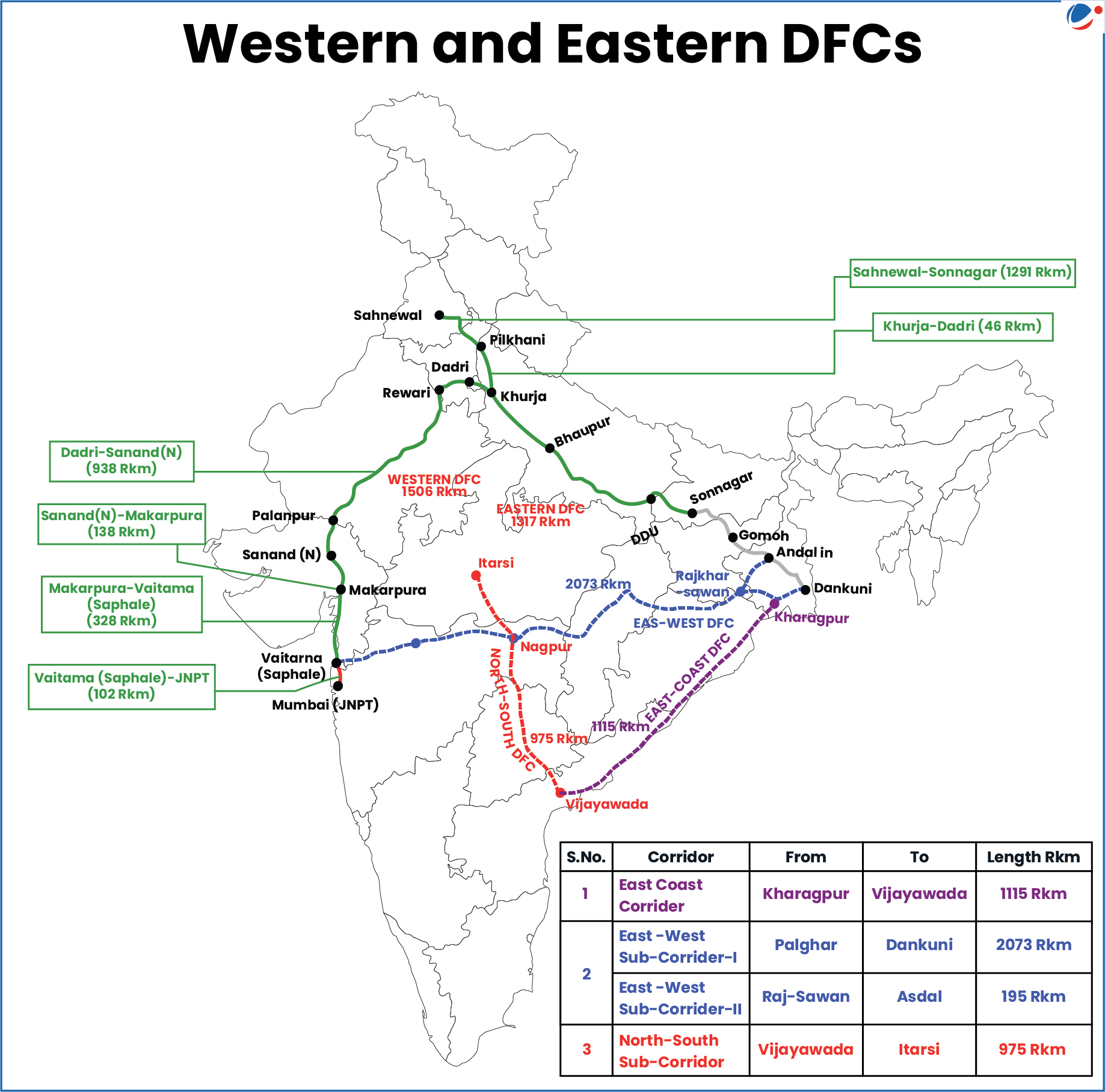
Western DFC is a 1,506-km project stretching from Dadri in Uttar Pradesh to Jawaharlal Nehru Port Terminal (JNPT) in Maharashtra.
About Dedicated Freight Corridor (DFC)
- Genesis: DFC Project was conceived in 2005 and aims at building dedicated freight-only railway lines.
- Two DFCs: Eastern DFC (EDFC) and Western DFC (WDFC) were approved in 2008.
- EDFC runs from Ludhiana (Punjab) to Sonnagar (Bihar) with a length of 1337 Km.
- Along with these two, Ministry of Railways has undertaken work towards Detailed Project Reports (DPR) for three new DFCs (currently under examination):
- East-Coast Corridor: Kharagpur to Vijayawada.
- East-West corridor:
- Palghar-Bhusawal-Nagpur-Kharagpur-Dankuni.
- Rajkharsawan - Kalipahari – Andal.
- North-South Sub-corridor: Vijayawada-Nagpur–Itarsi.
- Along with these two, Ministry of Railways has undertaken work towards Detailed Project Reports (DPR) for three new DFCs (currently under examination):
- EDFC runs from Ludhiana (Punjab) to Sonnagar (Bihar) with a length of 1337 Km.
- DFCCIL: Established in 2006, Dedicated Freight Corridor Corporation of India (DFCCIL) is a Special Purpose Vehicle set under administrative control of Ministry of Railways.
- It undertakes planning & development, mobilization of financial resources and construction, maintenance and operation of DFCs.
Importance of DFCs
- Ease Congestion: Mixed passenger and freight traffic limits operational flexibility.
- Enhanced Train Speed and Freight Productivity: Designed to handle high-capacity freight trains traveling at speeds of up to 100 km/h.
- Reduce Logistics Cost: Congestion, delays, and uncertain transit times increases costs for industries.
- Cleaner & Safer Transport: Entire DFC network is fully electrified and hence shifting freight movement from road to rail would reduce emissions.
- Alignment with National Infrastructure Goals: DFC is a crucial component of National Rail Plan for creating future-ready rail network by 2030.



