Union Minister cited the example of government having earned more than Rs 4,000 crore from Scrap including E-Waste during Swachhata campaign.
- He further highlighted the shift in economic thinking where discarded material is being seen as a source of economic value.
About Circular Economy
- Meaning: Economic system that uses a systemic approach to maintain a circular flow of resources by recovering, retaining, or adding to their value, while contributing to sustainable development (International Organization for Standardization).
- It is in contrast to traditional, linear economic model based on take-make-consume-throw away pattern.
- Potential In India: It could generate a market value of over $2 trillion and create close to 10 million jobs by 2050.
- Key Benefits of Circular Economy: Reduction in waste generation; Preservation of Natural Capital; Reducing raw material dependence; Creating Jobs; etc.
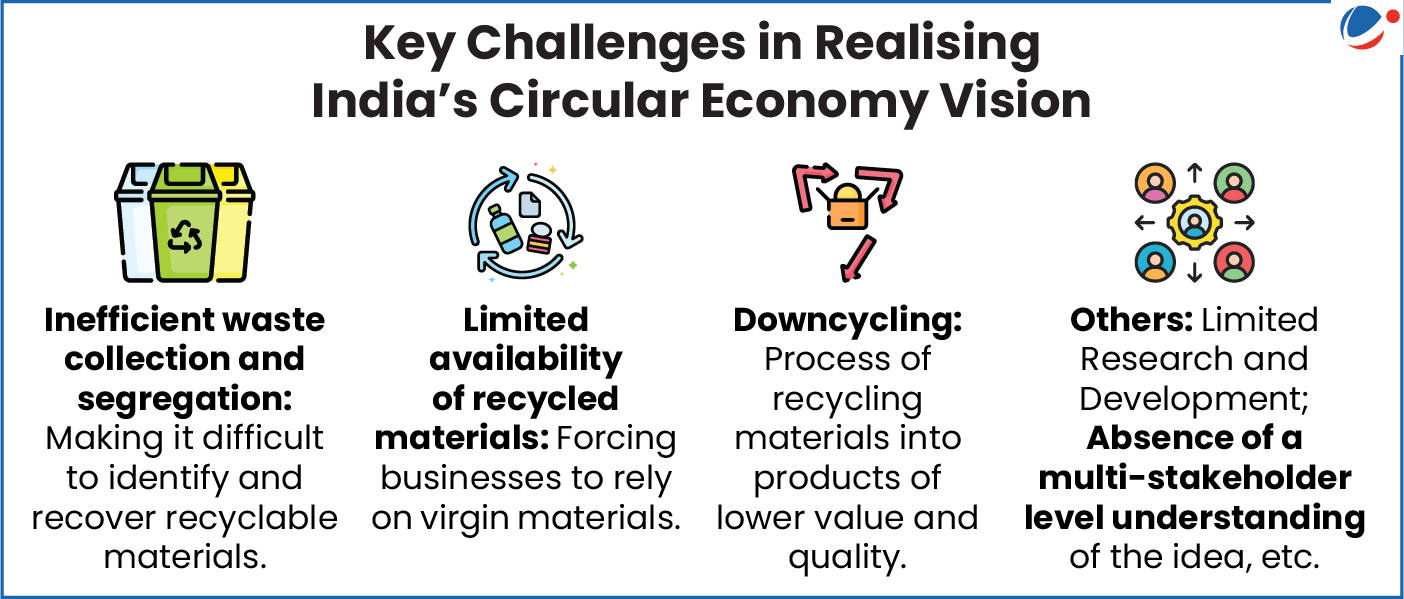
Key Measures taken towards Circular Economy in India
- Policy: National Resource Efficiency Policy (NREP), 2019; Framework of Extended Producer Responsibility (EPR), etc.
- Enabling Schemes: Swachh Bharat Mission (make India Zero Waste country); Atal Innovation Mission (supporting development of circular business models), etc.
- Research and Development: Circular Economy Cell at NITI Aayog with specialised working groups on tyres, e-waste, scrap metal, etc.
- Sector Level Policies: Steel Scrap Recycling Policy; MSE-Scheme for promotion and investment in circular economy (MSE-SPICE); Ecomark Rules, etc.
- Global Leadership Efforts: Jaipur Declaration at 12th (2025) Regional 3R (Reduce, Reuse, and Recycle) and Circular Economy Forum in Asia and Pacific, Mission LiFE, etc.