


Mounting volatility of global system has underscored the growing importance of regional cooperation and integration, with ASEAN leading as an example.
ASEAN’s Key Achievements Re-enforcing Regional Cooperation
- Commitment to Core Beliefs: Despite significant differences in culture, political models and socio-economic indicators, ASEAN functioned as cohesive, viable economic and political bloc for almost 60 years.
- Mutual Support and Trust: Accession of Timor Leste to ASEAN in 2025 is an example how members (in this case Indonesia) can put aside years of enmity for mutual support and growth for entire bloc.
- Wider Integration: E.g., Digital Economy Framework Agreement (DEFA) represents an example of “coalitions of smaller economies”, to accelerate digital transformation throughout the region.
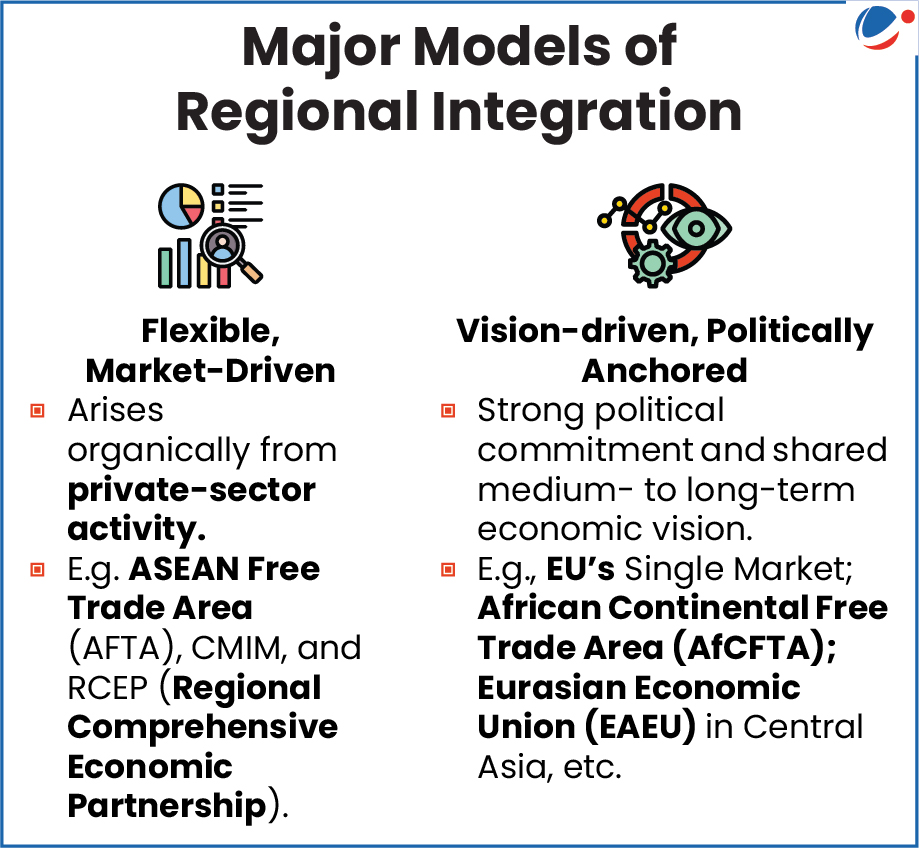
Other Key Benefits of Regional Integration
- Regional Financial Stability: E.g., Chiang Mai Initiative Multilateralisation (CMIM), established due to Asian Financial Crisis, provided ASEAN+3 (China, Japan, and Republic of Korea (ROK)) economies with a crucial safety net.
- Expands Markets and Input Sources: Ensuring better allocation of resources and accelerating economic growth.
- Reduce Inequality between countries: Freer trade and factor mobility from integration allow less-developed members to grow faster.
- Political Stability and Collective Bargaining: Strengthens diplomatic relationships and Increases the influence of member states in global trade negotiations.


