Rules governing the Freedom of Navigation (FoN) in International waters | Current Affairs | Vision IAS

Upgrade to Premium Today

Start Now
MENU
Home
Quick Links

High-quality MCQs and Mains Answer Writing to sharpen skills and reinforce learning every day.

Watch explainer and thematic concept-building videos under initiatives like Deep Dive, Master Classes, etc., on important UPSC topics.

A short, intensive, and exam-focused programme, insights from the Economic Survey, Union Budget, and UPSC current affairs.

ESC

In Summary

  • Iran attacked ships in the Strait of Hormuz, a chokepoint governed by UNCLOS transit passage rules.
  • Freedom of Navigation (FoN) is challenged by geopolitical leverage, legal ambiguities, unilateral actions, and security threats like piracy.
  • UNCLOS establishes principles for global commons and defines maritime zones, but enforcement remains a challenge.

In Summary

Iran has attacked ships responding to the US seizure of Iranian ships in conflict in Strait of Hormuz

  • At its narrowest, the strait lies entirely within the overlapping territorial waters of Iran and Oman, and is governed by transit passage under UNCLOS.

Institutional Architecture Governing FoN in International Waters

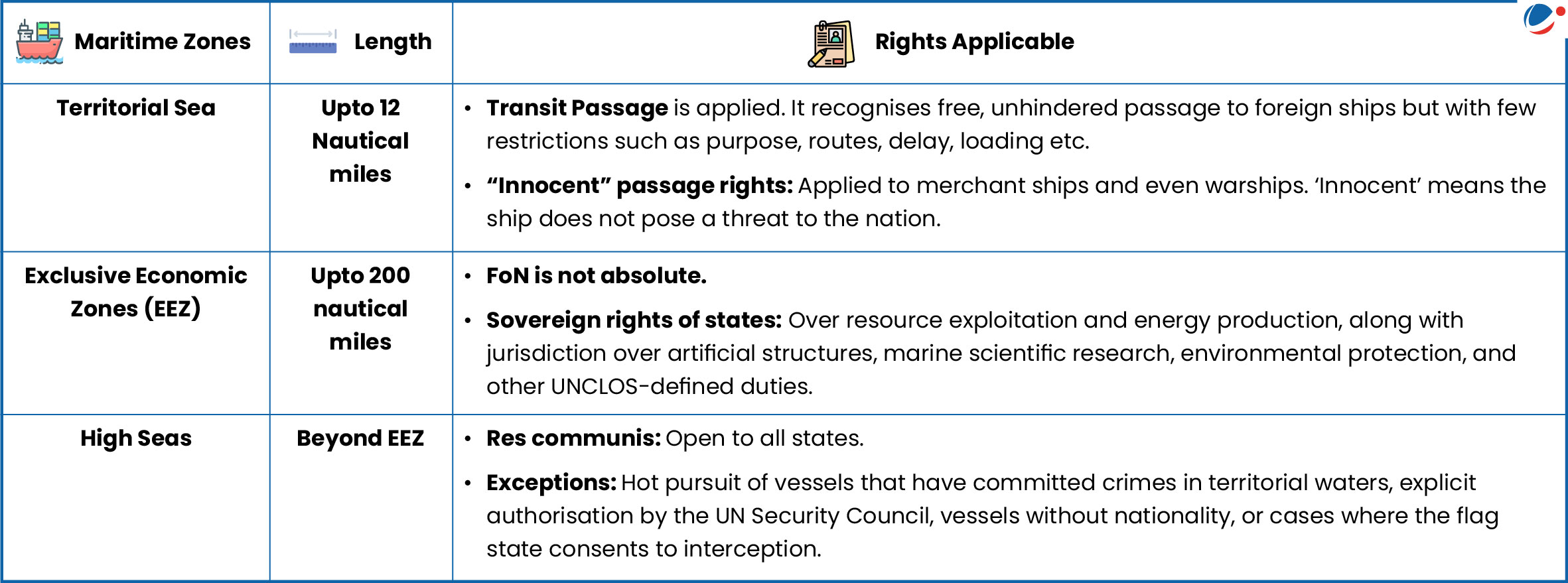
  • United Nations Convention on the Law of the Sea (UNCLOS):
    • Core Principles: Global Commons, Freedom of navigation, resource rights, and dispute resolution.
    • Defines maritime zones: 

Key Challenges to FoN in International Waters

  • Geopolitical & Strategic: FoN is often disrupted as states use chokepoints and sea lanes as tools of strategic leverage, blockades, and power rivalry.
  • Legal Ambiguity: Differing interpretations of UNCLOS rules and weak enforcement mechanisms.
  • Unilateral Actions & Sanctions: U.S. intercepted ships trading in Venezuelan oil and carrying oil to Cuba under domestic laws.
  • Security Threats: Piracy, terrorism, etc.

Watch Video News Today

Explore Related Content

Discover more articles, videos, and terms related to this topic

RELATED VIDEOS

2
Carbon Markets

Carbon Markets

YouTube HD
What is Artificial Rain? | Deep Dive With VisionIAS

What is Artificial Rain? | Deep Dive With VisionIAS

YouTube HD

RELATED TERMS

3

Chokepoints

Narrow passages of strategic importance through which sea-bound traffic must pass. Examples include the Panama Canal and the Suez Canal. Control or disruption of these chokepoints can have significant global economic and security consequences.

Global Commons

Areas of the Earth that are not owned by any single state and are accessible to all nations, such as the high seas, the atmosphere, and outer space. Their governance often relies on international cooperation and agreements.

Transit Passage

A legal regime under the United Nations Convention on the Law of the Sea (UNCLOS) that allows ships and aircraft to pass through international straits. It guarantees freedom of navigation and overflight for the purpose of continuous and expeditious transit.

Title is required. Maximum 500 characters.

Search Notes

Filter Notes

Loading your notes...
Searching your notes...
Loading more notes...
You've reached the end of your notes

No notes yet

Create your first note to get started.

No notes found

Try adjusting your search criteria or clear the search.

Saving...
Saved

Please select a subject.

Referenced Articles

linked

No references added yet