
Dual-use Satellites Blurring Lines of Modern Space War | Current Affairs | Vision IAS

Upgrade to Premium Today

Start Now
MENU
Home
Quick Links

High-quality MCQs and Mains Answer Writing to sharpen skills and reinforce learning every day.

Watch explainer and thematic concept-building videos under initiatives like Deep Dive, Master Classes, etc., on important UPSC topics.

A short, intensive, and exam-focused programme, insights from the Economic Survey, Union Budget, and UPSC current affairs.

ESC

In Summary

  • Space warfare involves kinetic and non-kinetic attacks on satellites, disrupting military operations and essential services like GPS and banking.
  • Key treaties like the Outer Space Treaty (1967) and Liability Convention (1972) aim to prevent weapon deployment and establish liability for damages.
  • India's initiatives include the Defence Space Agency (DSA) and CERT-In's Guidelines for Space Cyber Security.

In Summary

Cyber-attacks impacting satellite networks and GPS spoofing incidents brought to focus the issues concerning dual use satellites and modern space warfare.

Space in Modern Warfare

  • Meaning: Refers to military conflict conducted into or from outer space, aimed at disrupting or destroying satellites and other space assets.
    • It involves Kinetic (Anti- satellite weapons) and Non-kinetic weapons (cyber warfare and electromagnetic pulses (EMPs)).
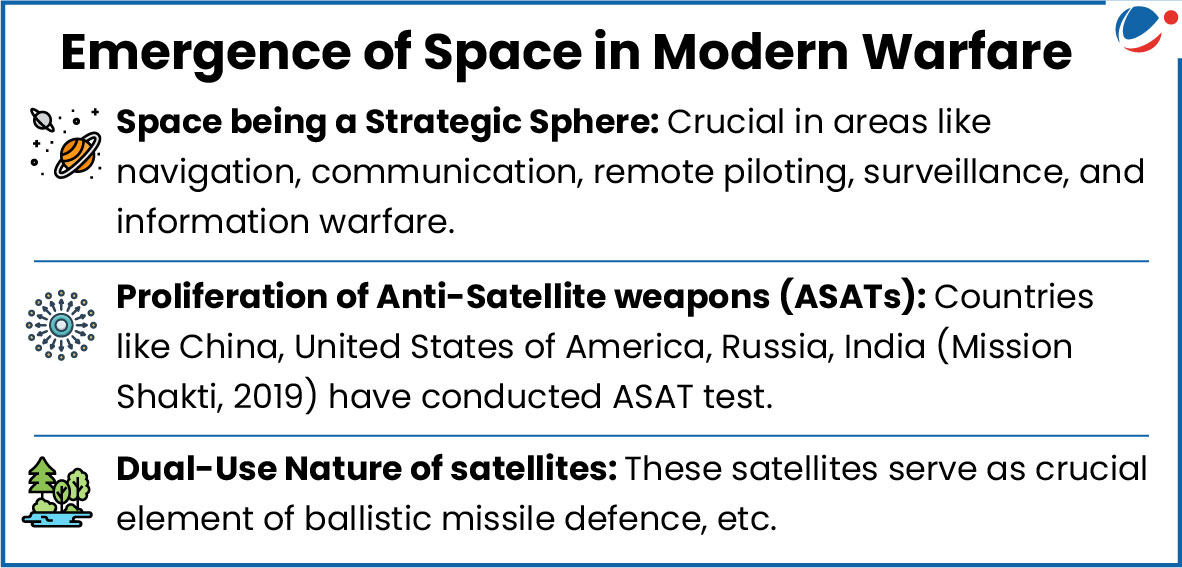
Consequences of Space Warfare 

  • Swiftness and Scale: Space amplifies weapon platforms by increasing velocities for missile trajectories, thus, enhancing speed and accuracy, potentially escalating conflicts.
  • Military Actions: Impair military operations like distant Drone operations, Anti-Access and Area Denial (A2/AD), and Manned Unmanned Teaming (MUMT) missions, etc. 
  • Debris: A minuscule fragment of wreckage from an obliterated satellite can harm spacecraft like International Space Station
  • Disruption of Essential Services: Including GPS Systems, Banking and power grids causing blackouts, etc.

Key Measures Preventing Warfare in Space

  • Outer Space Treaty (1967): Prohibits deployment of weapons of mass destruction into space.
  • The Liability Convention (1972): Expands upon Article 7 of Outer Space Treaty, establishing absolute liability for launching states for damages caused. 
  • The Moon Agreement (1984): Moon and other celestial bodies be used exclusively for peaceful purposes. 
  • Key Indian Initiatives: Defence Space Agency (DSA) to protect Indian interests in outer space; Guidelines for Space Cyber Security by Indian Computer Emergency Response Team (CERT-In), etc. 
Watch Video News Today

Explore Related Content

Discover more articles, videos, and terms related to this topic

RELATED VIDEOS

2
Personality in Focus | Kalpana Chawla

Personality in Focus | Kalpana Chawla

YouTube HD
Simplified | National Space Day: India's Space Journey

Simplified | National Space Day: India's Space Journey

YouTube HD

RELATED TERMS

3

CERT-In Guidelines for Space Cyber Security

Guidelines issued by the Indian Computer Emergency Response Team (CERT-In) to enhance the cybersecurity of space systems and networks, crucial for protecting critical space infrastructure from cyber threats.

Defence Space Agency (DSA) (India)

An Indian agency established to protect the nation's interests in outer space, focusing on space situational awareness, space weaponization, and ensuring the survivability of Indian space assets.

The Liability Convention (1972)

An international treaty that establishes absolute liability for launching states for any damage caused by their space objects, on Earth, in airspace, or in outer space.

Title is required. Maximum 500 characters.

Search Notes

Filter Notes

Loading your notes...
Searching your notes...
Loading more notes...
You've reached the end of your notes

No notes yet

Create your first note to get started.

No notes found

Try adjusting your search criteria or clear the search.

Saving...
Saved

Please select a subject.

Referenced Articles

linked

No references added yet
