
India’s First Artificial Intelligence (AI) Orbital Data Center (ODC) Satellite, Pathfinder | Current Affairs | Vision IAS

Upgrade to Premium Today

Start Now
MENU
Home
Quick Links

High-quality MCQs and Mains Answer Writing to sharpen skills and reinforce learning every day.

Watch explainer and thematic concept-building videos under initiatives like Deep Dive, Master Classes, etc., on important UPSC topics.

A short, intensive, and exam-focused programme, insights from the Economic Survey, Union Budget, and UPSC current affairs.

ESC

In Summary

  • India to build Orbital Data Centres (ODCs) for space computing, enhancing technological sovereignty and reducing reliance on foreign cloud infrastructure.
  • ODCs offer advantages like abundant power, free radiative cooling, scalability, and faster deployment compared to terrestrial data centres.
  • The Pathfinder satellite, featuring data center-grade GPUs and a hyperspectral imaging camera, is slated for launch in Q4 2026.

In Summary

To be built with partnership of Space-tech firm, Pixxel and AI startup, Sarvam where former will design, build, launch, and operate pathfinder satellite, while latter would provide AI backbone. 

  • The ODC, along with enhancing country’s space computing capabilities, would promote technological sovereignty by operating independently of foreign cloud infrastructure. 

About Orbital Data Centres (ODCs)

  • Meaning: Scalable, cloud-enabled data processing and storage infrastructure operating directly in space. 
    • Work either in conjunction with terrestrial cloud infrastructure or independently. 
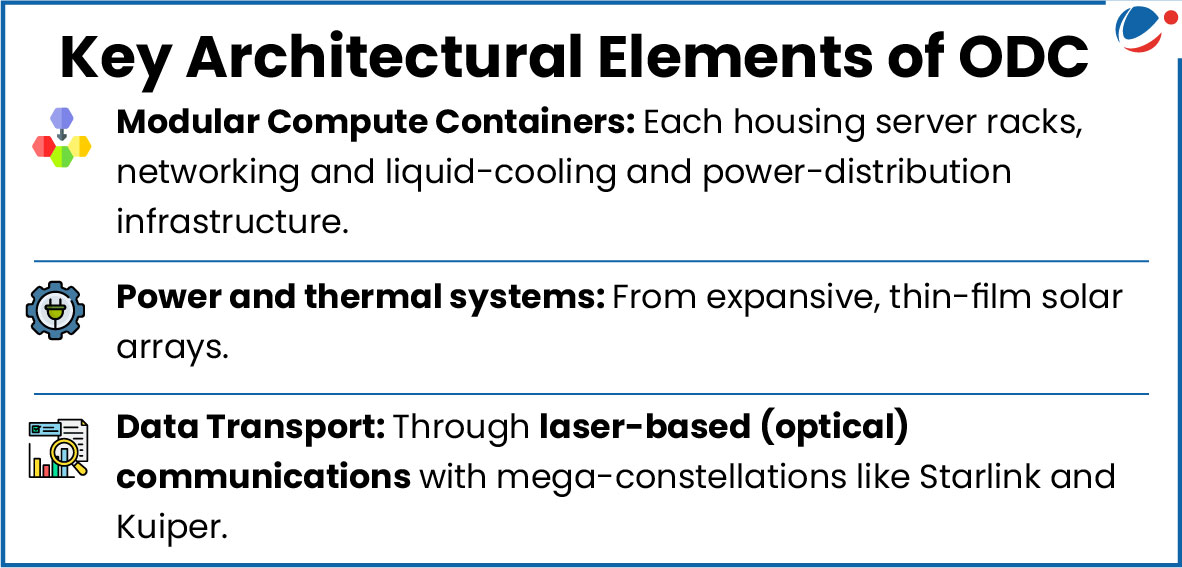
Significance of ODCs

  • Abundant, Uninterrupted power: In a dawn-dusk sun-synchronous orbit (SSO), it can leverage continuous, high-intensity solar power, unhindered by night-time, weather, or atmospheric attenuation.
  • Free radiative cooling: Deep vacuum of space serves as a gigantic, cold heatsink having effective ambient temperature of around -270 Celsius, eliminating freshwater needs for cooling. 
    • Single 40 megawatt (MW) terrestrial cluster can consume over 1 million tons of water annually for cooling.
  • Scalability and speed of deployment: ODCs can be linearly scaled almost indefinitely through modular design, and be launched faster compared to building terrestrial infrastructure.
  • Overcome Limitations of Terrestrial Data Centres: 
    • Huge Power Consumption: Large data centres consume approximately 1.5% of global power (WEF). 
    • Land and permitting constraints: Hyperscale data centres require significant land along with extensive planning, rights-of-way and environmental reviews.

About Pathfinder

  • 200-kilogram-class satellite, expected to reach orbit by fourth quarter of 2026. 
  • Key Features: 
    • Data Center-grade GPUs (Graphics Processing Unit): Unlike traditional satellite systems relying on low-power processors, it offers high performance computing in space. 
    • Hyperspectral Imaging Camera: To be deployed for first time on a satellite, offering faster and real time decision making.
Watch Video News Today

Explore Related Content

Discover more articles, videos, and terms related to this topic

RELATED TERMS

3

Hyperspectral Imaging Camera

An advanced imaging technology that captures image data across a wide range of the electromagnetic spectrum, providing more detailed spectral information than traditional multispectral cameras, enabling faster and real-time decision-making.

Graphics Processing Unit (GPU)

A specialized electronic circuit designed to rapidly manipulate and alter memory to accelerate the creation of images, videos, and animations. GPUs are crucial for training and running complex AI models due to their parallel processing capabilities.

Pathfinder Satellite

A 200-kilogram-class satellite designed to test and demonstrate new space technologies, such as data-center-grade GPUs and hyperspectral imaging cameras, for enhanced space computing capabilities.

Title is required. Maximum 500 characters.

Search Notes

Filter Notes

Loading your notes...
Searching your notes...
Loading more notes...
You've reached the end of your notes

No notes yet

Create your first note to get started.

No notes found

Try adjusting your search criteria or clear the search.

Saving...
Saved

Please select a subject.

Referenced Articles

linked

No references added yet