
Five Core Principles Guiding India’s Diplomacy | Current Affairs | Vision IAS

Upgrade to Premium Today

Start Now
MENU
Home
Quick Links

High-quality MCQs and Mains Answer Writing to sharpen skills and reinforce learning every day.

Watch explainer and thematic concept-building videos under initiatives like Deep Dive, Master Classes, etc., on important UPSC topics.

A short, intensive, and exam-focused programme, insights from the Economic Survey, Union Budget, and UPSC current affairs.

ESC

In Summary

  • India's diplomacy should be guided by five principles: Reciprocity, Diversification, Strategic Flexibility, Strategic Expansion, and Domestic Renewal.
  • Reciprocity involves mutual support with partners like the UAE, while Diversification expands engagements beyond traditional allies.
  • Strategic Flexibility means a pragmatic, interest-based approach, exemplified by engagement with both BRICS and Quad.

In Summary

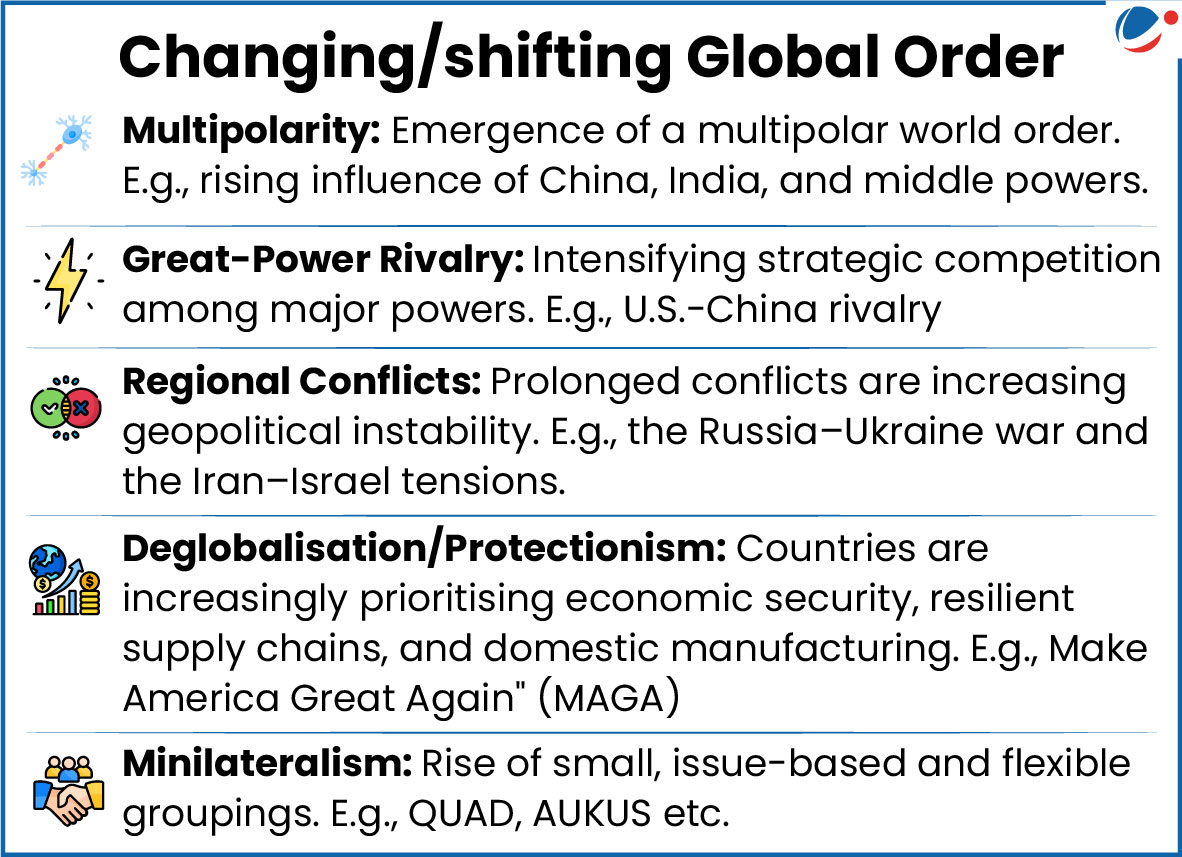
Amid a shifting global order marked by geopolitical rivalry, regional conflicts, and economic realignments, India’s diplomacy should be guided by five key strategic principles.

Five Core Principles for India’s Diplomacy 

  • Reciprocity: India’s foreign policy should be guided by mutual support and trust with strategic partners.
    • E.g., Despite the ongoing Iran conflict, the Prime Minister is set to visit the UAE which has consistently backed India on issues such as Kashmir and counter-terrorism.
  • Diversification: India should broaden its diplomatic and economic engagements beyond traditional partnerships to reduce strategic dependence and access new opportunities.
    • E.g., expanding cooperation with Europe in trade, advanced technology, etc.
  • Strategic Flexibility: India must adopt a pragmatic and interest-based approach amid changing global power equations and evolving geopolitical alignments. E.g., engagement with both BRICS and Quad.
  • Strategic Expansion: India should deepen outreach to emerging regions of economic and geopolitical importance to secure markets, resources, and connectivity.
    • E.g., growing India–Africa cooperation in trade, critical minerals and development partnerships.
  • Domestic Renewal: Strong diplomacy must be backed by domestic economic resilience, technological capacity, and institutional reforms to effectively navigate global uncertainties.
    •  E.g., focus on manufacturing, innovation, and technological self-reliance.
Watch Video News Today

Explore Related Content

Discover more articles, videos, and terms related to this topic

RELATED VIDEOS

1
Role of Indian Diaspora in Making India Self-Reliant

Role of Indian Diaspora in Making India Self-Reliant

YouTube HD

RELATED TERMS

3

Domestic Renewal

The process of strengthening a nation's internal capabilities, including its economic resilience, technological advancement, and institutional reforms, to effectively deal with external challenges and uncertainties. It underscores the link between domestic strength and foreign policy effectiveness.

Strategic Expansion

The policy of actively deepening engagement and building partnerships with emerging regions that hold significant economic and geopolitical importance. This aims to secure markets, resources, and improve connectivity for national development and security.

Quad

The Quadrilateral Security Dialogue (Quad) is an informal strategic forum comprising Australia, India, Japan, and the United States. It aims to promote a free, open, and inclusive Indo-Pacific region and serves as a platform for cooperation on various issues, including security and maritime domain awareness.

Title is required. Maximum 500 characters.

Search Notes

Filter Notes

Loading your notes...
Searching your notes...
Loading more notes...
You've reached the end of your notes

No notes yet

Create your first note to get started.

No notes found

Try adjusting your search criteria or clear the search.

Saving...
Saved

Please select a subject.

Referenced Articles

linked

No references added yet
