


Released by the Ministry of Statistics and Programme Implementation, it seeks to measure the contribution through knowledge in capital, labour, innovation, and digital sectors.
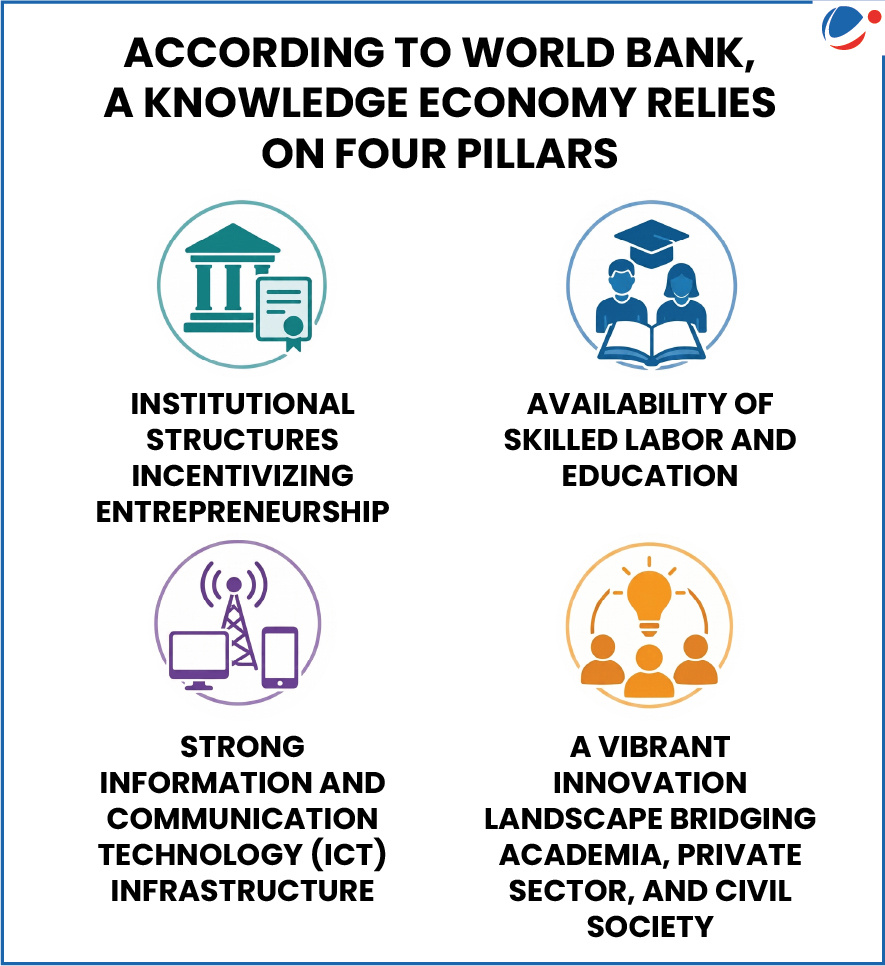
About Knowledge-based Economy
- Definition: It is a system of consumption and production that emphasizes the use of human capital like information, skills, technical expertise, and intellectual property over physical inputs and natural resources.
- Types of Knowledge:
- Codified Knowledge: Information that can be easily documented and transmitted digitally (e.g., know-what and know-why).
- Tacit Knowledge: Experience-based skills and capabilities that are harder to codify and transfer (e.g., know-how and know-who).
- Significance of a Knowledge-Based Economy
- Driven by Increasing Returns: Generate increasing returns through innovation spillovers, repeated use, and sustained long-term economic growth.
- Transformation of Value Creation: Commercializes science and innovation through IPRs like patents and copyrights, with knowledge-based activities contributing over 50% of GDP in major OECD economies.
- High-Skill Employment: Creates high-wage jobs and increases demand for skilled “knowledge workers”.
- National Innovation Systems: Relies on dynamic networks linking academia, government, and industry for interactive learning and innovation diffusion.
- Examples: Digital India by MeitY, Traditional Knowledge Digital Library, Ayush, GI Tags, etc.


