


Andhra Pradesh has recently announced financial incentives for 3rd child and 4th child to transition Demographics.
- India’s replacement fertility rate is 2.1 while South Indian states have 1.5 (Below replacement level).
- Replacement Rate refers to the average number of children a woman needs to have to replace exactly herself and a partner in a given population.
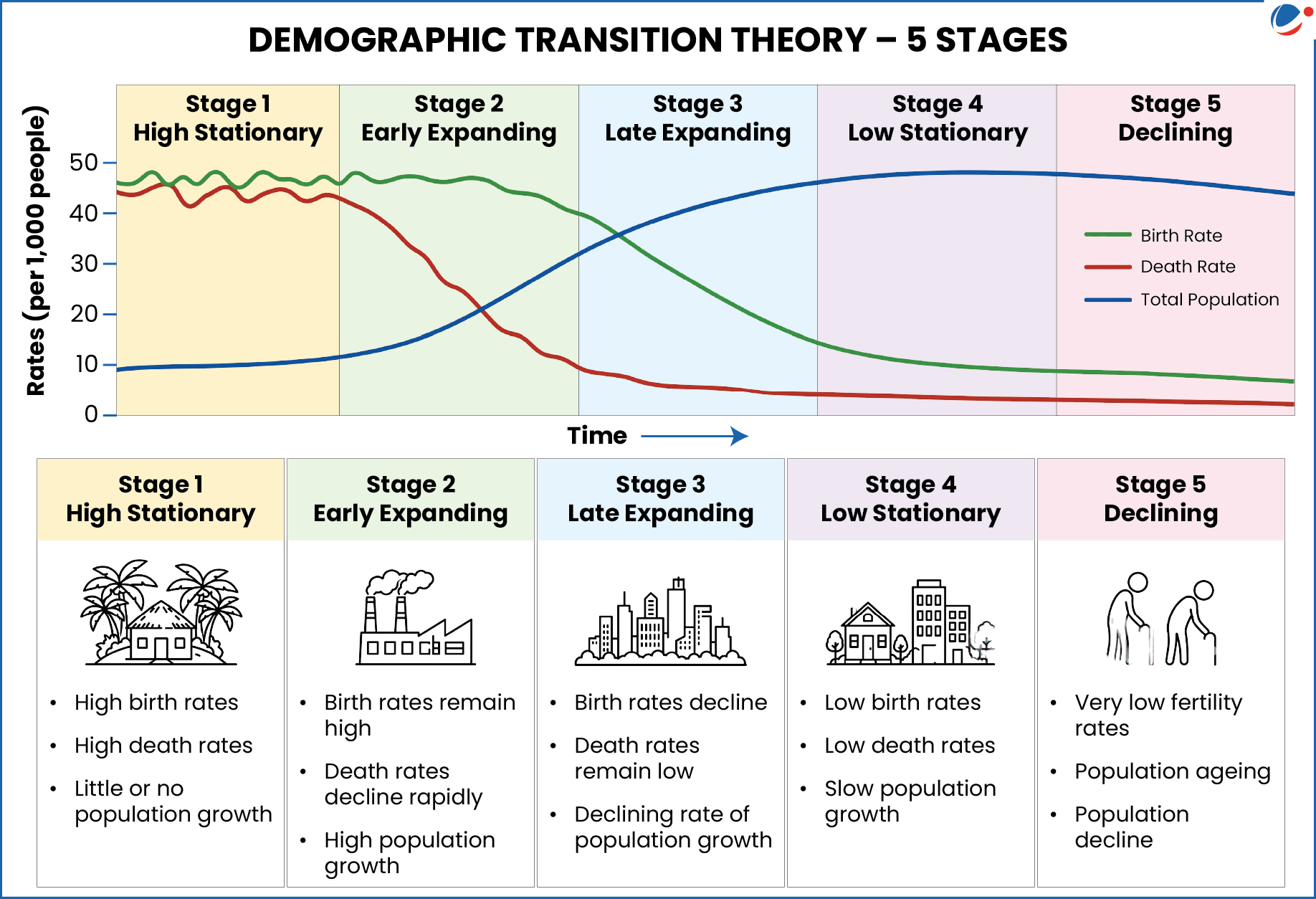
About Demographic Transition Theory (DTT)
- DTT describes the transition from a stage of high fertility and mortality to a stage of low fertility and mortality.
- It explains how a country’s population structure transforms as it develops economically.
- DTT was first coined by Warren S. Thompson (1929) and later on by Frank W. Notestein (1945).
Implications of Demographic transition on India
- Inter-State divergences: States with a high share of young population (e.g., Bihar, Uttar Pradesh) have a wider window of opportunity.
- Changing Dependency Ratio: By 2050, one in five Indians will be aged 60 or above—347 million people, up from ~149 million.
- Fiscal: Ageing states may experience shrinking tax bases, rising pension and healthcare expenditure, and greater fiscal stress due to higher debt and interest burdens.
- Political: Delimitation and political representation with higher population states gaining greater parliamentary representation.




