
The UN human rights office (OHCHR) has launched Global Alliance for Human Rights | Current Affairs | Vision IAS

Upgrade to Premium Today

Start Now
MENU
Home
Quick Links

High-quality MCQs and Mains Answer Writing to sharpen skills and reinforce learning every day.

Watch explainer and thematic concept-building videos under initiatives like Deep Dive, Master Classes, etc., on important UPSC topics.

A short, intensive, and exam-focused programme, insights from the Economic Survey, Union Budget, and UPSC current affairs.

ESC

In Summary

  • The Global Human Rights Alliance (GHRA) aims for a future with accountable governments, inclusive societies, and fair economies by placing human rights at the heart of decision-making.
  • GHRA is a sustained, inclusive, and action-oriented global endeavor with a three-year milestone leading to the 80th anniversary of the UDHR in 2028.
  • Core principles include purpose-driven action, inclusivity across sectors and regions, ecosystem-building of human rights mechanisms, and narrative-shifting through accessible language and innovative approaches.

In Summary

It is designed as a long-term effort leading up to the 80th anniversary of the Universal Declaration of Human Rights (UDHR) in 2028.

  • UDHR is a landmark UN declaration adopted in 1948 that sets out the fundamental rights and freedoms to which every person is entitled, regardless of nationality, race, gender, religion, or any other status.
About GHRA 

  • Goal: A future where governments are accountable, societies are inclusive, and economies are fair; where innovation puts people first, and respect shapes our relationships with each other and with the planet.
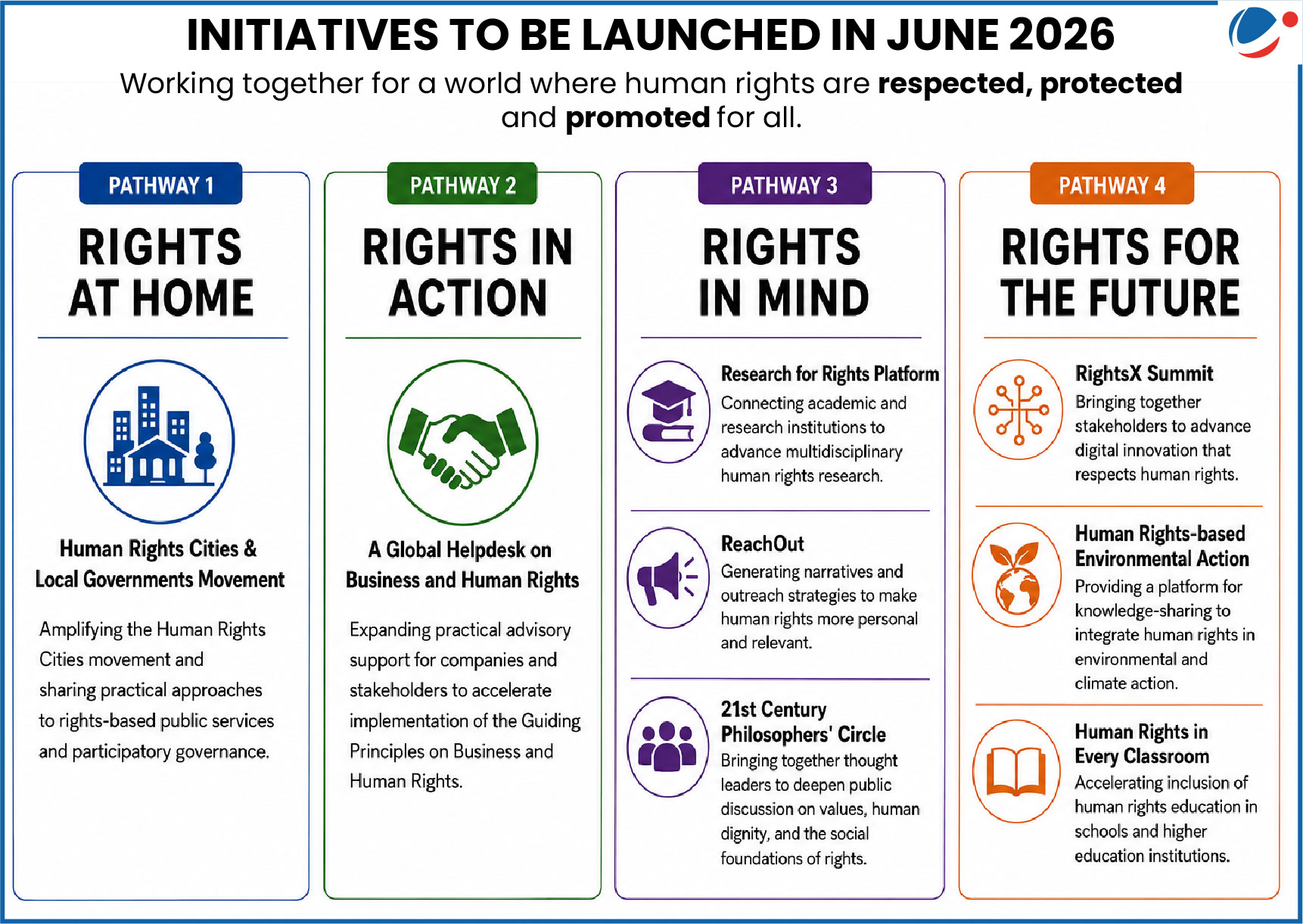
  • Aim: Placing the human right issue at the heart of decision-making. (See initiatives to be launched in the box)
  • Core principles
    • Purpose-driven: A sustained global endeavour with a three-year milestone at the 80th anniversary of the Universal Declaration of Human Rights (10 December 2028).
    • Inclusive: Engaging governments and non-state actors across regions and sectors, with a firm commitment to gender equality and participation from all ages, backgrounds, and identities.
    • Action-oriented: Delivering measurable change through collaborative, creative activities.
    • Ecosystem-building: Strengthening and connecting human rights mechanisms, institutions, and networks.
    • Narrative-shifting: Using accessible language, reaching new audiences, and embracing innovative approaches and partnerships.
  • Three guiding principles:
    • Imagine: envision a better future.
    • Dialogue: foster inclusive discussions.
    • Act: translate commitments into action.
Watch Video News Today

Explore Related Content

Discover more articles, videos, and terms related to this topic

RELATED VIDEOS

1
Lateral Entry

Lateral Entry

YouTube HD

RELATED TERMS

3

Ecosystem-building

In the context of human rights, this refers to strengthening and connecting existing mechanisms, institutions, and networks to create a more robust and collaborative environment for promoting and protecting human rights.

Non-state actors

Individuals or groups that are not part of a recognized state but can still influence international relations and regional dynamics. In West Asia, these actors, alongside state interests, contribute to complex geopolitical interactions.

Universal Declaration of Human Rights (UDHR)

A landmark international document adopted by the United Nations General Assembly in 1948, proclaiming the inalienable rights that everyone is entitled to as a human being.

Title is required. Maximum 500 characters.

Search Notes

Filter Notes

Loading your notes...
Searching your notes...
Loading more notes...
You've reached the end of your notes

No notes yet

Create your first note to get started.

No notes found

Try adjusting your search criteria or clear the search.

Saving...
Saved

Please select a subject.

Referenced Articles

linked

No references added yet