
Supreme Court (SC) flagged deep-rooted nexus between borrowers, ARCs and bankers. | Current Affairs | Vision IAS

Upgrade to Premium Today

Start Now
MENU
Home
Quick Links

High-quality MCQs and Mains Answer Writing to sharpen skills and reinforce learning every day.

Watch explainer and thematic concept-building videos under initiatives like Deep Dive, Master Classes, etc., on important UPSC topics.

A short, intensive, and exam-focused programme, insights from the Economic Survey, Union Budget, and UPSC current affairs.

ESC

In Summary

  • Supreme Court (SC) is reviewing Asset Reconstruction Companies (ARCs) functioning due to allegations of public money misuse in debt settlements.
  • ARCs acquire distressed bank assets for recovery/reconstruction, regulated by RBI, but face challenges like low recovery rates and delayed processes.
  • Suggested reforms include stakeholder advisory groups, enhanced transparency in asset valuation, and aligning incentives towards faster resolution.

In Summary

Hearing a PIL, SC held that there was a dire need to look into the functioning of ARCs (Asset Reconstruction Companies). 

  • The PIL alleged that debt of 1,537 crore rupee owed to public sector banks was settled through two ARCs for a mere 73 crore 50 lakh rupees showing misutilisation of public money. 

About ARCs

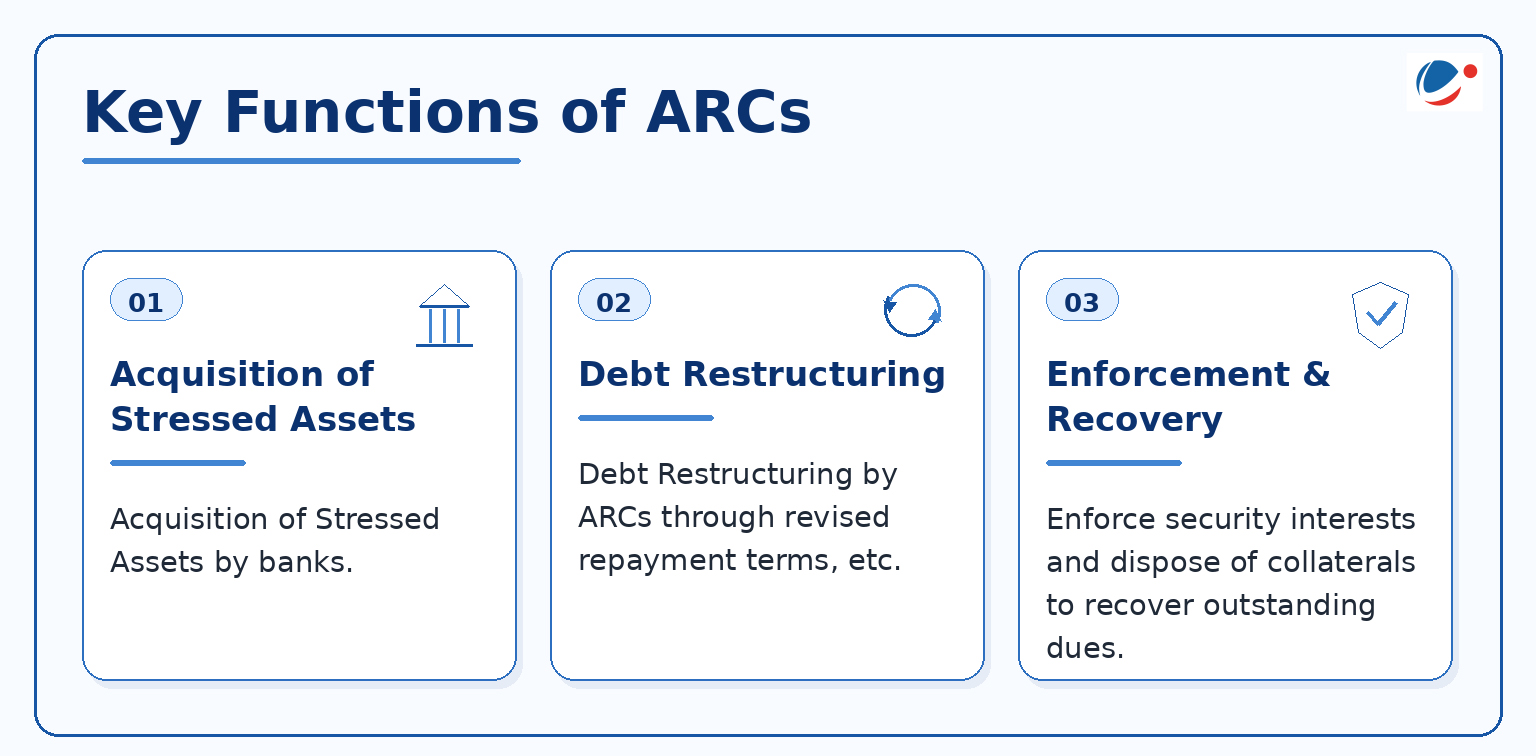
  • Meaning: Specialised financial institution to acquire financial assets (loans) of banks and financial institutions seeking to recover or re-construct them in an effort to combat the issue of non-performing assets in banking. 
    • Registered as a company under Section 3 of SARFAESI (Securitization and Reconstruction of Financial Assets and Enforcement of Security Interest) Act, 2002.
  • Regulation: Reserve Bank of India (RBI) has extensive regulatory control over ARCs
    • Twenty-seven ARCs are currently registered with RBI. 
Challenges associated with ARCs

  • Low Recovery Rates: Due to litigation delays, valuation disputes, and borrower insolvency.
  • Limited Restructuring Expertise: Determining the fair value of distressed assets is inherently complex and may result in disagreements. 
  • Delayed Process: Recovery proceedings often involve prolonged litigation before tribunals and courts, affecting the overall efficiency. 
  • Recovery Focussed: Activities of ARC have been mainly recovery-focused as opposed to revival-focused. 

Ways to Reform ARCs

  • Constitute a key advisory group with all stakeholders to review the functioning of ARC sector and suggest time-bound measures.
  • Enhancing transparency in asset valuation and sale processes. 
  • Aligning incentives toward faster resolution rather than asset accumulation. 
Watch Video News Today

Explore Related Content

Discover more articles, videos, and terms related to this topic

RELATED VIDEOS

3
News Today (Aug 18-19-20, 2024)

News Today (Aug 18-19-20, 2024)

YouTube HD
News Today (May 30, 2025)

News Today (May 30, 2025)

YouTube HD
News Today (Feb 05, 2026)

News Today (Feb 05, 2026)

YouTube HD

RELATED TERMS

3

Recovery Focussed vs. Revival Focussed

This distinction highlights that ARCs have historically focused on simply recovering the money from distressed assets rather than actively working to revive the underlying businesses, which could potentially lead to higher returns and preservation of economic activity.

Valuation Disputes

Disagreements that arise over the fair market value of an asset, particularly distressed assets acquired by ARCs, which can delay recovery and restructuring processes.

PIL (Public Interest Litigation)

A litigation filed in a court of law for the protection of 'Public Interest', such as pollution, terrorism, road safety, constructional hazards etc. It is a mechanism to provide justice to the poor, ignorant, downtrodden and aggrieved persons who cannot approach the court due to poverty, disability or any other disability.

Title is required. Maximum 500 characters.

Search Notes

Filter Notes

Loading your notes...
Searching your notes...
Loading more notes...
You've reached the end of your notes

No notes yet

Create your first note to get started.

No notes found

Try adjusting your search criteria or clear the search.

Saving...
Saved

Please select a subject.

Referenced Articles

linked

No references added yet