
NITI Aayog releases Report on the ‘Investment Friendliness Index’ | Current Affairs | Vision IAS

Upgrade to Premium Today

Start Now
MENU
Home
Quick Links

High-quality MCQs and Mains Answer Writing to sharpen skills and reinforce learning every day.

Watch explainer and thematic concept-building videos under initiatives like Deep Dive, Master Classes, etc., on important UPSC topics.

A short, intensive, and exam-focused programme, insights from the Economic Survey, Union Budget, and UPSC current affairs.

ESC

In Summary

  • The Investment Index encourages states to improve investment ecosystems, with Gujarat, Maharashtra, and Tamil Nadu as top performers.
  • States influence private capital by managing land, labor, utilities, and offering fiscal/infrastructure incentives.
  • Investment is a historical driver of growth, with capital expenditure having a multiplier effect of at least four times on economic output.

In Summary

Announced in the Union Budget 2025-26, the Index aims to strengthen the spirit of both competitive and cooperative federalism by encouraging states to adopt best practices and continuously improve their investment ecosystems.

Key Findings of the Report

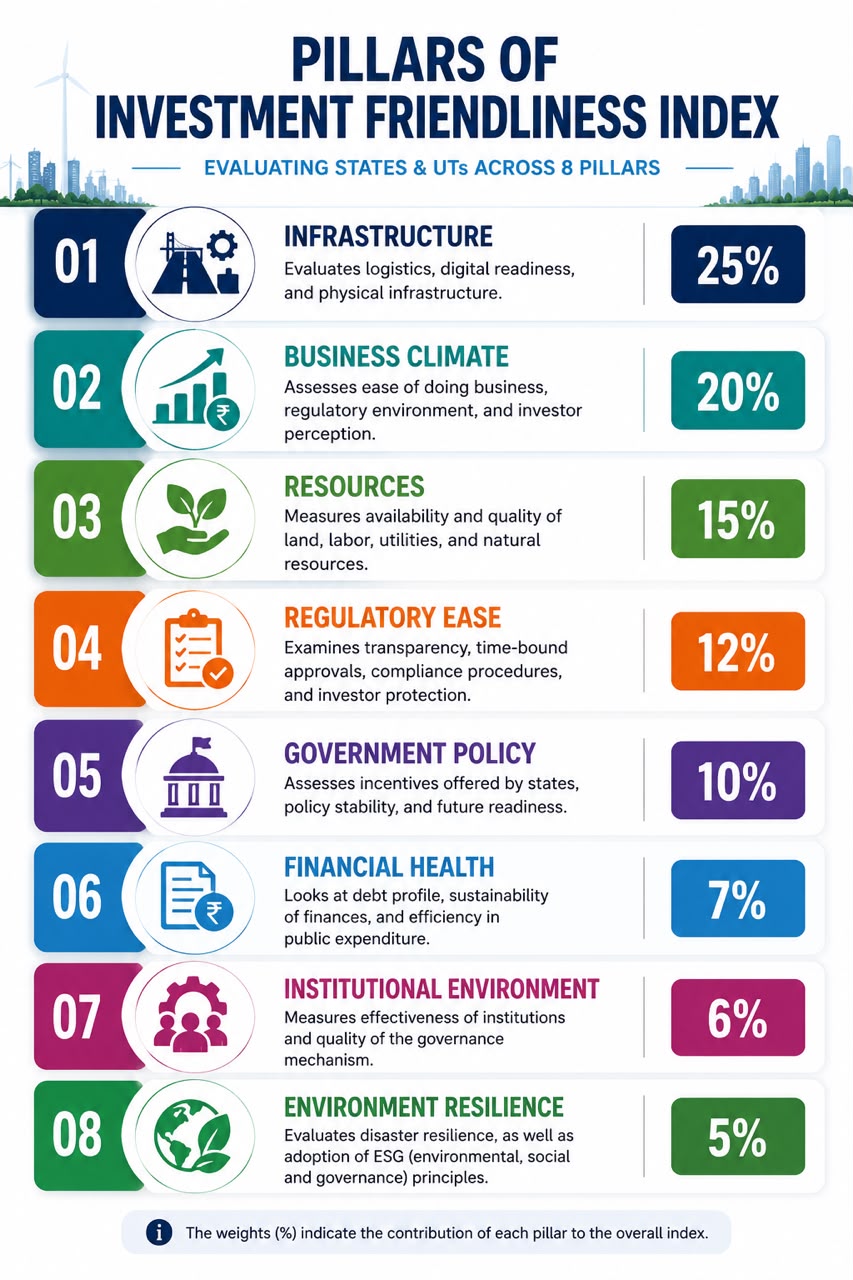
  • Evaluation Framework: Evaluates all 28 States and 8 UTs across 84 indicators grouped under 8 pillars (refer infographic).
  • Performance Categories and Results: States are scored out of 100 and classified into four performance tiers:
    • Top Performers (Score > 50): Gujarat (Score 56.6), Maharashtra, Tamil Nadu, Goa and Odisha.
    • Frontrunners (Score 45–50): Delhi, Madhya Pradesh, Andhra Pradesh, etc.
    • Emerging Performers (Score 40–44.9): Bihar, Jammu & Kashmir, Punjab, etc.
    • Aspiring States (Score < 40): Arunachal Pradesh, Ladakh, Lakshadweep, etc.
  • Peer-Group Rankings (3 Categories): 
    • Large States: Gujarat
    • Hilly and North-Eastern States: Uttarakhand
    • UTs and City States: Goa

Why Investments are Significant for Growth?

  • Historical Driver of Growth: Investments have accounted for over half of India's economic growth since the economic reforms of 1992.
  • Multiplier Effects: Capital investments stimulate industrialisation, drive innovation, build critical infrastructure, and generate large-scale employment. 
    • The Economic Survey 2022-23 estimated that economic output can increase by at least four times the amount of capital expenditure incurred.

Significance of State-level Reforms for Private Capital Flow

  • Jurisdiction over Key Inputs: Such as industrial land allotment, labour regulations, and utility access fall strictly under state governance.
  • Approval and Clearance Timelines: Implementing centralised single-window portals drastically reduces business setup times, replacing bureaucratic delays with predictable, fast-track approvals.
  • Fiscal and Infrastructure Enablers: States influence location decisions by offering targeted incentives like capital subsidies and developing robust local logistics, transport, and energy networks.
Watch Video News Today

Explore Related Content

Discover more articles, videos, and terms related to this topic

RELATED VIDEOS

3
Impact Investments

Impact Investments

YouTube HD
Economic Survey (Chapter 5,6 & 7)

Economic Survey (Chapter 5,6 & 7)

YouTube HD
Circularity in Textile Structure

Circularity in Textile Structure

YouTube HD
Title is required. Maximum 500 characters.

Search Notes

Filter Notes

Loading your notes...
Searching your notes...
Loading more notes...
You've reached the end of your notes

No notes yet

Create your first note to get started.

No notes found

Try adjusting your search criteria or clear the search.

Saving...
Saved

Please select a subject.

Referenced Articles

linked

No references added yet
