
India’s first two Geothermal Wells Commissioned in Ladakh | Current Affairs | Vision IAS

Upgrade to Premium Today

Start Now
MENU
Home
Quick Links

High-quality MCQs and Mains Answer Writing to sharpen skills and reinforce learning every day.

Watch explainer and thematic concept-building videos under initiatives like Deep Dive, Master Classes, etc., on important UPSC topics.

A short, intensive, and exam-focused programme, insights from the Economic Survey, Union Budget, and UPSC current affairs.

ESC

In Summary

  • Ladakh commissioned India's first and deepest geothermal wells (1000m) at Puga Valley, executed by ONGC, for a 1 MW power project.
  • Geothermal energy harnesses Earth's crust heat, utilizing high-enthalpy (electricity) or low-medium enthalpy (direct-use) resources.
  • India has potential in 10 provinces, but faces challenges like high investment and exploration risks despite policy support.

In Summary

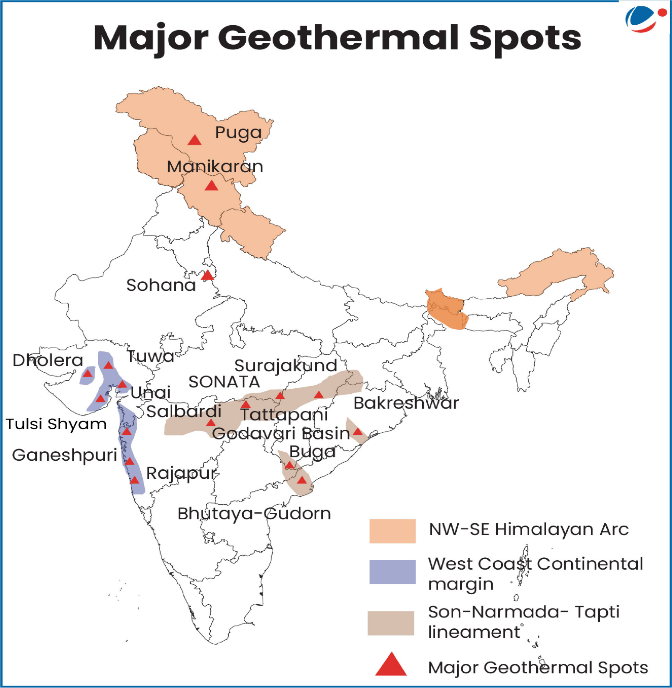
Lieutenant Governor of Ladakh commissioned the country's first and deepest (1,000 m) geothermal wells (Executed by ONGC) at Puga Valley.

  • These two wells are critical to implementation of the 1 MW geothermal power project at Puga, which will be India’s first demonstration-scale geothermal power project.

About Geothermal Energy
  • It harnesses heat stored within Earth's crust. 
    • The system consists of multiple components including production and reinjection (wells, pumps), transport (pipelines), distribution (heat exchangers) and end-use application.
  • Sources
    • High-enthalpy resources: Volcanic regions, geysers and hot springs primarily for electricity generation. 
    • Low- to medium-enthalpy resources:  Like hot rocks and shallow ground layers, better suited for direct-use applications (e.g. heating and cooling, agri-food, aquaculture), etc. 
  • Potential In India
    • 381 hot springs (identified by Geological Survey of India) with surface temperatures ranging from 35°C to 89°C.
    • 10 geothermal provinces (identified) in India including Himalayan Geothermal Province; Cambay Graben; Aravalli etc. 
  • Benefits: Reliable and uninterrupted electricity generation, low carbon emissions, reducing dependence on fossil fuels, ideal for remote areas etc. 
  • Challenges: High initial investment, exploration risks, limited to certain regions, requires advanced technology, etc. 
  • Policy: MNRE formulated National Policy on Geothermal Energy 2025 for exploration and development of geothermal resources in India. 
Watch Video News Today

Explore Related Content

Discover more articles, videos, and terms related to this topic

RELATED TERMS

3

National Policy on Geothermal Energy 2025

A policy framework formulated by the Ministry of New and Renewable Energy (MNRE) to guide the exploration, development, and utilization of geothermal resources in India, aiming to harness its potential for energy security and sustainability.

MNRE

Ministry of New and Renewable Energy. The nodal ministry of the Government of India responsible for all matters relating to new and renewable energy, including the development of Small Hydro Power projects.

Geological Survey of India (GSI)

A scientific and research organization under the Ministry of Mines, Government of India, responsible for geological surveys, exploration of minerals, and related activities.

Title is required. Maximum 500 characters.

Search Notes

Filter Notes

Loading your notes...
Searching your notes...
Loading more notes...
You've reached the end of your notes

No notes yet

Create your first note to get started.

No notes found

Try adjusting your search criteria or clear the search.

Saving...
Saved

Please select a subject.

Referenced Articles

linked

No references added yet
