
India's first privately developed orbital launch vehicle Vikram-1 Successfully Launched | Current Affairs | Vision IAS

Upgrade to Premium Today

Start Now
MENU
Home
Quick Links

High-quality MCQs and Mains Answer Writing to sharpen skills and reinforce learning every day.

Watch explainer and thematic concept-building videos under initiatives like Deep Dive, Master Classes, etc., on important UPSC topics.

A short, intensive, and exam-focused programme, insights from the Economic Survey, Union Budget, and UPSC current affairs.

ESC

In Summary

  • Vikram-1, developed by Skyroot Aerospace, demonstrates India's private sector capability for on-demand satellite launches, making India the third nation with such capacity.
  • The Vikram-1 rocket is fully designed and manufactured in India, capable of deploying 350 kg to LEO or 260 kg to SSO, featuring an all-carbon composite structure and a 3D-printed liquid-fuel engine.
  • India's space economy, currently valued at USD 8.4 billion, is projected to reach USD 40-45 billion in the next decade, with space startups growing from 1 in 2014 to nearly 400.

In Summary

It is developed by Skyroot Aerospace under Mission Aagaman and demonstrated India's capability for commercial, on-demand satellite launches by the private sector.

  • India became the third country, after the United States and China, to have launching capabilities in the private sector.

About Vikram-1

  • Fully designed and manufactured in India.
  • Capability: Small Satellite deployment (up to 350 kg into Low Earth Orbit (LEO) or up to 260 kg to Sun-Synchronous Orbit (SSO))
  • Features:
    • All-carbon composite structure.
    • 4-stage rocket with 3 solid stages and a liquid stage.
    • 3D-printed liquid-fuel engine.
    • Autonomous Guidance, Navigation and Control (GNC) system powered by the Ramanujan mission computer.
    • Mission Payload: SCOPE (Skyroot), Drishti (DCUBED technology demonstrator), SOLARAS S3 (Grahaa Space), Embrace (Cosmoserve) robotic arm for space debris capture.
    • Symbolic payloads: Cosmic Bloom (floral-shaped artwork); gold micro-rocket with sculptures of C. V. Raman, Vikram Sarabhai and A. P. J. Abdul Kalam.

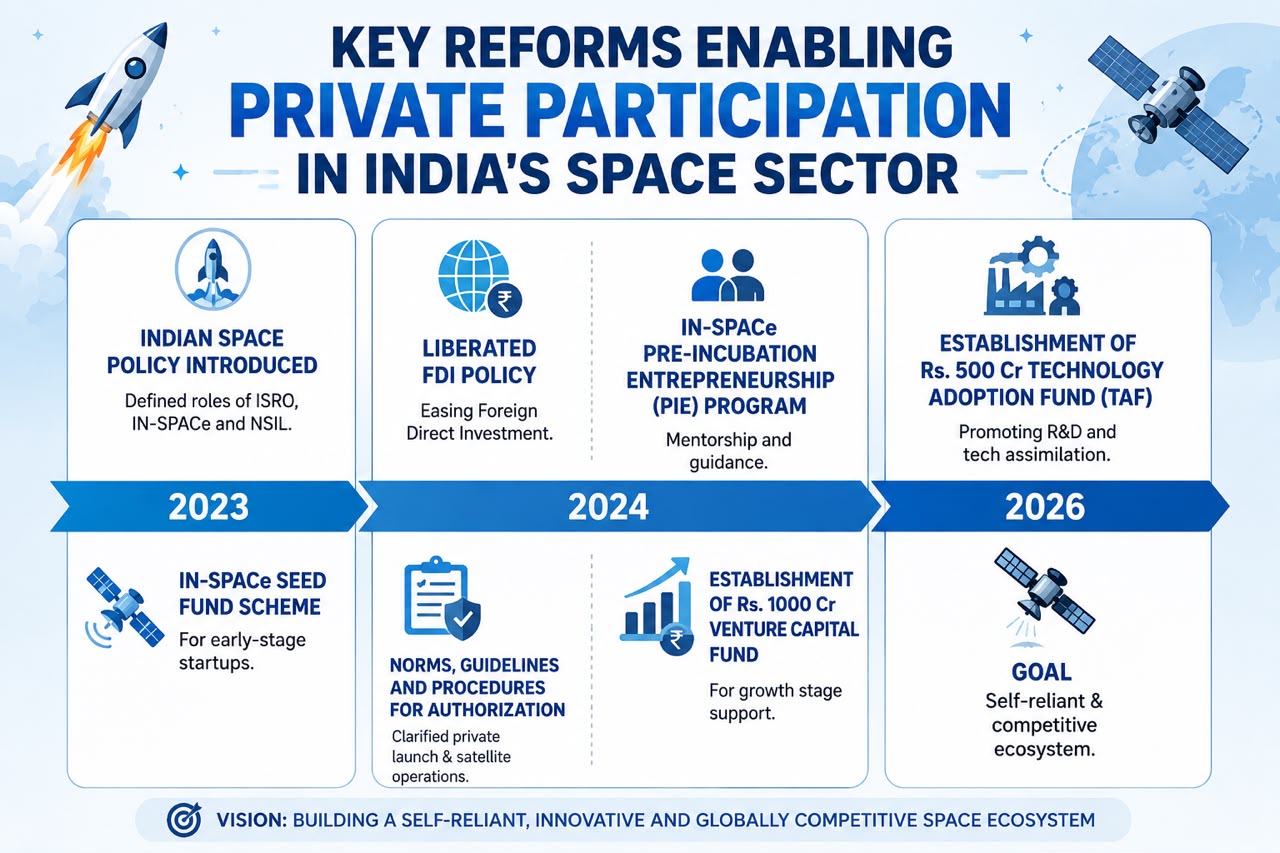
Status of India's Space Sector

  • India accounts for only ~2% of the global space economy.
  • The number of space startups has increased from just 1 in 2014 to nearly 400 (2026).
  • India's space economy is currently valued at around USD 8.4 billion and is projected to grow to USD 40–45 billion over the next decade. It is further aimed to reach USD 100 billion by 2040.
Watch Video News Today

Explore Related Content

Discover more articles, videos, and terms related to this topic

Title is required. Maximum 500 characters.

Search Notes

Filter Notes

Loading your notes...
Searching your notes...
Loading more notes...
You've reached the end of your notes

No notes yet

Create your first note to get started.

No notes found

Try adjusting your search criteria or clear the search.

Saving...
Saved

Please select a subject.

Referenced Articles

linked

No references added yet
