
Mobile internet services were temporarily suspended in parts of Central Delhi during the protest | Current Affairs | Vision IAS

Upgrade to Premium Today

Start Now
MENU
Home
Quick Links

High-quality MCQs and Mains Answer Writing to sharpen skills and reinforce learning every day.

Watch explainer and thematic concept-building videos under initiatives like Deep Dive, Master Classes, etc., on important UPSC topics.

A short, intensive, and exam-focused programme, insights from the Economic Survey, Union Budget, and UPSC current affairs.

ESC

In Summary

  • India records high internet shutdowns, with 65 in 12 states/UTs as per Access Now's 2025 report.
  • Telecommunications (Temporary Suspension of Services) Rules, 2024, govern shutdowns for public emergency/safety, requiring Review Committee approval.
  • SC's Anuradha Bhasin ruling mandates necessity and proportionality, yet many orders lack justification.

In Summary

India continues to record one of the highest numbers of Internet shutdowns in the world. Access Now’s 2025 report recorded 65 shutdowns across 12 States and Union Territories.

Legal Framework for Internet Shutdowns in India 

  • Internet shutdowns in India are governed by the Telecommunications (Temporary Suspension of Services) Rules, 2024, issued under the Telecommunications Act, 2023.  
    • These rules replace the Telecom Suspension Rules, 2017, and regulate the process for suspending telecom services, including internet services. 
    • It can be implemented in case of public emergency or in the interest of public safety, and only for specified purposes such as maintaining public order.
  • Authority to Issue Shutdown Orders: Union Home Secretary (for national-level shutdowns) and State Home Secretary (for state-level shutdowns). 
    • In unavoidable circumstances, an officer not below the rank of Joint Secretary, duly authorised by the government, may issue the order, subject to subsequent approval.
  • Procedural Safeguards: Every suspension order must be reviewed by a Review Committee, constituted separately by the Union and State governments, within the prescribed timeframe.
  • Judicial Precedent: The Supreme Court of India in the case of Anuradha Bhasin v. Union of India (2020) ruled that indefinite internet shutdowns are unconstitutional and that such curbs should meet the tests of necessity and proportionality.  
    • However, many shutdown orders lack proper documentation and justification.
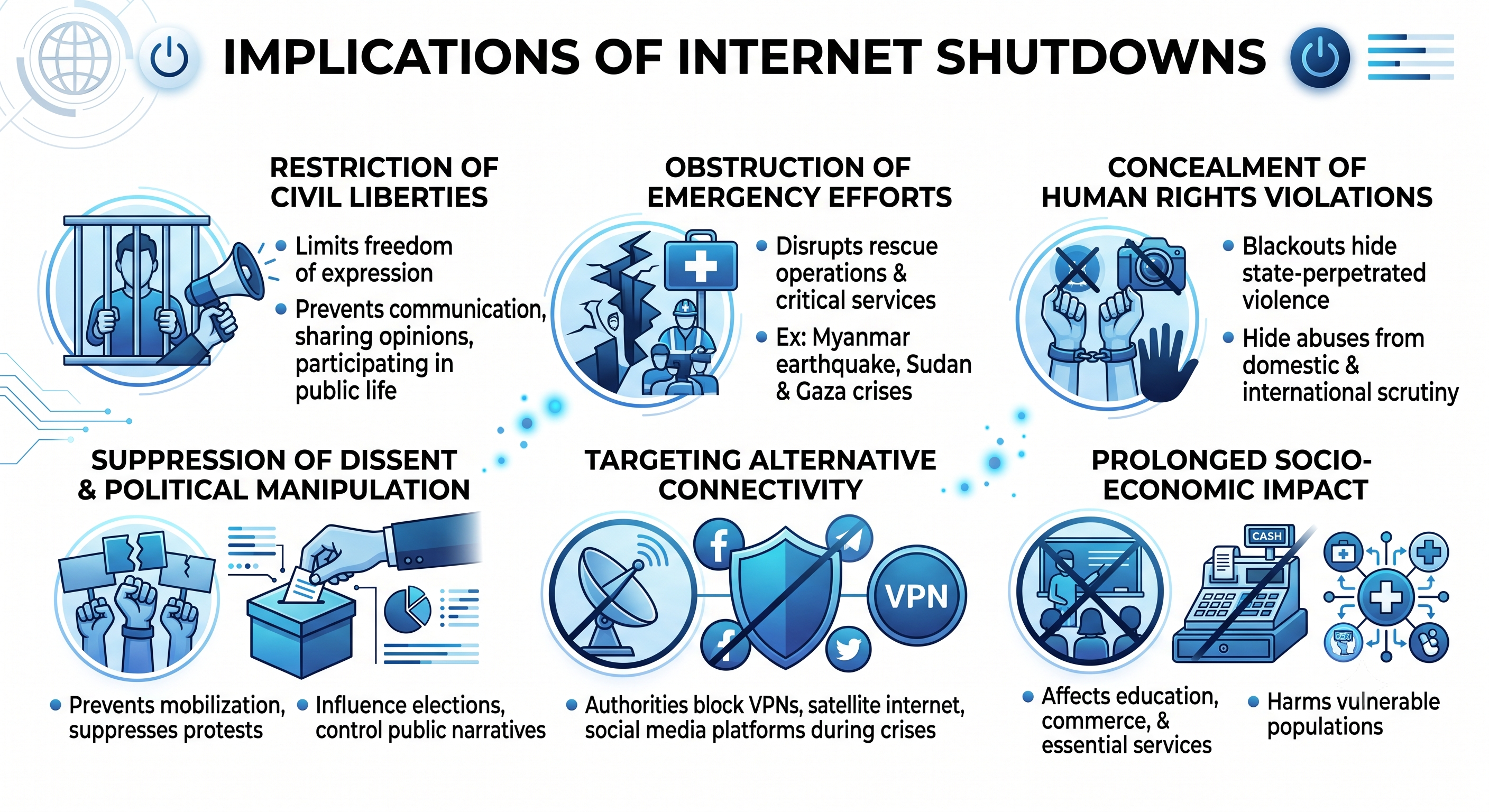
 

Watch Video News Today

Explore Related Content

Discover more articles, videos, and terms related to this topic

RELATED VIDEOS

1
Lateral Entry

Lateral Entry

YouTube HD

RELATED TERMS

3

Necessity and Proportionality

Legal tests applied to government actions, including internet shutdowns. 'Necessity' means the action must be indispensable to achieve a legitimate objective, and 'proportionality' means the action taken should be proportionate to the objective sought, with minimal impact on fundamental rights.

Anuradha Bhasin v. Union of India (2020)

A landmark Supreme Court judgment that declared indefinite internet shutdowns unconstitutional. The court mandated that any such curbs must adhere to the principles of necessity and proportionality, requiring proper justification and limited duration.

Review Committee

A committee constituted by Union and State governments to review the necessity and legality of every suspension order for telecom services, including internet shutdowns. This is a procedural safeguard to ensure orders are justified.

Title is required. Maximum 500 characters.

Search Notes

Filter Notes

Loading your notes...
Searching your notes...
Loading more notes...
You've reached the end of your notes

No notes yet

Create your first note to get started.

No notes found

Try adjusting your search criteria or clear the search.

Saving...
Saved

Please select a subject.

Referenced Articles

linked

No references added yet
