
The United Nations Environment Programme (UNEP) released the report “No Transition Without Justice” | Current Affairs | Vision IAS

Upgrade to Premium Today

Start Now
MENU
Home
Quick Links

High-quality MCQs and Mains Answer Writing to sharpen skills and reinforce learning every day.

Watch explainer and thematic concept-building videos under initiatives like Deep Dive, Master Classes, etc., on important UPSC topics.

A short, intensive, and exam-focused programme, insights from the Economic Survey, Union Budget, and UPSC current affairs.

ESC

In Summary

  • Environmental Rule of Law is crucial for Just Transition, ensuring fairness and inclusivity in economic shifts.
  • It involves strong laws, rights-based approaches, meaningful participation, and accountability in managing transition finance.
  • Responsive dispute resolution and context-specific strategies are vital for successful and equitable transitions.

In Summary

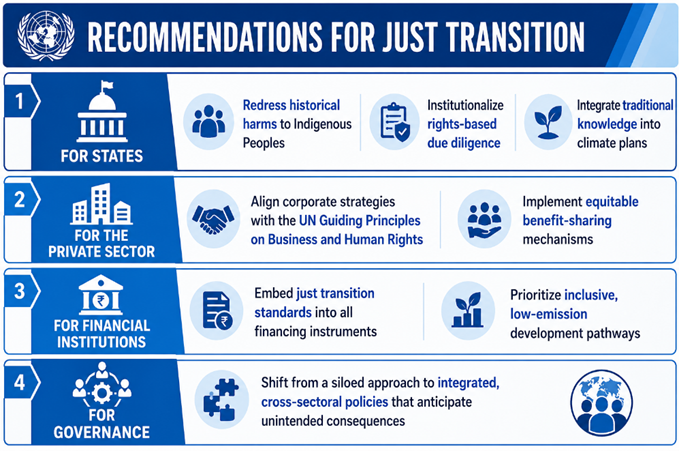
It explores how environmental rule of law acts as both a catalyst and a framework for achieving just transition.

  • Just Transition refers to a fair, inclusive and rights-based transformation towards environmentally and socially sustainable and resilient economies and societies that respects environmental rule of law and ensures no one is left behind in addressing environmental challenges across all sectors.

Role of Environmental Rule of Law in Just Transition

  • Laws and Institutions: To balance environmental protection with social safeguards e.g. Forest Rights Act (FRA), 2006 protecting tribals from encroachment.
  • Rights-based approach: Protecting and supporting environmental human rights defenders (EHRDs), such as the right to a clean and healthy environment.
  • Meaningful participation: Involving marginalized groups in decision-making (e.g., Colombia's Terra Initiative: Indigenous-led solar projects). 
  • Accountability and Integrity: Esp. in managing just transition finance e.g. EU Just Transition Fund providing retraining to displaced coal workers. 
  • Coordinated Mandates: e.g. Jharkhand’s cross-sectoral Task Force on Sustainable Just Transition including 17 different state departments.
  • Responsive Dispute Resolution: e.g. in Orissa Mining Corporation Ltd (2013), case Supreme court banned mining in Niyamgiri hills to protect indigenous Dongoria Kondhs.
  • Context-Specific Strategies: Tailoring transition policies to unique national and regional realities e.g. Banning Meghalaya’s Rat hole mining due to safety concerns.




Watch Video News Today

Explore Related Content

Discover more articles, videos, and terms related to this topic

RELATED VIDEOS

2
Carbon Markets

Carbon Markets

YouTube HD
What is Artificial Rain? | Deep Dive With VisionIAS

What is Artificial Rain? | Deep Dive With VisionIAS

YouTube HD

RELATED TERMS

3

Rat hole mining

A controversial and often dangerous method of coal extraction where narrow tunnels or holes are dug into the ground, commonly practiced in regions like Meghalaya, known for its safety concerns and environmental impact.

Orissa Mining Corporation Ltd (2013) case

A landmark Supreme Court case in India where mining in the Niyamgiri hills was banned to protect the indigenous Dongoria Kondh tribe and their sacred lands, highlighting the importance of indigenous rights and environmental protection.

EU Just Transition Fund

A financial instrument established by the European Union to support regions most affected by the transition to a climate-neutral economy, providing funding for retraining displaced workers and creating new economic opportunities.

Title is required. Maximum 500 characters.

Search Notes

Filter Notes

Loading your notes...
Searching your notes...
Loading more notes...
You've reached the end of your notes

No notes yet

Create your first note to get started.

No notes found

Try adjusting your search criteria or clear the search.

Saving...
Saved

Please select a subject.

Referenced Articles

linked

No references added yet